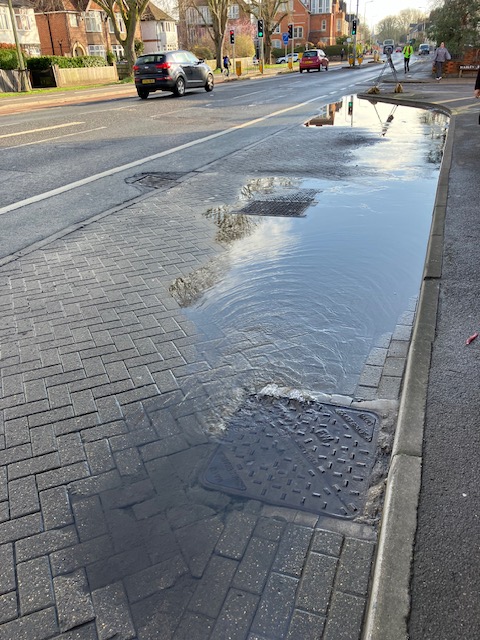
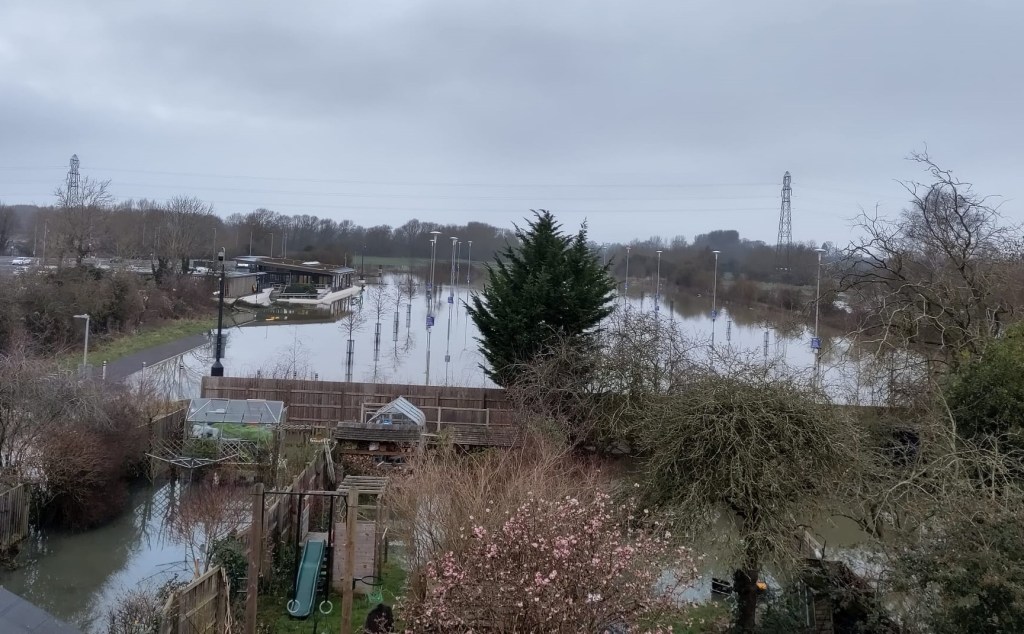
Oxford Flood Alliance will be speaking at a public meeting on flooding in south Oxford and what can be done about it. This area of Oxford has particular issues with groundwater though the neighbourhood is also affected by river flooding.
David Macdonald, a hydrologist and local resident, will explain how groundwater flooding occurs, Jed Ramsay from Project Groundwater, a government funded initiative which is working with the community, will talk about local resilience and mitigation, Richard Harding from the Environment Agency will talk about the Oxford Flood Alleviation Scheme and how this will benefit local residents, and Simon Collings from OFA will talk about the work of the alliance.
The meeting has been organised by the local city councillors, Anna Railton and Naomi Waite, and will be chaired by Cllr Railton. Information about flood insurance, Project Groundwater and the Oxford Flood Alleviation Scheme will be available at the event.
The meeting will take place on 21 March, 7pm, at South Oxford Christian Centre, Wytham Street, OX1 4TW.
The Environment Agency has objected to plans for a large housing development just north of Oxford because they believe the Thames Water sewer network will not cope with the extra load.
‘Thames Water’s treatment plant in Oxford has been illegally discharging sewage for six years, causing significant risk to the rivers and environment from pollution, the EA has said.
‘The increased pressure on the sewage infrastructure from 1,450 new houses planned to the north of Oxford would pose an unacceptable risk of pollution into waterways, the agency said in a letter of objection.
‘It warned it was “not acceptable” for a new housing development to go ahead until Thames Water had carried out the required investment to bring the works within legal limits.’
In recent weeks we have seen dilute sewage leaking out of manhole covers at various locations in west Oxford. We’ve also seen houses and businesses flooded by sewage. All of this sewage is then washing into the local river system. We have asked Thames Water to explain what is going on and what hey plan to do about it but have so far had no adequate response. We have raised the issue with Layla Moran MP.
Without serious investments by Thames Water, more development in the city will result in increased risk of sewer flooding for local residents, and more discharges of sewage polluting our rivers. We must have independent proof that improvements Thames Water plan to make at the Oxford Sewage Treatment Works are adequate and that the company is meeting its legal obligations before more connections are made to the system.
Oxford Flood Alliance welcomes this intervention by the EA.
Liz Sawyer from Oxford Flood Alliance is quoted in a story in the Oxford Mail today about overflowing sewers in the Botley Rd area. Floodwater which has infiltrated the sewer network is causing manhole covers to overflow and has resulted in flooding in some homes and businesses.
Annie Blows, who lives on Botley Road, said sewage is pumping out of the drains in her laundry room and out across her garden: ‘You can see it’s full of loo roll and all sorts. It’s terrifying to think about the health risk.’
Outside in the street sewage is leaking from drain covers and forming large puddles. It is fountaining out of a manhole cover in the middle of the Botley Road. Sewage is also pooling in the Waitrose service area, the store remains open as usual.
Ms Blows said a Thames Water representative told her they ‘had to make a decision about whether to flood us, the vets, and the other few houses in our row, or risk 300 other houses.’
‘Some notice would have been good,’ she added. ‘We could have moved our appliances and furniture – but as it is everything’s damaged.’
Sewage in Annie Blows’ laundry roomSewage bubbling out in Botley RdLeaking sewer cover near bus stop
Liz Sawyer, who lives further along Botley Rd, says her family has had to stop using their downstairs loo because it flushes away so slowly. Liz says: ‘There have been bubbling drains and inspection chambers in the area for weeks – even when the water was lower than it is now. There are several in North Hinksey village. The system seems to be under pressure in a way that hasn’t happened before. This is deeply worrying.’
‘Thames Water is contributing to the budget for the planned Oxford Flood Alleviation Scheme (OFAS), because the company believes it will help reduce these sewage leaks, caused by ageing infrastructure. But there are clearly major issues ahead for Thames Water, as climate change worsens.’
Thames Water have had staff in the area and have been using tankers to try to pump out sewage from the system to relieve the pressure. The company told the Oxford Mail they have ‘arranged for an extensive clean and investigation of our sewers to identify any obstructions which may be disrupting the flow in the area.’
Flooding was top of the agenda for delegates attending the National Farmers Union conference last week, according to a report in today’s Guardian. Up and down the country framers report having had one of their worst winter’s ever with fields inundate, crops ruined and planting delayed. Demand for seed for spring sowing has driven up prices because of scarcity of supply.
‘In the 12 months to January,’ the article says, ‘only four of England’s 139 hydrological areas (regions around rivers, lakes and other water sources) were classed as having normal rainfall levels. Of the remaining areas, 47 were rated as having notably high levels, and 76 – more than half – were deemed exceptionally high.’
These figures demonstrate just how serious flooding is becoming across the country and why the government needs to do more in response.
Forecasts for this years grain harvest predict a 25% drop in yields. Some farmers are calling for better flood protection and higher levels of compensation.
South Hinksey could have a permanent flood bund in place by the end of 2025 if the Oxford Flood Alleviation Scheme gets the go ahead in the coming months. The Environment Agency has said the permanent bund would be ‘upfront in the build programme’, so if spades went in the ground this year South Hinksey would start to benefit immediately.
Adrian Porter of OFA, who lives in the village, said. ‘By winter 2025 we’d likely be protected. With a bit of good luck later this year, this really could be our last flood.’
Demountable barriers are currently in place in South Hinksey because of the high floodwater levels. It is the second time this year the defences have been deployed. In January the barriers went up too late to stop some property flooding, so this time the EA have acted quickly to have equipment in place in case it’s needed.
The deployment of temporary defences, Adrian says, has become ‘depressingly normal’. There was a barrier deployment in 2021, a near deployment in 2022, and now two deployments in 2024.
Barriers being erected in South HinkseyFlood barrier crossing a resident’s garden
‘Each time the disruption for the community is significant,’ Adrian explains, ‘with the farm yard and car-park occupied, horses displaced, gardens churned up and rotas of people to keep an eye on things overnight as the EA don’t have the staff to do it themselves.’
The decision to deploy is made by an over-stretched agency with input from advisors, flood modelling data, on-the-ground photographs and other ground-truthing evidence. It is inevitably a balance of strategy, finance, operations and infrastructure. In January the EA got the timing wrong, an awful 48 hours ensued and several properties flooded as a result.
This is totally avoidable. OFAS, which is awaiting planning consent, would mean the village wouldn’t need to rely on the vagaries of human decision-making and temporary barriers. Protection would be there every day of every year.
‘We are a beautifully diverse community of young and old,’ Adrian says, ‘who thrive despite the lack of pub and shop. We work so hard to make this the perfect place for children to grow up and for everyone to enjoy, but with flooding an ever-present threat it is hard to feel completely safe. There is a solution. Let’s get on and deliver the Oxford Flood Alleviation Scheme.’
The Oxford Mail picked up on this story. You can read their version online here.
With river levels rising again the Environment is today deploying flood barriers in South Hinksey as a precaution against possible flooding. In January the agency responded too late to a rapidly changing situation resulting in some property flooding. River levels on the Thames downstream from Osney Lock are currently 30cms below the January peak, but more heavy rain is forecast for tomorrow. The agency is taking no chances this time to ensure defences are in place if needed.
The Government does not know if it is making the UK more resilient to flooding. In a report published on 17 January 2024, the Public Accounts Committee (PAC) warns that the Department for Environment, Food and Rural Affairs (Defra) has no overall numerical target for the UK’s level of long-term flood resilience, and so cannot know if it is progressing in its 2020 ambition to create “a nation more resilient to future flood and coastal erosion risk”.
Flood protection will be provided for at least 40% fewer properties than planned, according to Environment Agency (EA) forecasts. This is due to factors including inflation and the bureaucracy associated with approving projects. With the programme’s success relying on the completion of many large projects where the EA has only medium or low confidence of delivering by 2027, the Committee is concerned that the number of properties better protected could turn out to be even fewer than the current revised-down forecast of 200,000.
In 2022-23, there were 5.7 million properties in England at risk of flooding. The Committee’s report highlights a range of concerns in Government’s support and approach to flood resilience, including:
smaller and rural communities losing out due to a lack of flood protection provision for communities of fewer than 100 houses that can nevertheless be devastated by the impact of flooding;
new housing continuing to be built in high flood risk areas without adequate mitigations, as over half of Local Planning Authorities said they rarely or never inspect a new development to check compliance with flood risk planning conditions;
a lack of necessary leadership and support from Government for local authorities on how to address the increasing risks of surface water flooding.
Due to a lack of funding, the Environment Agency (EA) has not been able to meet its target of maintaining 98% of its high consequence flood defences (which protect the most properties) at their required condition. The report highlights that 203,000 properties are at increased risk due to deteriorating flood defences, more than the 200,000 separate properties the Government expects to better protect through its ongoing capital programme by 2027. These figures illustrate that poor maintenance is undermining progress from new capital expenditure and Defra’s failure to establish what the appropriate balance is between building new defences and maintaining existing ones.
The National Flood Forum, an umbrella organisation representing local flood groups like OFA, has welcomed the report. The NFF believes that the government’s current approach is too focused on personal resilience. While this undoubtedly has a place, it should only be one part of a bigger bolder Government vision for flood mitigation. The NFF is calling on Government to adopt a strategy that embraces a truly multifaceted integrated approach to flood defence and that adequately tackles the impacts of future flood risk.
The Seacourt P&R extension is underwater again following the heavy rainfall on Thursday last week. Council workers had just spent two days clearing up the silt and debris from the Storm Henk flooding in January. That labour was largely wasted. The extension has been out of operation since 1 January, so for 42 days this year already.
Flood Grant information relating to Storm Henk is now on the Flood Toolkit section of the County Council website. Households and businesses which suffered flood damage in January may qualify for help with funding resilience measures designed to reduce future flood risk and aid recovery after a flood. Details of the available funding schemes can be found here.
Today’s Oxford Times (8 February 2024) carries a letter supporting the flood alleviation scheme from Maggie Stoppard, the widow of Dr Peter Rawcliffe. Peter was one of the founders of the Oxford Flood Alliance. The letter describes Maggie’s personal experience of floods in South Hinksey, where she and Peter lived, and goes on to say:
‘In early 2024 Oxford was once again subject to serious flooding. Climate change means flood events are likely to recur with increasing frequency and severity in future, with the city centre potentially at risk.
OFAS would put an end to this repeated ordeal for more than a thousand residents across Oxford. It would do so in a way that is a net benefit to our county’s wildlife. The scheme would create new stream and wetland habitats, include more trees and hedgerow and preserve or replace grassland and meadow.’
Maggie’s letter appears alongside an Oxford Times editorial about the flooding in January of a number of sites across the county which are earmarked for housing development. Planning professionals are now calling for a rethink of housing plans, and their comments have attracted support from across the political spectrum. ‘Flood risk needs to be taken seriously by the planning authorities,’ says the editorial.
OFA fully endorses this view. One of the reasons we have problems with flooding in areas like Earl St and Duke St is because of bad planning decisions in prior decades. Building on the floodplain has to stop.