
OFA Steering Group member Adrian Porter was on the BBC’s Morning Live on 19 July talking about the experience of being flooded. The interview with Adrian, who lives in South Hinksey, was part of a report on climate change and the growing risk of flooding in the UK. The item also featured a team of Oxfordshire Firefighters undergoing training in flood related rescue work. People trapped in vehicles in flood water, as shown on the programme, is typical of the kind of emergency the Fire Service has to respond to. But the service has also provided vital emergency support in Oxford in recent years by deploying pumps to keep roads and residential areas clear of flood water. This report was a powerful reminder that flooding has a serious impact on people’s lives and that the risk of it happening is increasing. The programme’s take away: home and business owners need to be prepared in the same way the Fire Service ensures its personnel are prepared.
Category Archives: Uncategorized
Regeneration at Tumbling Bay
In 2019 the Environment Agency built a fish pass just to the north of Tumbling Bay in Botley Park. An area of scrub was cleared and a small channel excavated to allow fish to navigate around the weirs in the bathing area, and access the Thames.
The area between the fish pass and the bathing pool was seeded with a wild-flower mix, and in recent weeks the meadow has been a glorious sight. There is lots of knapweed, also ox-eye daisy and lady’s bedstraw, and plenty of butterflies including gatekeepers (photo below), small skippers, meadow browns, and green-veined whites. The stream itself is also rich in vegetation.
This illustrates how just three years on, an area which was cleared, excavated and re-profiled can already be looking attractive and providing habitat to wildlife. If the Oxford Flood Alleviation Scheme does get built we expect to see many areas recovering similarly quickly.



How can homes and businesses stand up to flooding?
Protecting individual properties from flooding, and enabling those which do flood to recover quickly, is still in its infancy in the UK. Few companies make and sell flood-protection products, and few builders know how to make a house or business flood resilient. The new BeFloodReady centre at Wallingford, which launched in May, aims to change all this. Four members of the OFA Steering Group went to see what the centre might offer those of us at risk of flooding.
It’s an impressive set up, with a teaching room and a series of flood-resilient rooms which are used to provide accredited training to professionals. There are two reception rooms, a bathroom and a kitchen (pictured below), all of which can be filled with water. The rooms have a variety of floor coverings and types of wall construction to simulate different scenarios. They are used to demonstrate how a flooded property can be dried out and restored quickly, given the right equipment and processes.

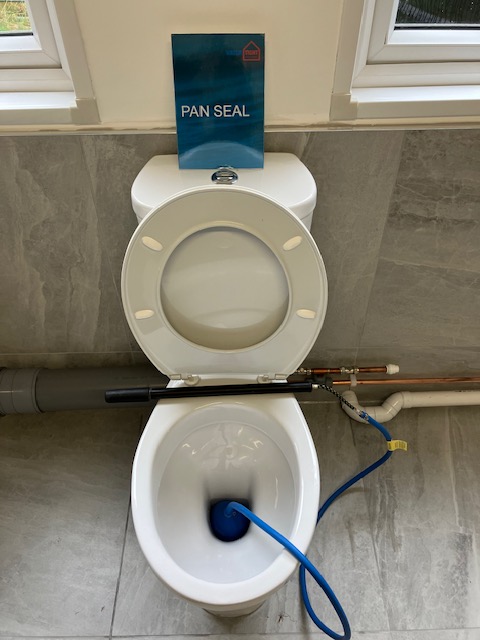
In the teaching area there is a display of different types of flood barriers, air bricks and air-brick covers, flood-resistant doors, and other products. Some items, such as doors, are expensive, but a simple device like a lavatory bung (pictured below), which can prevent sewage flooding your home, is easily affordable.
As well as providing practical training, the centre has developed a series of standards for the design, installation and maintenance of property-level resilience measures. This work is led by Graham Brogden MBE, who spoke at OFA’s tenth annual public meeting back in 2018. Graham was working for Aviva then and talked about how insurers were starting to pay much closer attention to property-level flood resilience.
During our visit Graham talked us through the code which has been created to standardise Property Flood Resilience (PFR) measures across the country. Over time this should help raise the quality of service property owners receive from professional providers of flood protection. The code provides property owners with a standard against which to evaluate anyone offering advice and services in this area. This short video explains the approach: https://www.youtube.com/watch?v=4sZv6Z3O8BA
Graham showed us an online platform, based on the code, which can be used by professionals to capture data on individual properties, inform the design of solutions, and enable monitoring of their effectiveness. The platform, developed by Resilico, also has a free app which householders can download to their phones. This provides flood alerts, including warnings of surface-water flooding, and includes a template for creating a bespoke flood-preparedness plan for your home or business. You can even set up reminders to periodically check that equipment like pumps and flood gates are in good working order. Search your app store for ResilicoConnect.
The insurance industry is increasingly focusing on the adoption of Property Flood Protection measures with Flood Re due to phase out in 2039. ‘Flood Re has already started its transition plan,’ Graham told us, ‘and this heavily relies on properties being made more resilient to flooding, using both resistant and recoverability measures, to help reduce the impact flooding can have on a property. They have also recently introduced the Build Back Better scheme, which a number of insurers have signed up to. This means that when a property floods Flood Re will provide an additional £10,000 on top of the repair costs to help make the property more resilient for the future.’
Even with the Oxford Flood Alleviation Scheme in place, there will be homes and businesses in Oxford that remain at some level of flood risk. For those properties, flood resilience will remain important and the Wallingford centre will be a useful resource. If the flood scheme is built the number of properties which remain at risk will be much reduced. This will mean that targeted interventions to improve property-level resilience for those communities still needing protection could be feasible.
The BeFloodReady centre is the UK’s first dedicated facility to deliver accredited training. It is funded by Defra as part of the government’s PFR Pathfinders programme which aims to increase knowledge and skills in the building and insurance industries around property flood resilience. OFA visited the centre on 5 July 2023. For more information visit: https://www.befloodready.uk/
Why we need a two-stage channel
Critics of the Oxford Flood Alleviation Scheme claim that the proposed new stream and secondary channel deliver little benefit. Oxford Flood Alliance disagrees. We were formed in 2007 by people from communities most vulnerable to flooding. We believe that the proposed two-stage channel is vital to protect those communities.
The planning application documents include an updated comparison between the scheme as designed and the scheme minus the two-stage channel (Appendix Q to the Environmental Statement). This document shows clearly that those communities OFA grew out of, especially those along the Botley Road, would flood more frequently and to a greater depth without the channel.
- In an event with a 20% chance of happening in a given year, the kind of event we might expect to see every 5 years, Duke St starts to flood without the channel.
- In a 5% chance event Duke and Earl St flood, so does Marlborough Court. With the channel, only Duke St is affected. Flooding on Osney Island is more extensive than with the channel, though some areas are affected even with the channel.
- In a 2% chance event Bulstake Close would go under without the channel, sections of Botley Rd would flood, flooding on Osney would be more extensive than with the channel, and St Frideswide’s church and vicarage would flood. Earl and Duke St, and Marlborough Court flood at this level even with the channel. Flood depths will be greater without the channel.
- In a 1% chance event Mill St and adjoining streets flood without a channel, as do Henry Rd, Helen Rd, Binsey Lane, and the whole of Old Botley. There is extensive flooding on Osney. Parts of Grandpont, Jericho, St Thomas and Hythe Bridge St also flood without a channel.
There is no perfect scheme and the most vulnerable communities are already having to accept that the project cannot protect them against a 1% chance event, or even in some cases a 5% chance event. Community and household-level flood defences will still be needed in these situations. The scheme with ‘no channel’ would be significantly less effective.
Overall, the flood alleviation scheme has to balance a range of competing interests. Protecting all homes and businesses at risk from a 1% chance event is not achievable. It would cost too much and have too great an impact on the local environment. OFA believes the proposed scheme is a reasonable compromise between improving flood protection for the city and meeting concerns about cost, disruption to people’s lives, biodiversity and recreation.
If you live or work in any of the flood-affected areas, or travel through these areas for work or school, you will be better off with the channel.
OFAS CPO inquiry confirmed
DEFRA has now confirmed that an inspector will be appointed to hear objections from landowners to Compulsory Purchase Orders issued as part of the Oxford Flood Alleviation Scheme. The project team has been expecting an inquiry of this kind to be established, and the decision comes as no surprise.
The project needs to acquire land in order to build the scheme, and is following the legal processes required for this to happen. This is a normal part of any infrastructure project. Where individual landowners object to their land being acquired they have the right to have their arguments heard by an independent planning inspector. This is the process which the Secretary of State has now confirmed will take place. A date is yet to be set but we expected this to happen towards the end of the year.
The inquiry will be an independent forum where the merits or otherwise of criticisms of the scheme can be determined. The CPO inquiry is separate to the planning application process currently underway with Oxfordshire County Council, which is also providing independent scrutiny of the scheme. We are waiting currently for the date of the Planning Committee meeting where the application will be decided to be confirmed.
OFA in the news
OFA steering group member Simon Collings was interviewed Monday 22 May for a BBC News report on a new flood resilience training centre which has opened at Wallingford. The BeFloodReady centre provides advice and training on how to make properties more resilient to flooding.
With flooding expected to increase as a result of climate change, household level preparedness will become increasingly important. Exceptionally heavy downpours of the kind we have already seen this year, can cause flash flooding in areas which have not flooded before. It is particularly in these areas where property level measures can help protect against flooding and facilitate quick recovery where flooding does occur.
Simon spoke about being flooded in 2007, and the benefits which flood resilience measures brought during the 2014 floods when a submersible pump kept water out of the house (picture below). OFA has long been an advocate of property level resilience measures, and welcomes this new initiative from DEFRA.

Floodgates, air brick covers and pumps are, however, only effective up to a point. Household resilience measures have a contribution to make to flood risk management but they are not an alternative to the Oxford Flood Alleviation Scheme. We need both.
OFAS and rights of way
A number of West Oxford residents have recently been asking about how the existing right of way along Hinksey Causeway, also known as Monk’s Causeway, will be affected by the Oxford Flood Alleviation Scheme. This is the footpath which runs from The Fishes in North Hinksey to Osney Mead.
Information about footpath diversions is available here on the Oxford Flood Alleviation Scheme website. Scroll down to the relevant section. The impacts of the diverted public footpaths were assessed in the Environmental Statement Chapter 6 Recreation and Public Access, which forms part of the planning application for the scheme.
Two sections of Hinksey Causeway will be affected.
The first is the section which runs from Osney Mead past the electricity sub-station to where the ‘electric way’ starts (photo below). This path has to be moved 10m east to allow for the construction of a flood wall and flood gate, part of the flood defence which will run down the eastern side of Oatland’s Park and extends down to this area. This section of the path will be stone surfaced.

In the case of the other affected section, the issue is that the existing right of way doesn’t correspond to the path people actually use. OFAS will use the route people actually walk, so the legal right of way is being re-registered so the legal rights apply to the route people actually use. This section will have timber decking, a boardwalk. It will cross the two stage channel – an area which will be boggy at wet times of year.
Re-alignment of a public right of way is a legal process, hence the formal notices which have appeared recently in the press and along the path. The Environment Agency has to follow this process to establish the new legal rights of way. This path will remain a right of way and, apart from the initial section at Osney Mead, will follow the current route.
The footpath will be temporarily closed while it’s being constructed, this includes making a new footbridge, but people will have Willow Walk as an alternative.
This is a summary of information supplied to us by the Environment Agency under Open Public Licence.
Natural flood management, storage and property-level defences
Some critics of the Oxford Flood Alleviation Scheme have talked about the need for a ‘catchment-wide’ approach as an alternative. There are certainly benefits to thinking about the whole upper Thames catchment, but could such an approach deliver results within a meaningful timescale?
One issue OFA looked at early on, once the Flood Alleviation project was underway, was the potential for natural flood management techniques to contribute to reducing flood risk in Oxford. In August 2015 we organized a seminar and heard from a range of experts on this subject.
The overall conclusion was that natural flood-management techniques can bring benefits in smaller catchments, especially in lower-order flooding events. Isolated projects in the upper Thames would, however, have no measurable impact on Oxford with its large catchment (about 2,500 km2 upstream).
A complete re-landscaping of the Thames catchment might, if it could be achieved, reduce flood peaks by 10–15% – so helping with the flood risk but not solving it fully. Achieving the transformations in land-use necessary to deliver this benefit would require radical new legislation and/or a new culture of approaches to land management, taking ‘around 40 years’ to implement.
We found that storage could potentially play some role, but the volume of water involved in a major flood cannot be contained upstream of Oxford. The Environment Agency has always been clear about this. An effective upstream storage area would need to store approximately 50 million m3 of water. This is equivalent to an area the size of Oxford under 1 metre of water. There’s not enough capacity in the floodplain to store that amount of water.
The Environment Agency is exploring options for some future element of storage to mitigate against worsening climate change. Storage is not a viable alternative to the flood scheme but could be a useful backup in the future, as could major changes to land use upstream.
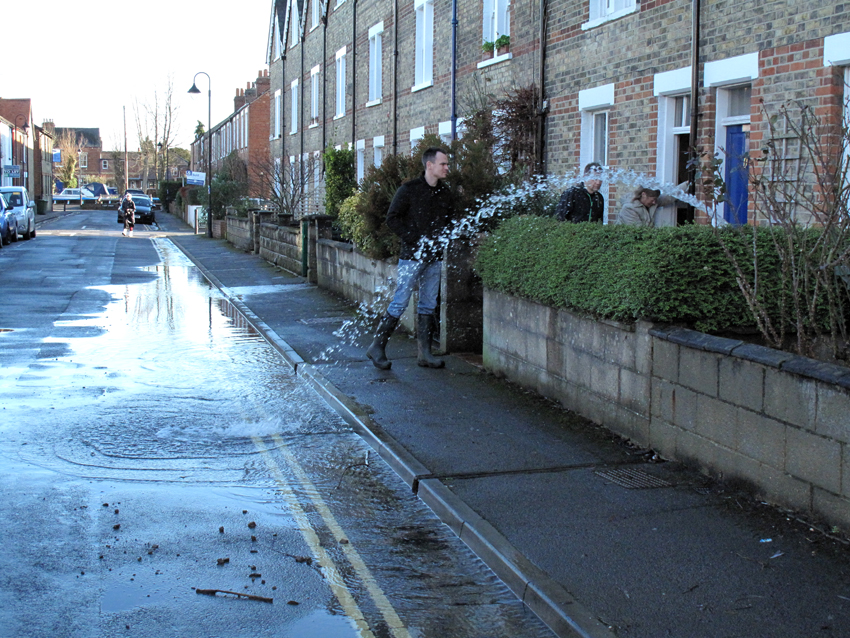
As well as these two options we also spent a lot of time looking at property-level resilience measures. Several steering group members made significant alterations to their homes to reduce the impact of floodwater in their property and speed up recovery after a flood. A number of us were allocated flood gates, air brick covers, and small submersible pumps by the City Council, funded by the EA. The pumps proved vital in Jan 2014 in keeping water out of vulnerable houses on Osney Island (see picture below).
There are things we can do at household level but these are only effective up to a certain scale of flooding. They are not a substitute for the flood scheme. Even with the scheme in place some properties still face risk and will need to deploy property-level defences.
A decade on and a key decision point
We are expecting the County Council to decide on the planning application for the Oxford Flood Alleviation Scheme in the next few months. This is a major milestone for the project. Here’s a brief reminder of how we got here.
Back in the autumn of 2013 members of the OFA steering group met with the Environment Agency to discuss a list of ten ideas we had proposed for further reducing flood risk in the city. These ideas were additional to the ‘short-term measures’ already implemented following the 2007 floods.
The EA had analysed our suggestions. Some were discounted as the likely benefits were less than the cost, but some of the ideas they agreed would work. Their advice, however, was not to treat these as isolated projects, but to revisit the business case for a larger flood scheme capable of providing a much higher level of protection. The measures we had proposed would be more effective if they were part of such a scheme.
We agreed with this analysis and accepted that a further programme of short-term measures would bring limited benefit. The time had come to look to a more enduring solution.
The floods of January and February 2014 were a timely reminder of the risk the city faced and created the political momentum we needed to get the project moving, including strong support from national government. The plan which grew out of these discussions is the Oxford Flood Alleviation Scheme.
Large infrastructure projects start high level and become more and more detailed as they pass the hurdles set for each stage. OFAS has been developed in this way, with the output from each iteration subject to consultation, independent scrutiny, and approval by DEFRA and the Treasury. Over the past ten years the scheme has evolved, taking on board many suggestions from individuals and groups. This process has helped ensure the scheme is as good as it can be.
The project design for which the EA is seeking planning permission is the product of ten years of research, design, consultation, review and revision. We’re now at a point where we need a decision. The County Council planning officers have subjected the scheme to rigorous scrutiny. Elected councillors on the planning committee will make their decision, guided by the officers. This is the democratic process for agreeing how we go forward.
We very much hope the Council will decide for the project. Climate change is already increasing risk of flooding, and Oxford urgently needs a flood alleviation scheme.
Seacourt Park & Ride open again
The Seacourt Park and Ride extension opened again yesterday after being closed for 19 days due to flooding. This is the second flood event at the facility this year, bring the total time the car park has been close due to flooding to 54 days.
 oxford flood alliance