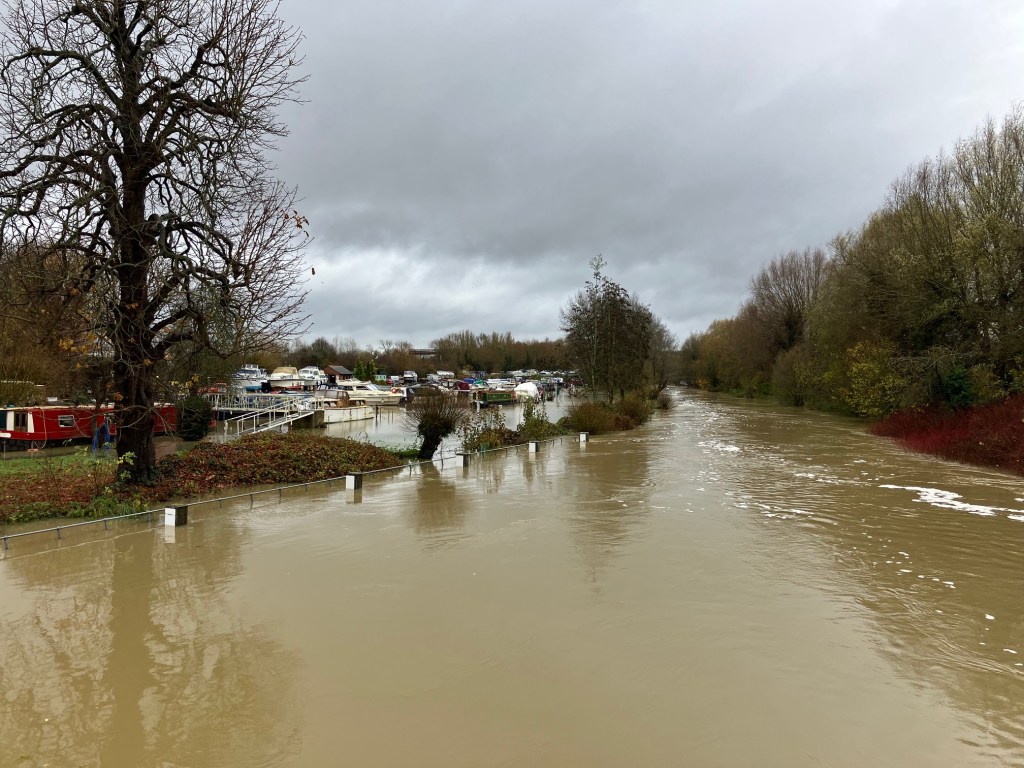
Flood scheme making steady progress

The Environment Agency (EA) says it expects construction of the Oxford Flood Alleviation Scheme to start in late 2026. Following approval of the Compulsory Purchase Order by the Secretary of State in May 2025, the EA is in the process of acquiring the land, and rights over land, needed to construct the scheme. Over the summer the Agency tendered for a construction partner and they expect to announce the company selected by the end of the year. 

Outstanding issues

The project still needs to secure some approvals, including the formal planning permission. Oxfordshire County Council’s Planning and Regulation Committee resolved to grant planning permission last year, subject to the EA signing a Section 106 Agreement relating to biodiversity and habitat management and monitoring. The project team is working closely with the council to conclude this agreement, which they expect to do before the end of the year. The project will then need sign off on the Full Business Case from HM Treasury.

Community relations

The EA is planning to launch a Stakeholder Advisory Group to support engagement with residents. This group will be made up of local individuals who represent the community. They will provide advice and local insights as the project prepares for and begins construction.

The new construction partner will be appointing a Community Liaison Officer to ensure there is a named contact who can respond to immediate concerns relating to the construction site and escalate matters to the site manager and project team, as necessary. 

On site activity 

The project has been installing additional groundwater monitoring devices to collect groundwater data, and gauge boards to measure surface water levels. These will allow them to chart water levels before, during, and after construction of the scheme.

In August, a team surveyed for underground utilities, including electric cables and water and sewage pipes to prevent any disturbance of those assets while installing the new monitoring points.

More information about the scheme can be found here: Oxford Flood Alleviation Scheme | Engage Environment Agency
BBC South Today on flooding in Oxford

On 23 April BBC South Today broadcast a substantial report on flooding and flood resilience in Oxford (starts 10 mins into the programme).

The item, researched and presented by Alexis Green, begins with householders and a business on Osney Island showing how they cope with flooding. Residents demonstrate the use of pumps and floodgates, and Jacqui Mangold, of the Vishuddha Yoga Centre, explains how their building is designed to allow flood water to enter the ground floor. The construction materials allow rapid recovery from a flood. Residents also discuss the impact of flooding on their lives.

Bas Van Schaik of Earl St, further west along Botley Rd, talks about flooding in those streets and about the large pumps at the bottom of Earl St. He describes the problems of sewage during a flood and the traces of excrement left behind on the streets. He says when he moved to Earl St in 2016 there was already talk of a flood scheme but ten years on we’re still waiting for the first spade in the ground. Residents of West Oxford, he says, find it hard to understand why the flood alleviation scheme is taking so long.

Robbie Williams of the Environment Agency explains how the Oxford Flood Alleviation Scheme is designed to reduce flood risk for the city. The EA says it is vital to future growth and prosperity in Oxford. The scheme will create a large wetland area and new species-rich meadows in the Oxford floodplain.

The report closes with comments from residents of North and South Hinksey concerned about the impacts the scheme could have on their local environment.

The broadcast was trailed earlier in the day on BBC Radio Oxford with a representative  of OFA interviewed live on the Sophie Law breakfast show.

An article by Alexis Green on Oxford’s flooding is on the BBC website here.

Call for more investment in flood protection

The research and policy consultancy Public First, has warned that without decisive action, ‘flooding will remain a significant economic harm, threatening prosperity and long-term growth.’ Their latest report identifies risks of escalating costs caused by flood damages and wider economic losses unless sustained investment is made to strengthen the UK’s resilience.

Around 2 million people are exposed to flooding in the UK each year. Immediate physical damage to property and infrastructure costs £2.4bn annually, and by 2050, are expect to reach £3.6bn. In addition, each year of flood events causes a decade-long downward pressure on the economy worth at least £6.1bn, according to the analysis. Investing £1.5bn per year in flood preparedness, the level recommended by the National Infrastructure Commission in 2023, would be repaid many times over by avoiding these costs. The government has committed to invest £1.3bn up to 2026, but it has not announced commitments beyond this.

An opinion survey conducted as part of the research revealed three-quarters (75%) of UK adults believe flooding occurs more frequently and causes more damage across the country than before. Nearly half (45%) of the public expect flooding to worsen in their local area in the next five years, and 58% expect it to worsen across the UK in the same period. Climate change is seen as one of the major factors causing this. Two-thirds of UK adults don’t think the country or their local area is prepared to deal with future flooding.

The report was compiled by Public First with oversight by an independent committee chaired by Emma Howard Boyd, the former Chair of the Environment Agency. She says: “The upcoming multi-year Spending Review is an opportunity for the government to protect communities from flooding where previous administrations fell short. As floods get worse, there’s more damage to flood defences, so we need to see more investment to better protect communities and maintain existing defences.

New group aims to improve Oxfordshire’s response to flooding

A new group will help Oxfordshire improve its readiness and response to flooding by bringing together many of the key organisations responsible for tackling it, Oxfordshire County Council has announced.

The Oxfordshire strategic flood risk group has been formed as a direct result of a flooding summit held by Oxfordshire County Council last month. It will be chaired from the new year by Prof Robert Van de Noort CBE, Vice Chancellor of Reading University and former Chair of the Thames Valley Flood and Costal Committee.

Councillor Dr Pete Sudbury, Deputy Leader of Oxfordshire County Council with Responsibility for Climate Change, Environment and Future Generations, said: “It is a real privilege and wonderful news for Oxfordshire to have Robert agree to contribute in this way. He is a real heavyweight in the sector, widely acknowledged as having led innovative approaches to flooding as chair of the Thames Valley Flood and Costal Committee for eight years.

“The rapid acceleration in extreme rainfall events means the traditional approaches focused around high-risk areas are no longer enough, and we need to shift very rapidly to a whole landscape approach. Having Robert on board really adds impetus to achieving that at the pace and scale necessary.”

The group will include representatives from the city and district councils, Thames Water, the Environment Agency, the Northeast Cotswold Farmer Cluster, landowners and community flood resilience groups.

Prof Van de Noort said: “I look forward to working alongside people representing all parts of the community across Oxfordshire. Flooding is an issue that can affect anyone and requires everyone to play their part to keep people safe from its worst impacts.

“I am fortunate to work alongside some of the world’s most eminent weather, climate and flood scientists at Reading, who advise world leaders and the UK government on how to manage flood risks. Floods will always occur, but the difference between a flood hazard and a flood disaster is in how we prepare for them and respond to them.”

The aim is to take a collective strategic overview of the management of flood risk in the county. It will support coordination of these matters with wider economic growth and water resource management initiatives.

It will also improve integration of flood risk planning and response at a strategic level in the county, and will be the central point of liaison between local, regional and national flooding policy developments.

November’s summit, which was prompted by the floods that affected Oxfordshire in January due to Storm Henk, was held while parts of the county were recovering from more recent flooding incidents. Oxford Flood Alliance attended the event,

It provided an opportunity for stakeholders to discuss a shared approach to flood response and resilience in Oxfordshire; to understand the future trajectories of flooding in Oxfordshire; and to deepen shared understanding of the range of potential solutions to increase flood resilience, sharing best practice to help others develop their own plans.

It asked questions such as what a joined-up response from multiple organisations looks like during the immediate aftermath of a flood, and what could be improved or changed.

Cllr Sudbury added: “We need to try to get ahead of the game, or the economic and social losses from flooding are likely to spiral to an uncontrollable level.

“Surface water flooding can probably affect almost anywhere, if the rain is as intense as we experienced in September. We’re moving from sporadic floods, every few years, to multiple sequential clusters of them.

“The next ratchet up is continuous flooding over an extended period and so we need to look to pre-empt that. That will take time, effort, collaborative cross-agency work and widespread citizen activation.”

Flood risk increasing says EA

One-in-four properties in England – that’s 8 million homes and businesses – could be at risk from flooding by 2050 as a result of climate change according the latest report from the Environment Agency. Currently around 6.3 million properties are considered at risk, which is higher than previously thought. The new figure is the result of improved modelling.

“The frequency and severity of the kind of flood events that we’ve been experiencing are likely to become more and more challenging,” Julie Foley, director of flood risk strategy at the EA, said.

The new National Assessment of Flood Risk (published 17 December) looks at flood risk from rivers, the sea and surface water. Revised assumptions about risk of surface water flooding – where heavy rainfall overwhelms drainage systems – accounts for much of the overall increase in current estimations of the number of properties at risk.

Building on floodplains, if the practice continues, could push these figures even higher. Conversely, investing in effective flood defences would reduce the risk of flooding. The EA recently issued a mid-term report on its £200m flood and coastal innovation programmes, in which projects are demonstrating how practical innovative actions can improve resilience to flooding and coastal erosion in a changing climate.

Upstream storage hits a roadblock

An investigation by the Environment Agency into the potential to store flood water upstream in the catchment has concluded that the benefits are only marginally greater than the costs. Without changes to the methodology mandated by government for calculating cost-benefit ratios the proposal will not qualify for funding. The agency looked at more than 700 potential sites, narrowing these down to 17 viable sites with sufficient volume.

Upstream strorage is one of two approaches the Environment Agency has been exploring as part of the Thames Valley Flood Scheme launched in March 2021. The other approach is natural flood management. These are not alternatives to the Oxford Flood Alleviation Scheme, but additional measures which are likely to be needed because of global warming.

The conclusions of the flood storage study are clearly disappointing, but we understand that discussions have started with DEFRA about the methodology. Any change in policy will take time.

Meanwhile, the natural flood management projects continue. There is a lot of interesting work going on here, see for example the North East Cotswold Farm Cluster, which is part of the Evenlode Catchment Partnership.

Oxford Flood Alliance is a strong supporter of these nature-based initiatives which bring multiple benefits, not just flood-risk reduction.

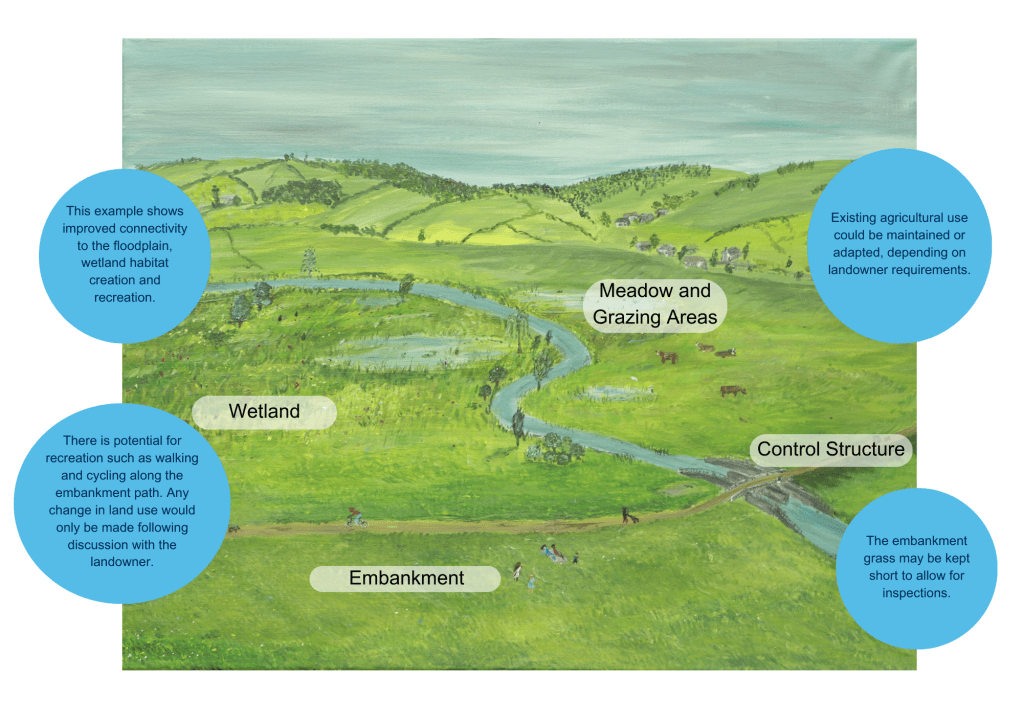
What a flood storage area might look like (Environment Agency image)

Oxfordshire Under Water

The County Council hosted a flood summit, Oxfordshire Under Water, on 29 November – good timing given the recent emergency. Because of climate change we’re experiencing rainfall events unlike anything we’ve seen before. So how do we improve our resilience to flooding?

The event was led by Cllr Pete Sudbury, with representatives from the various local authorities (staff and councillors), the Environment Agency, Thames Water, the farming community, environmentalists, and several flood groups.

In the breakout session five groups spent 30 mins each on two questions: how do we improve resilience, and what does an effective response to a flood event look like? This was a rich discussion with many common threads emerging in the feedback. One theme was the role local flood groups can play in spreading reliable information to neighbours and feeding back on issues to the various response agencies. There was general recognition this isn’t as organised as it should be.

Making the link between flooding and climate change, and the need for behaviour changes in society (dietary, travel, consumption) if we’re to contain global warming was also discussed. Local flood groups can help raise these issues. Social inequalities and the impact of flooding on disadvantaged households was also highlighted.

There is much we can do to improve on current ways of working, with more joined-up thinking, and collaboration to make the best use of scarce resources. Flood-risk reduction, nature conservation, sustainable food production and reducing carbon emissions are inter-related.

We need to move away from a society where people see themselves as ‘consumers’, expecting ‘service’, to one were we see ourselves as ‘citizens’ asking what we can do to contribute.

November flood emergency

River levels in Oxford have peaked and are starting to fall after a week of disruption, with flood defences deployed in several parts of the city. Members of Oxford Flood Alliance have been busy working with residents and the authorities to make sure homes and businesses stay dry. Overall the emergency response has been well managed.

Intense rainfall was experienced across the catchment on Sunday 24 November. Minster Lovell rain gauge recorded 53.2 mm, almost a month’s worth of rain, in just 24 hours. St John’s Lechlade recorded 46.9 mm in the same period. Soils were already sodden after the record-breaking deluge at the end of September and predicting what might happen was challenging. The Environment Agency thought initially that we might see river levels similar to those in January this year.

In the event the floods were not as bad as feared, with the highest levels 150 mm lower than in January. There were two flood peaks in Oxford. The first came on 26 November, driven by the Evenlode and local surface water, the second on 29 November as water made its way down from the headwaters of the Thames. Levels are expected to remain high into early December with a lot of water still flowing through the city.

OFA is deeply frustrated that we have been waiting since the beginning of the year (albeit with a change of government during that period) for the Secretary of State at DEFRA to sign off on the compulsory purchase order for the Oxford Flood Alleviation Scheme. If the scheme were in place we would not have to experience the stress, disruption to daily life and costly emergency response seen over the last week.

River Thames in flood 27 November 2024

OFA on BBC Radio Oxford

OFA steering group member Simon Collings spoke on the Sophie Law show this morning (20 November 2024) during a discussion on flooding. The County Council yesterday discussed a series of measures designed to deal with flooding across the county. These include retrofitting sustainable urban drainage systems (SuDs) into council owned properties and roads, helping communities develop flood plans, and getting tougher with Thames Water.

Cllr Pete Sudbury said that the impacts of climate change appear to be accelerating and the authorities need to up their response. We’re seeing more flash flooding and the proposal to retrofit SuDs was part of a response to that. But this comes against a backdrop of a decade of austerity with funding cuts for local authorities and the Environment Agency. We face ‘a perfect storm’ he said. ‘No pun intended’.

Simon spoke about two recommendations in particular, the possibility of complaining to OFWAT about Thames Water’s failure to provide reports after floods (which they have a legal obligation to do), and the potential role that local flood groups could play.

OFA has called in the past for more pressure to be applied to Thames Water to ensure investment in sewage infrastructure is happening. We have also called for improvements in the way the company responds to incidents of sewage flooding. We need national bodies to be engaged with this.

We also believe local flood groups and residents have a role to play in identifying problem hot spots, checking of the condition of gullies, culverts and other flood assets, and raising awareness locally of what people can do to protect against floods and reduce the impacts. We believe the authorities could be engaging more effectively with local flood groups.

There a meeting on 29 November to discuss ways to improve flood resilience in Oxfordshire. This will bring together a wide range of interested parties. OFA will be at the meeting.

Groundwater flood resilience South Oxford

Project Groundwater is seeking views from people in South Oxford who have experienced groundwater flooding. The insights of local residents will help the project understand how resilient the community is currently and what might be done to make it more resilient. The survey questionnaire can be found here. People who respond have the chance to qualify for a free flood resilience survey. It is open to residents in New Hinksey and Grandpont. There will be a public drop in at South Oxford Community Centre on 20 November, 4-7pm.

OFA has been working with Project Groundwater in helping set up a flood action group in South Oxford. The project is a government funded initiative managed by Bucks County Council which is working with a number of communities affected by groundwater. It has published 7 podcasts so far, most recently on insurance and on natural flood management techniques, which are worth a listen.