BBC South Today on flooding in Oxford

On 23 April BBC South Today broadcast a substantial report on flooding and flood resilience in Oxford (starts 10 mins into the programme).

The item, researched and presented by Alexis Green, begins with householders and a business on Osney Island showing how they cope with flooding. Residents demonstrate the use of pumps and floodgates, and Jacqui Mangold, of the Vishuddha Yoga Centre, explains how their building is designed to allow flood water to enter the ground floor. The construction materials allow rapid recovery from a flood. Residents also discuss the impact of flooding on their lives.

Bas Van Schaik of Earl St, further west along Botley Rd, talks about flooding in those streets and about the large pumps at the bottom of Earl St. He describes the problems of sewage during a flood and the traces of excrement left behind on the streets. He says when he moved to Earl St in 2016 there was already talk of a flood scheme but ten years on we’re still waiting for the first spade in the ground. Residents of West Oxford, he says, find it hard to understand why the flood alleviation scheme is taking so long.

Robbie Williams of the Environment Agency explains how the Oxford Flood Alleviation Scheme is designed to reduce flood risk for the city. The EA says it is vital to future growth and prosperity in Oxford. The scheme will create a large wetland area and new species-rich meadows in the Oxford floodplain.

The report closes with comments from residents of North and South Hinksey concerned about the impacts the scheme could have on their local environment.

The broadcast was trailed earlier in the day on BBC Radio Oxford with a representative  of OFA interviewed live on the Sophie Law breakfast show.

An article by Alexis Green on Oxford’s flooding is on the BBC website here.
More wet winters on the way

Analysis by climate scientists working as part of the World Weather Attribution group shows that the heavy rain and storms seen last Autumn and Winter were 10 times more likely in a world with global warming of 1.2C. This is the latest of hundreds of studies which clearly point to observable changes in our weather being linked to human-created global warming.

As well as making such rainfall events more likely, global warming also means the rain is 20% more intense. The Met Office predicts that wet winters like the one we’ve just seen could occur once every five years, and it warns that could be every three years if global temperatures rise by 2C.

The rapidly changing climate makes it imperative that more is down to build resilience so that communities can better cope. Less well off households are particularly vulnerable, the scientists say, as they are much less likely to have insurance and cannot afford the costs of repairs following flooding.

More information of the report, published by the Met Offices, is here.

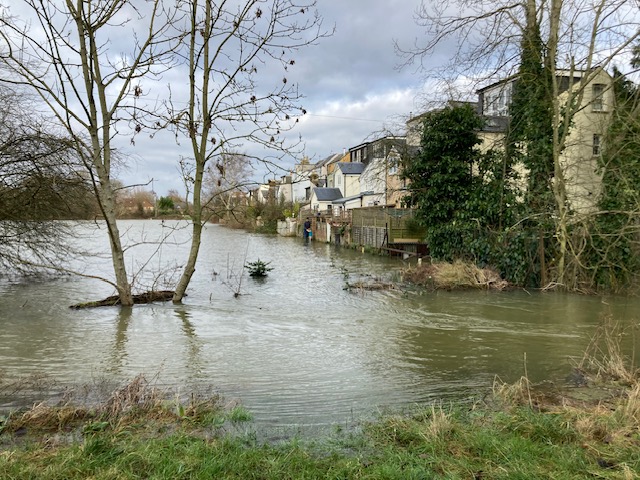
Flood water in meadow behind Marlborough Road, Oxford, January 2024

OFA featured in podcast about flood resilience

Project Groundwater has just released the first of a new series of podcasts looking at different aspects of groundwater flooding. Episode 1 focuses on ‘resilience’ and features interviews with two academic experts on the topics, Dr Karen Potter and Dr Sarah Fitton, plus Simon Collings from Oxford Flood Alliance.

The term ‘resilience’ appears with increasing frequency in the literature about flooding, but what precisely is understood by this word is far from clear. It can mean a number of different things, and is often used to denote what is in fact a complex topic. Without being clear what we mean in any given context evaluating the success of actions to improve resilience could be difficult, and well-meaning interventions may in fact bring no benefit. There is also a risk that an emphasis on ‘community resilience’ in government policy could shift the burden of responding to floods onto communities, and away from the state. Getting he balance right will be critical.

There are things which those directly affected by flooding can do to protect their businesses and homes, and ensure they can recover quickly from a flood. But such measures need to be complemented by actions from the Environment Agency, local authorities and others, both at times of flooding and in modifying the built environment to reduce risk of property flooding.

The degree to which a group of residents has the ability, time and resources to improve their personal resilience as well as influence their wider environment, will vary from one location to another. There are risks of less well-off communities being left behind, and the degree to which ‘capacity’ can be built in vulnerable communities remains little understood.

The podcast, hosted by Katie Hargrave-Smith, lasts 40 mins and can be accessed here.

(OFA is working with Project Groundwater to try to establish a flood action group in South Oxford, an area of the city which has particular issues with groundwater.)

OFA in the news

OFA steering group member Simon Collings was interviewed Monday 22 May for a BBC News report on a new flood resilience training centre which has opened at Wallingford. The BeFloodReady centre provides advice and training on how to make properties more resilient to flooding.

With flooding expected to increase as a result of climate change, household level preparedness will become increasingly important. Exceptionally heavy downpours of the kind we have already seen this year, can cause flash flooding in areas which have not flooded before. It is particularly in these areas where property level measures can help protect against flooding and facilitate quick recovery where flooding does occur.

Simon spoke about being flooded in 2007, and the benefits which flood resilience measures brought during the 2014 floods when a submersible pump kept water out of the house (picture below). OFA has long been an advocate of property level resilience measures, and welcomes this new initiative from DEFRA.

Floodgates, air brick covers and pumps are, however, only effective up to a point. Household resilience measures have a contribution to make to flood risk management but they are not an alternative to the Oxford Flood Alleviation Scheme. We need both.