
As part of our commitment to ensuring the Oxford Flood Alleviate Scheme delivers a benefit for wildlife we have continued to survey butterflies in the Oxford floodplain this year. A group of us take turns to record butterflies along a fixed route each week from 1 April to 30 Sept. The route, called a ‘transect’ , is registered with the UK Butterfly Monitoring Scheme. Our surveying follows the methodology set out by UKBMS and we submit data to it.
This year saw an increase in the number of butterflies recorded compared to 2024 which was a poor year nationally. Also, many species emerged earlier than is normal because of the warm spring and summer. The number of species recorded was similar to last year, but with a few differences in the species list.
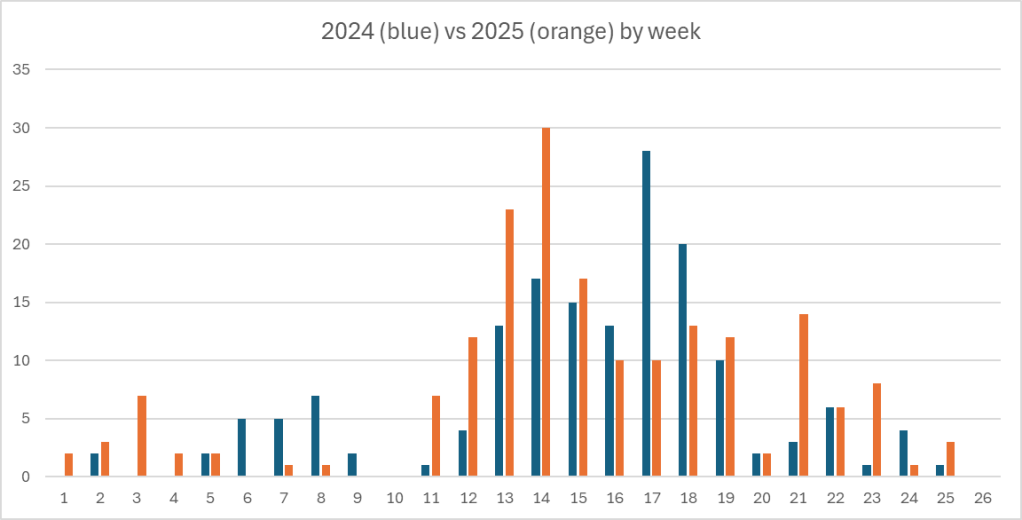
The transect is divided into six sections each of which represents a different type of habitat. The main difference in results this year was the big increase in butterflies recorded in section2, along the southern edge of the Bulstake Stream just south of Osney Mead. Most of the butterflies in this section were recorded in areas close to telegraph poles and a hedge where the grass was not cut all year. This suggests that a different management of the meadows, with some areas left uncut, would boost butterfly numbers.
The grass in the meadow was mowed three times this year, with an impact which can be seen in the low numbers in section 3. Sections 5 and 6 are scrub and meadow at Hogacre Eco-park were we see the highest numbers and a greater range of species.

This data has been shared with the Environment Agency with whom we are talking about ways to enhance butterfly numbers as they acquire land for the scheme (sections 1-3), begin to manage it differently, and plant more hedgerows and trees. We also share our data with the Hogacre trustees with whom we collaborate.
We have access to data from transects at Chilswell Valley, across the A34 from South Hinksey, and Oxford University Farm at Wytham. Butterflies are far more abundant on these other transects compared with the floodplain, which again suggests significant room for improvement.
 oxford flood alliance