The Environment Agency has objected to plans for a large housing development just north of Oxford because they believe the Thames Water sewer network will not cope with the extra load.
‘Thames Water’s treatment plant in Oxford has been illegally discharging sewage for six years, causing significant risk to the rivers and environment from pollution, the EA has said.
‘The increased pressure on the sewage infrastructure from 1,450 new houses planned to the north of Oxford would pose an unacceptable risk of pollution into waterways, the agency said in a letter of objection.
‘It warned it was “not acceptable” for a new housing development to go ahead until Thames Water had carried out the required investment to bring the works within legal limits.’
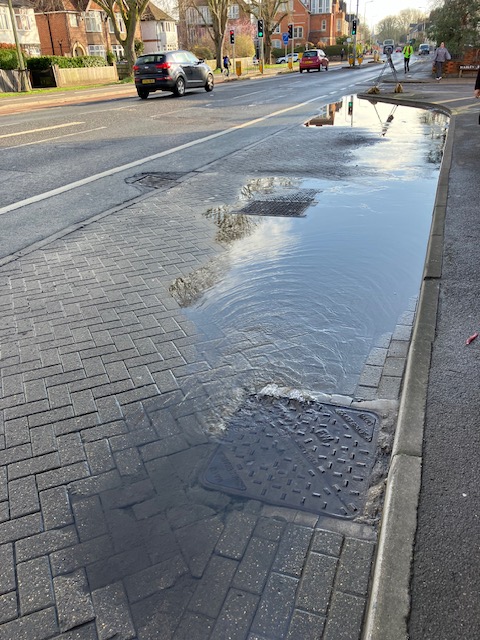
In recent weeks we have seen dilute sewage leaking out of manhole covers at various locations in west Oxford. We’ve also seen houses and businesses flooded by sewage. All of this sewage is then washing into the local river system. We have asked Thames Water to explain what is going on and what hey plan to do about it but have so far had no adequate response. We have raised the issue with Layla Moran MP.
Without serious investments by Thames Water, more development in the city will result in increased risk of sewer flooding for local residents, and more discharges of sewage polluting our rivers. We must have independent proof that improvements Thames Water plan to make at the Oxford Sewage Treatment Works are adequate and that the company is meeting its legal obligations before more connections are made to the system.
Oxford Flood Alliance welcomes this intervention by the EA.
Liz Sawyer from Oxford Flood Alliance is quoted in a story in the Oxford Mail today about overflowing sewers in the Botley Rd area. Floodwater which has infiltrated the sewer network is causing manhole covers to overflow and has resulted in flooding in some homes and businesses.
Annie Blows, who lives on Botley Road, said sewage is pumping out of the drains in her laundry room and out across her garden: ‘You can see it’s full of loo roll and all sorts. It’s terrifying to think about the health risk.’
Outside in the street sewage is leaking from drain covers and forming large puddles. It is fountaining out of a manhole cover in the middle of the Botley Road. Sewage is also pooling in the Waitrose service area, the store remains open as usual.
Ms Blows said a Thames Water representative told her they ‘had to make a decision about whether to flood us, the vets, and the other few houses in our row, or risk 300 other houses.’
‘Some notice would have been good,’ she added. ‘We could have moved our appliances and furniture – but as it is everything’s damaged.’
Sewage in Annie Blows’ laundry roomSewage bubbling out in Botley RdLeaking sewer cover near bus stop
Liz Sawyer, who lives further along Botley Rd, says her family has had to stop using their downstairs loo because it flushes away so slowly. Liz says: ‘There have been bubbling drains and inspection chambers in the area for weeks – even when the water was lower than it is now. There are several in North Hinksey village. The system seems to be under pressure in a way that hasn’t happened before. This is deeply worrying.’
‘Thames Water is contributing to the budget for the planned Oxford Flood Alleviation Scheme (OFAS), because the company believes it will help reduce these sewage leaks, caused by ageing infrastructure. But there are clearly major issues ahead for Thames Water, as climate change worsens.’
Thames Water have had staff in the area and have been using tankers to try to pump out sewage from the system to relieve the pressure. The company told the Oxford Mail they have ‘arranged for an extensive clean and investigation of our sewers to identify any obstructions which may be disrupting the flow in the area.’
South Hinksey could have a permanent flood bund in place by the end of 2025 if the Oxford Flood Alleviation Scheme gets the go ahead in the coming months. The Environment Agency has said the permanent bund would be ‘upfront in the build programme’, so if spades went in the ground this year South Hinksey would start to benefit immediately.
Adrian Porter of OFA, who lives in the village, said. ‘By winter 2025 we’d likely be protected. With a bit of good luck later this year, this really could be our last flood.’
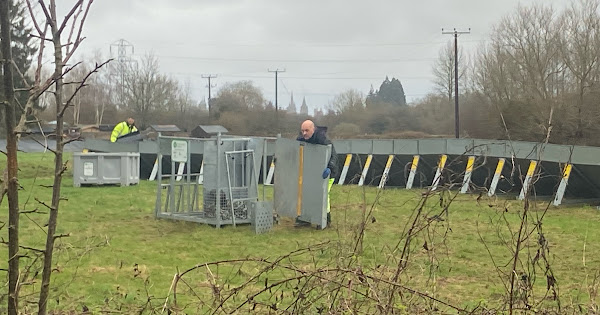
Demountable barriers are currently in place in South Hinksey because of the high floodwater levels. It is the second time this year the defences have been deployed. In January the barriers went up too late to stop some property flooding, so this time the EA have acted quickly to have equipment in place in case it’s needed.
The deployment of temporary defences, Adrian says, has become ‘depressingly normal’. There was a barrier deployment in 2021, a near deployment in 2022, and now two deployments in 2024.
Barriers being erected in South HinkseyFlood barrier crossing a resident’s garden
‘Each time the disruption for the community is significant,’ Adrian explains, ‘with the farm yard and car-park occupied, horses displaced, gardens churned up and rotas of people to keep an eye on things overnight as the EA don’t have the staff to do it themselves.’
The decision to deploy is made by an over-stretched agency with input from advisors, flood modelling data, on-the-ground photographs and other ground-truthing evidence. It is inevitably a balance of strategy, finance, operations and infrastructure. In January the EA got the timing wrong, an awful 48 hours ensued and several properties flooded as a result.
This is totally avoidable. OFAS, which is awaiting planning consent, would mean the village wouldn’t need to rely on the vagaries of human decision-making and temporary barriers. Protection would be there every day of every year.
‘We are a beautifully diverse community of young and old,’ Adrian says, ‘who thrive despite the lack of pub and shop. We work so hard to make this the perfect place for children to grow up and for everyone to enjoy, but with flooding an ever-present threat it is hard to feel completely safe. There is a solution. Let’s get on and deliver the Oxford Flood Alleviation Scheme.’
The Oxford Mail picked up on this story. You can read their version online here.
The Government does not know if it is making the UK more resilient to flooding. In a report published on 17 January 2024, the Public Accounts Committee (PAC) warns that the Department for Environment, Food and Rural Affairs (Defra) has no overall numerical target for the UK’s level of long-term flood resilience, and so cannot know if it is progressing in its 2020 ambition to create “a nation more resilient to future flood and coastal erosion risk”.
Flood protection will be provided for at least 40% fewer properties than planned, according to Environment Agency (EA) forecasts. This is due to factors including inflation and the bureaucracy associated with approving projects. With the programme’s success relying on the completion of many large projects where the EA has only medium or low confidence of delivering by 2027, the Committee is concerned that the number of properties better protected could turn out to be even fewer than the current revised-down forecast of 200,000.
In 2022-23, there were 5.7 million properties in England at risk of flooding. The Committee’s report highlights a range of concerns in Government’s support and approach to flood resilience, including:
smaller and rural communities losing out due to a lack of flood protection provision for communities of fewer than 100 houses that can nevertheless be devastated by the impact of flooding;
new housing continuing to be built in high flood risk areas without adequate mitigations, as over half of Local Planning Authorities said they rarely or never inspect a new development to check compliance with flood risk planning conditions;
a lack of necessary leadership and support from Government for local authorities on how to address the increasing risks of surface water flooding.
Due to a lack of funding, the Environment Agency (EA) has not been able to meet its target of maintaining 98% of its high consequence flood defences (which protect the most properties) at their required condition. The report highlights that 203,000 properties are at increased risk due to deteriorating flood defences, more than the 200,000 separate properties the Government expects to better protect through its ongoing capital programme by 2027. These figures illustrate that poor maintenance is undermining progress from new capital expenditure and Defra’s failure to establish what the appropriate balance is between building new defences and maintaining existing ones.
The National Flood Forum, an umbrella organisation representing local flood groups like OFA, has welcomed the report. The NFF believes that the government’s current approach is too focused on personal resilience. While this undoubtedly has a place, it should only be one part of a bigger bolder Government vision for flood mitigation. The NFF is calling on Government to adopt a strategy that embraces a truly multifaceted integrated approach to flood defence and that adequately tackles the impacts of future flood risk.
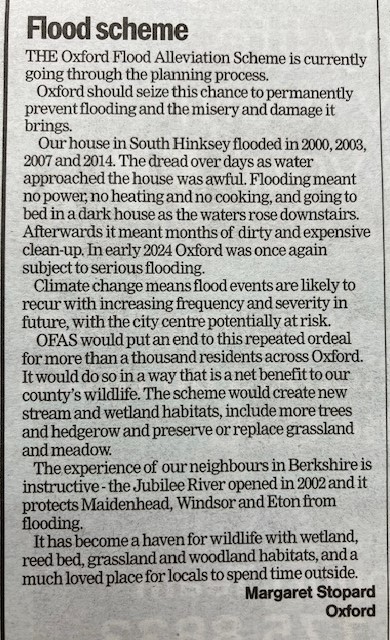
Today’s Oxford Times (8 February 2024) carries a letter supporting the flood alleviation scheme from Maggie Stoppard, the widow of Dr Peter Rawcliffe. Peter was one of the founders of the Oxford Flood Alliance. The letter describes Maggie’s personal experience of floods in South Hinksey, where she and Peter lived, and goes on to say:
‘In early 2024 Oxford was once again subject to serious flooding. Climate change means flood events are likely to recur with increasing frequency and severity in future, with the city centre potentially at risk.
OFAS would put an end to this repeated ordeal for more than a thousand residents across Oxford. It would do so in a way that is a net benefit to our county’s wildlife. The scheme would create new stream and wetland habitats, include more trees and hedgerow and preserve or replace grassland and meadow.’
Maggie’s letter appears alongside an Oxford Times editorial about the flooding in January of a number of sites across the county which are earmarked for housing development. Planning professionals are now calling for a rethink of housing plans, and their comments have attracted support from across the political spectrum. ‘Flood risk needs to be taken seriously by the planning authorities,’ says the editorial.
OFA fully endorses this view. One of the reasons we have problems with flooding in areas like Earl St and Duke St is because of bad planning decisions in prior decades. Building on the floodplain has to stop.
Fifty-seven residents from Earl St, Duke, St and Marlborough Court have written to the Leader of Oxfordshire County Council calling for construction work on the Oxford Flood Alleviation Scheme to begin urgently. They are frustrated that the scheme has been 10 years in design but there is still no firm date for when construction will start. These streets are some of the most vulnerable in Oxford and this January many residents relived the nightmare of past floods.
The letter, organsied by Earl St resident Dr Sebastiaan van Schaik, says:
Re: floods in West Oxford and the urgency of the Oxford Flood Alleviation Scheme
Dear Cllr Leffman,
I’m writing to you on behalf of 57 residents of Earl Street, Duke Street, and Marlborough Court in West Oxford. As I’m sure you are aware, West Oxford and the Abingdon Road areas were severely affected by the floods in early January. We’re grateful to the people from the EA and ODS who worked 24/7 to redirect water and reduce damage to the best of their abilities. Most floors have now dried, pumps are gone, and the electricity is back on, but the streets are still littered with sewage and road surfaces remain in urgent need of repair.
Needless to say, these floods come at a huge emotional and financial cost. For some of us, these were the first or most serious floods we’ve experienced; others still remember the trail of destruction left by the water back in 2000, 2003, 2007 and 2014. On top of that, the impact on local businesses is substantial, at a time many are already struggling. And all of us know: these floods could have been prevented.
In 2015, the Environment Agency first consulted with local residents and organisations on draft designs of Oxford’s Flood Alleviation Scheme (OFAS). Of all the different options to reduce flood risks, the proposed natural channel has been shown by detailed modelling to be the most effective, and residents cannot wait for the work to commence. With this channel, our streets and homes wouldn’t have flooded. But instead, 10 years on from the 2014 floods, not a single spade has touched soil. And we all know that climate change will only result in more frequent and more severe floods. We need action now.
It is profoundly disappointing that we are still waiting for work to start. And to West Oxford residents, there is a deep added irony: badly planned railway works have cut us off from the city we live in. Meanwhile, the Botley Interchange can apparently be closed at the drop of a hat, effectively cutting us off from both sides. Private companies like Thames Water are allowed to flood our streets with sewage, and are permitted to maintain a semi-permanent bike lane closure on Osney Bridge. And big, tall biotech labs can be designed, approved, and built in the area within only a few years.
Yet our local and central governments and agencies are somehow unable to commence work on a carefully-designed natural flood channel through empty grassland, in order to provide West Oxford residents with the most basic of comforts: a safe and dry home. We all understand the need for due diligence, careful planning application processes, and procedures around compulsory purchase orders, but at the current rate it is likely that some of us will not live to see the completion of this scheme. We feel deeply let down.
Therefore, on behalf of 57 residents of our streets, I urge you and the County Council you lead to please collaborate closely with central government and the Environment Agency in order to cut red tape and expedite the building of the Oxford Flood Alleviation Scheme.
At the same time, I urge our local City Councillors Pressel and Muddiman (both CC) to work with the County Council and EA to have the new flood channel completed as soon as possible. There are local elections coming up in 2024 (City) and 2025 (County), and it should not come as a surprise to anyone that this topic is high on the list of concerns of local residents.
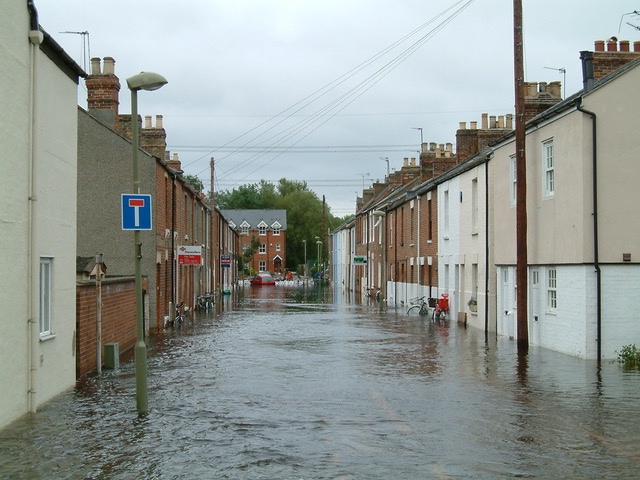
Earl St in July 2007
Dr van Schaik was interviewed on BBC Radio Oxford on Monday 5 Feb, and the story was also picked up by the Oxford Mail, and the Oxford Clarion.
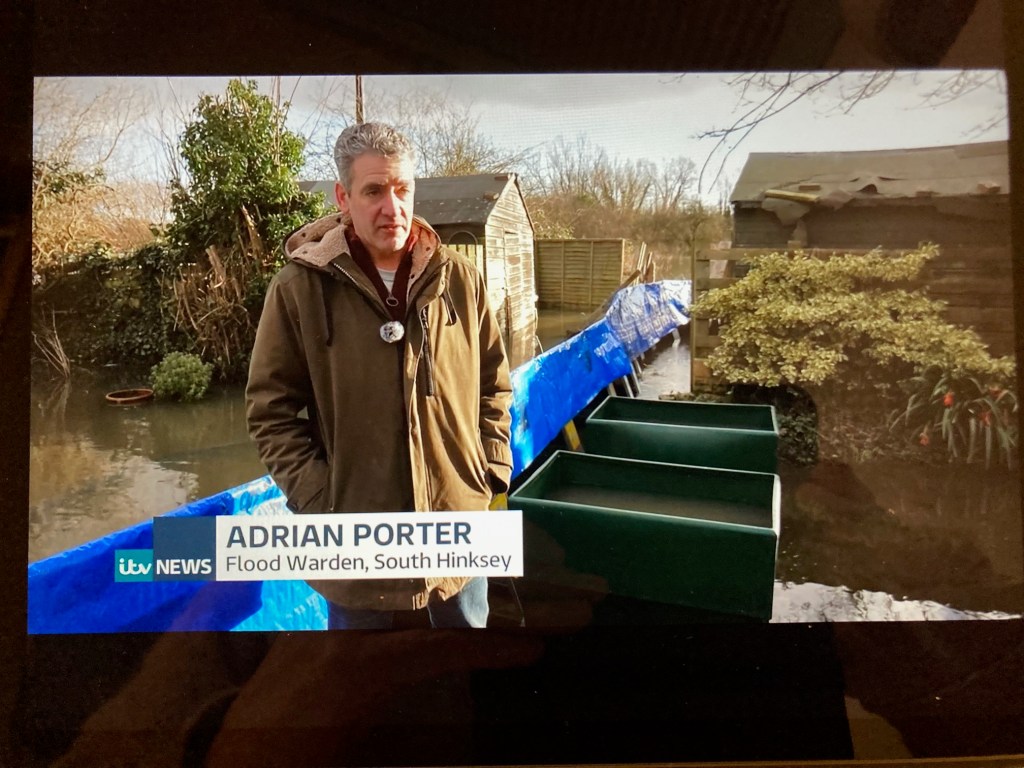
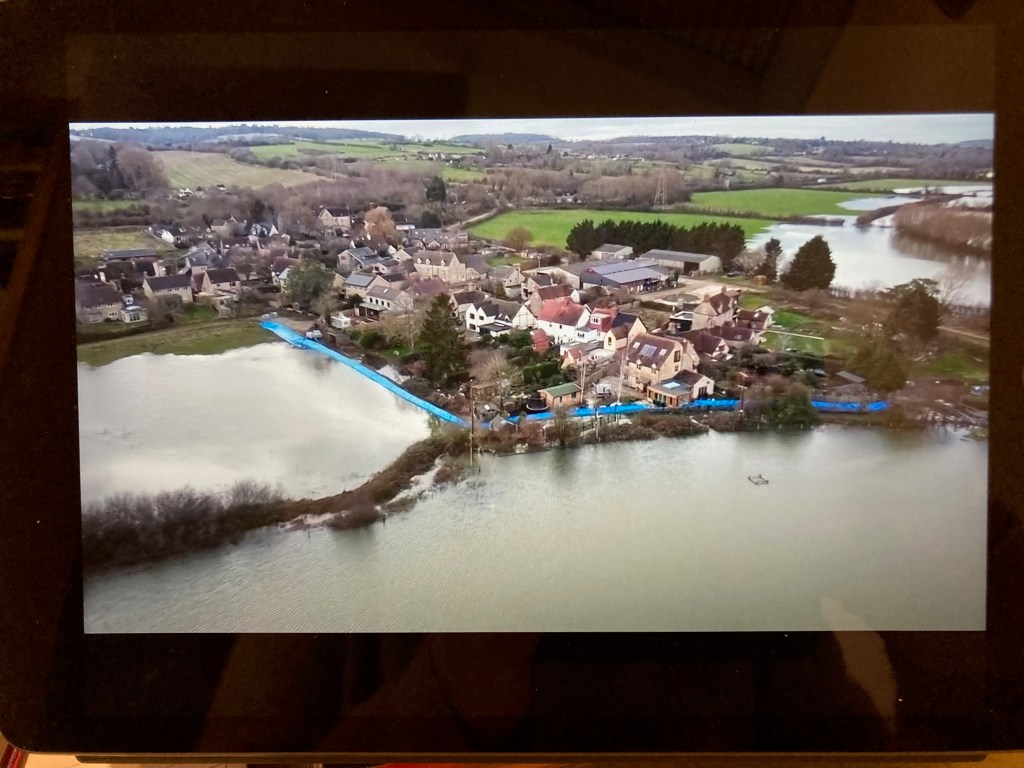
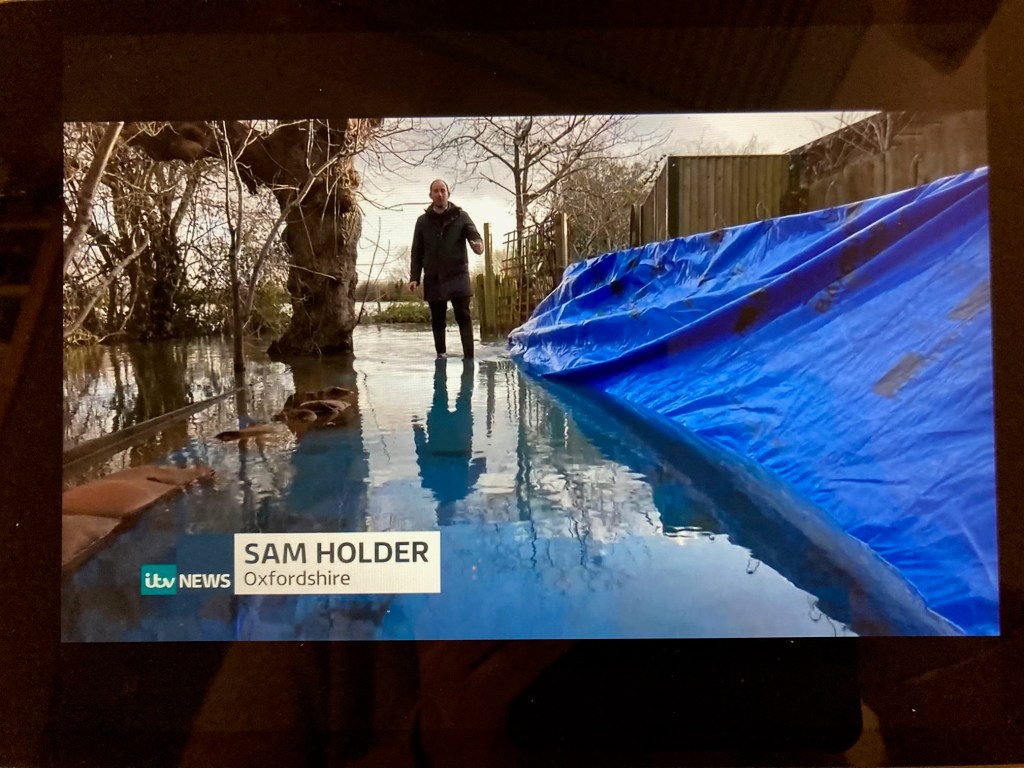
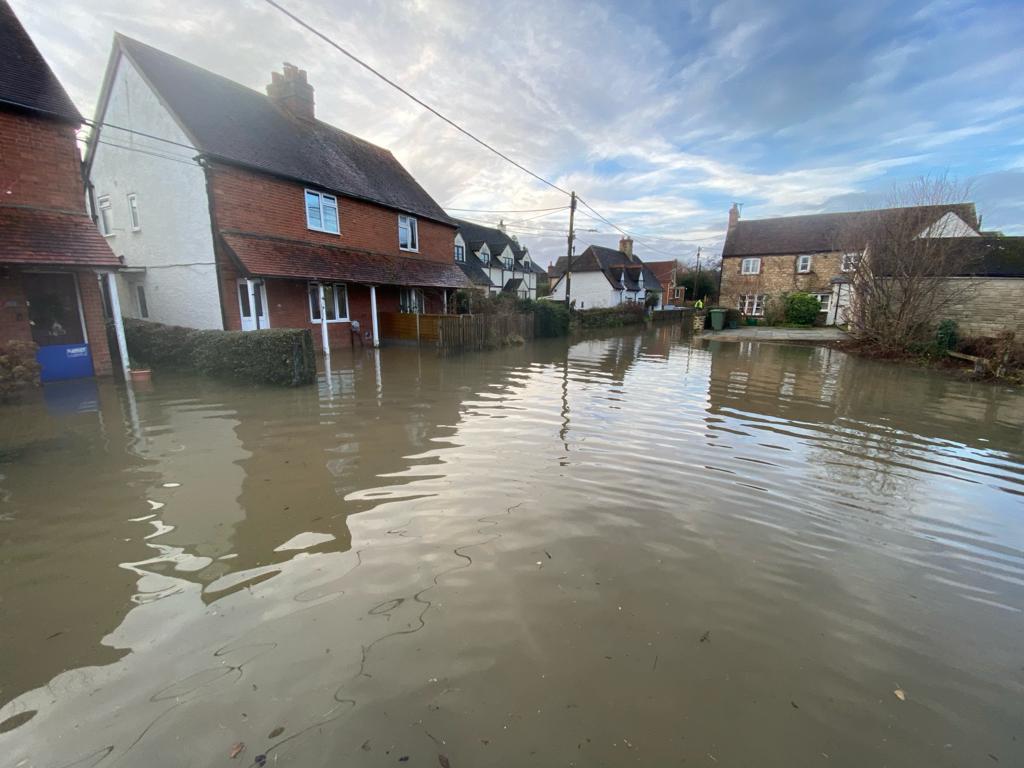
Adrian Porter from OFA was interviewed by ITV yesterday as part of a report on the flooding in South Hinksey. The news item focused on the failure of the Environment Agency to fully deploy defences around the village last Thursday, 4 January. After torrential rain on the Thursday evening, stream culverts in the village were overwhelmed, a large garden at the top of the village was under 1m of water and the sewers surcharged with enough pressure to lift the manhole covers. All that flow ended up in the lower part of the village and was prevented from flowing away by the flood water.
Without pumps and no effective barrier, residents had no alternative but to watch the water rise and do their best to protect their homes. Flood water, pluvial water and sewage water combining to create the worst flood event in ten years.
It took until Saturday evening for the barrier to be completed, pumps deployed and the water to be reduced to below-threshold levels throughout the community. But by then residents had endured serious flooding including within properties, and massive personal & emotional disruption for three days.
The defences are now functioning and floodwater has drained from the village. Sam Holder, the ITV reporter, made a forceful case for having permanent defences in place rather than relying on temporary measures. He asked why, after 10 years of development, the flood scheme is still stuck in planning? The problem he said is ‘bureaucracy’.
Built into the OFAS scheme is a permanent bund for South Hinksey, which would provide early benefit within the implementation of the scheme, and protect the community from all events up to and including 1% AEP (1 in 100 year event). The deployment decision would be reduced to that of pumping equipment and the risk of a delayed or incomplete barrier would be removed. The water seal from a bund would greatly exceed that provided by the temporary defences meaning fewer or smaller pumps would be needed and the barrier, personnel and pumps not needed here would be free to use elsewhere.
This event has proven that the village is defendable, but also that we need a permanent solution that provides the same or better benefit more reliably. That solution is the Oxford Flood Alleviation Scheme.
River levels in Oxford remain high this morning, but have now stabilised. Some homes and businesses have flooded in the last two days, and thousands more people in the city have faced a stressful 48hrs as the response services have battled to contain floodwater. If the proposed Oxford Flood Alleviation Scheme were in place today none of this would have been happening. At these kinds of river levels roads would have remained open, properties and businesses would have stayed dry, and local residents would not have had to endure sleepless nights.
Because we don’t have the scheme in place we have to rely on temporary barriers and pumps to keep flood water at bay. Deployment of these defences depends on Environment Agency and Council staff working long hours to erect and maintain them, often in difficult circumstances. For the most part the response has been effective this time, but in South Hinksey the weather conditions on the night of 5 January meant temporary barriers could not be fully erected and low lying areas of the village were inundated. Barriers and pumps are now working and floodwater has been cleared. If OFAS were in place the village would not have gone through this ordeal, and until the scheme is built communities remain vulnerable to temporary defences failing.
South Hinksey 5 Jan 2024South Hinksey 6 Jan 2024
Oxford is used to floods having the long slow buildup. This time river levels rose very fast. One question which will need to be looked at when the operational response is evaluated is whether defences were in place early enough in some locations.
OFA believes the big flood scheme is needed now. If proof were still needed of why the scheme is essential, the last few days have provided it.
The Environment Agency issued a flood warning at 9.32am today for the River Thames and tributaries at New Botley, New Hinksey, North Hinksey, South Hinksey and Grandpont. The EA advise property flooding is expected. Their statement says: ‘River levels are rising on the River Thames and the watercourses around Oxford, including the Bulstake Stream as a result of heavy rainfall. Therefore, flooding of low lying land, roads and property is expected later this afternoon 04/01/2024, especially in the areas closest to the river in New Botley. Areas most at risk are properties on Botley Road, and the roads off Botley Road in New Botley.’
This is likely to be the most serious flooding we have seen since January 2014, the last big event. On 9 January 2014 the Thames south of Osney Lock peaked at 3.93m, the Bulstake Stream at 3.02m, and the Seacourt at 3.08. Current levels are around 30cms below those 2014 levels, but the river is sill rising with more heavy rain forecast. Current levels are higher than the Dec 2020 floods, and approaching the levels reached in February 2021, the previous worst flooding since 2014.
We understand that temporary defences will be erected at South Hinksey today and that the City Council is deploying defences behind Bulstake Close. The EA and local authorities are keeping the situation under close review and have teams ready to respond as need arises.
Everyone living in the affected areas should take the warnings seriously, monitor the evolving situation, and consider whether they need to take action to protect themselves and their property.
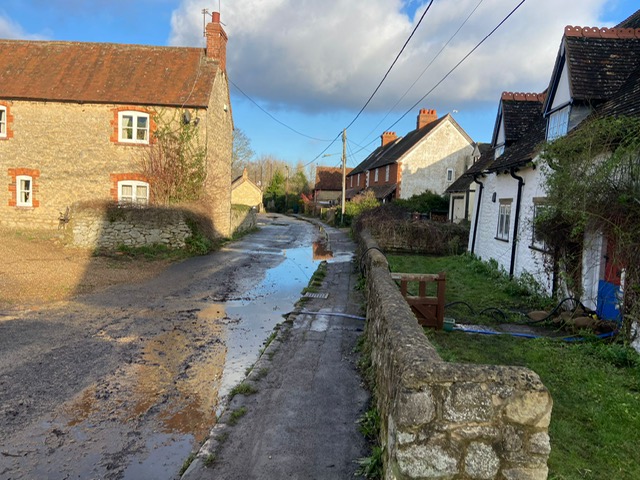
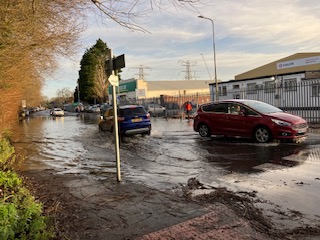
Bottom of Ferry Hinksey Rd this morning. End of Willow Walk also flooded.
12 Oxford City Councillors have successfully asked for the application to be Called-in for consideration by the council’s Planning Review Committee. The next meeting of that committee is (provisionally) on 18 January 2018 so that seems the likely date – but subject to confirmation.
Also in the Oxford Mail re city centre car park charges rising – NB this affects only Worcester St (104 spaces) and Gloucester Green (209). Oxpens (420) and Westgate (1002) are not affected.




 On the BBC:
  oxford flood alliance