Flood scheme making steady progress

The Environment Agency (EA) says it expects construction of the Oxford Flood Alleviation Scheme to start in late 2026. Following approval of the Compulsory Purchase Order by the Secretary of State in May 2025, the EA is in the process of acquiring the land, and rights over land, needed to construct the scheme. Over the summer the Agency tendered for a construction partner and they expect to announce the company selected by the end of the year. 

Outstanding issues

The project still needs to secure some approvals, including the formal planning permission. Oxfordshire County Council’s Planning and Regulation Committee resolved to grant planning permission last year, subject to the EA signing a Section 106 Agreement relating to biodiversity and habitat management and monitoring. The project team is working closely with the council to conclude this agreement, which they expect to do before the end of the year. The project will then need sign off on the Full Business Case from HM Treasury.

Community relations

The EA is planning to launch a Stakeholder Advisory Group to support engagement with residents. This group will be made up of local individuals who represent the community. They will provide advice and local insights as the project prepares for and begins construction.

The new construction partner will be appointing a Community Liaison Officer to ensure there is a named contact who can respond to immediate concerns relating to the construction site and escalate matters to the site manager and project team, as necessary. 

On site activity 

The project has been installing additional groundwater monitoring devices to collect groundwater data, and gauge boards to measure surface water levels. These will allow them to chart water levels before, during, and after construction of the scheme.

In August, a team surveyed for underground utilities, including electric cables and water and sewage pipes to prevent any disturbance of those assets while installing the new monitoring points.

More information about the scheme can be found here: Oxford Flood Alleviation Scheme | Engage Environment Agency

Butterfly monitoring – year 2 results

As part of our commitment to ensuring the Oxford Flood Alleviate Scheme delivers a benefit for wildlife we have continued to survey butterflies in the Oxford floodplain this year. A group of us take turns to record butterflies along a fixed route each week from 1 April to 30 Sept. The route, called a ‘transect’ , is registered with the UK Butterfly Monitoring Scheme. Our surveying follows the methodology set out by UKBMS and we submit data to it.

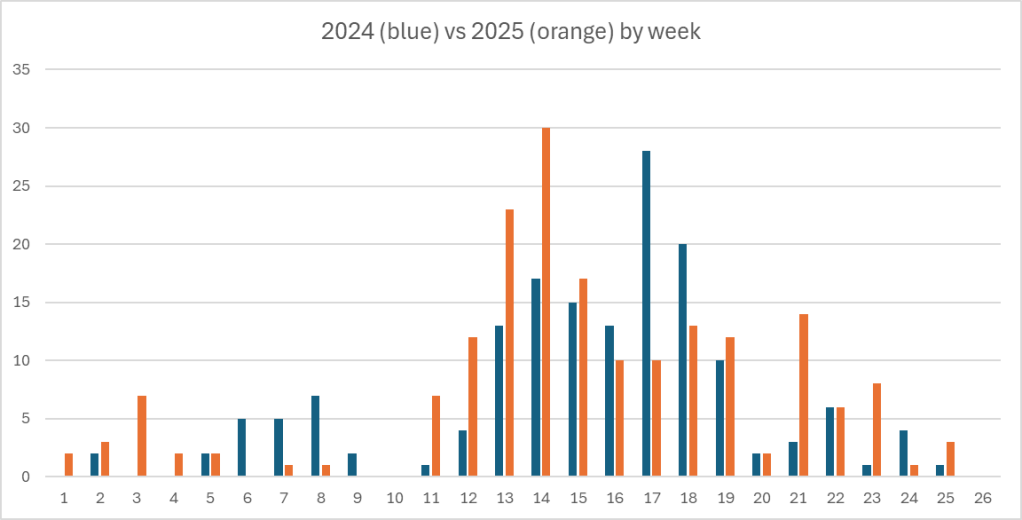
This year saw an increase in the number of butterflies recorded compared to 2024 which was a poor year nationally. Also, many species emerged earlier than is normal because of the warm spring and summer. The number of species recorded was similar to last year, but with a few differences in the species list.

Numbers of butterflies recorded by week 2024 vs 2025

The transect is divided into six sections each of which represents a different type of habitat. The main difference in results this year was the big increase in butterflies recorded in section2, along the southern edge of the Bulstake Stream just south of Osney Mead. Most of the butterflies in this section were recorded in areas close to telegraph poles and a hedge where the grass was not cut all year. This suggests that a different management of the meadows, with some areas left uncut, would boost butterfly numbers.

The grass in the meadow was mowed three times this year, with an impact which can be seen in the low numbers in section 3. Sections 5 and 6 are scrub and meadow at Hogacre Eco-park were we see the highest numbers and a greater range of species.

This data has been shared with the Environment Agency with whom we are talking about ways to enhance butterfly numbers as they acquire land for the scheme (sections 1-3), begin to manage it differently, and plant more hedgerows and trees. We also share our data with the Hogacre trustees with whom we collaborate.

We have access to data from transects at Chilswell Valley, across the A34 from South Hinksey, and Oxford University Farm at Wytham. Butterflies are far more abundant on these other transects compared with the floodplain, which again suggests significant room for improvement.

A Common blue butterfly

BBC South Today on flooding in Oxford

On 23 April BBC South Today broadcast a substantial report on flooding and flood resilience in Oxford (starts 10 mins into the programme).

The item, researched and presented by Alexis Green, begins with householders and a business on Osney Island showing how they cope with flooding. Residents demonstrate the use of pumps and floodgates, and Jacqui Mangold, of the Vishuddha Yoga Centre, explains how their building is designed to allow flood water to enter the ground floor. The construction materials allow rapid recovery from a flood. Residents also discuss the impact of flooding on their lives.

Bas Van Schaik of Earl St, further west along Botley Rd, talks about flooding in those streets and about the large pumps at the bottom of Earl St. He describes the problems of sewage during a flood and the traces of excrement left behind on the streets. He says when he moved to Earl St in 2016 there was already talk of a flood scheme but ten years on we’re still waiting for the first spade in the ground. Residents of West Oxford, he says, find it hard to understand why the flood alleviation scheme is taking so long.

Robbie Williams of the Environment Agency explains how the Oxford Flood Alleviation Scheme is designed to reduce flood risk for the city. The EA says it is vital to future growth and prosperity in Oxford. The scheme will create a large wetland area and new species-rich meadows in the Oxford floodplain.

The report closes with comments from residents of North and South Hinksey concerned about the impacts the scheme could have on their local environment.

The broadcast was trailed earlier in the day on BBC Radio Oxford with a representative  of OFA interviewed live on the Sophie Law breakfast show.

An article by Alexis Green on Oxford’s flooding is on the BBC website here.

If the Oxford Flood Alleviation Scheme were in place this wouldn’t be happening

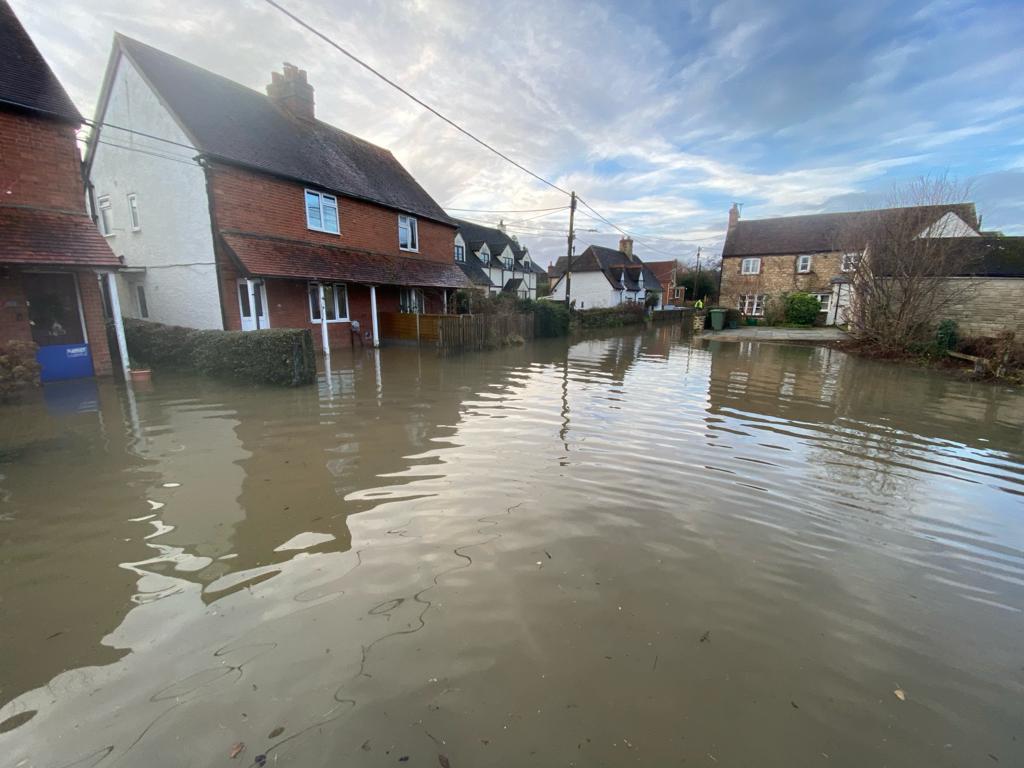
River levels in Oxford remain high this morning, but have now stabilised. Some homes and businesses have flooded in the last two days, and thousands more people in the city have faced a stressful 48hrs as the response services have battled to contain floodwater. If the proposed Oxford Flood Alleviation Scheme were in place today none of this would have been happening. At these kinds of river levels roads would have remained open, properties and businesses would have stayed dry, and local residents would not have had to endure sleepless nights.

Because we don’t have the scheme in place we have to rely on temporary barriers and pumps to keep flood water at bay. Deployment of these defences depends on Environment Agency and Council staff working long hours to erect and maintain them, often in difficult circumstances. For the most part the response has been effective this time, but in South Hinksey the weather conditions on the night of 5 January meant temporary barriers could not be fully erected and low lying areas of the village were inundated. Barriers and pumps are now working and floodwater has been cleared. If OFAS were in place the village would not have gone through this ordeal, and until the scheme is built communities remain vulnerable to temporary defences failing.

Oxford is used to floods having the long slow buildup. This time river levels rose very fast. One question which will need to be looked at when the operational response is evaluated is whether defences were in place early enough in some locations.

OFA believes the big flood scheme is needed now. If proof were still needed of why the scheme is essential, the last few days have provided it.

Why we need a two-stage channel

Critics of the Oxford Flood Alleviation Scheme claim that the proposed new stream and secondary channel deliver little benefit. Oxford Flood Alliance disagrees. We were formed in 2007 by people from communities most vulnerable to flooding. We believe that the proposed two-stage channel is vital to protect those communities.

The planning application documents include an updated comparison between the scheme as designed and the scheme minus the two-stage channel (Appendix Q to the Environmental Statement). This document shows clearly that those communities OFA grew out of, especially those along the Botley Road, would flood more frequently and to a greater depth without the channel.

  • In an event with a 20% chance of happening in a given year, the kind of event we might expect to see every 5 years, Duke St starts to flood without the channel.
  • In a 5% chance event Duke and Earl St flood, so does Marlborough Court. With the channel, only Duke St is affected. Flooding on Osney Island is more extensive than with the channel, though some areas are affected even with the channel.
  • In a 2% chance event Bulstake Close would go under without the channel, sections of Botley Rd would flood, flooding on Osney would be more extensive than with the channel, and St Frideswide’s church and vicarage would flood. Earl and Duke St, and Marlborough Court flood at this level even with the channel. Flood depths will be greater without the channel.
  • In a 1% chance event Mill St and adjoining streets flood without a channel, as do Henry Rd, Helen Rd, Binsey Lane, and the whole of Old Botley. There is extensive flooding on Osney. Parts of Grandpont, Jericho, St Thomas and Hythe Bridge St also flood without a channel.

There is no perfect scheme and the most vulnerable communities are already having to accept that the project cannot protect them against a 1% chance event, or even in some cases a 5% chance event. Community and household-level flood defences will still be needed in these situations. The scheme with ‘no channel’ would be significantly less effective.

Overall, the flood alleviation scheme has to balance a range of competing interests. Protecting all homes and businesses at risk from a 1% chance event is not achievable. It would cost too much and have too great an impact on the local environment. OFA believes the proposed scheme is a reasonable compromise between improving flood protection for the city and meeting concerns about cost, disruption to people’s lives, biodiversity and recreation.

If you live or work in any of the flood-affected areas, or travel through these areas for work or school, you will be better off with the channel.

OFAS CPO inquiry confirmed

DEFRA has now confirmed that an inspector will be appointed to hear objections from landowners to Compulsory Purchase Orders issued as part of the Oxford Flood Alleviation Scheme. The project team has been expecting an inquiry of this kind to be established, and the decision comes as no surprise.

The project needs to acquire land in order to build the scheme, and is following the legal processes required for this to happen. This is a normal part of any infrastructure project. Where individual landowners object to their land being acquired they have the right to have their arguments heard by an independent planning inspector. This is the process which the Secretary of State has now confirmed will take place. A date is yet to be set but we expected this to happen towards the end of the year.

The inquiry will be an independent forum where the merits or otherwise of criticisms of the scheme can be determined. The CPO inquiry is separate to the planning application process currently underway with Oxfordshire County Council, which is also providing independent scrutiny of the scheme. We are waiting currently for the date of the Planning Committee meeting where the application will be decided to be confirmed.

Natural flood management, storage and property-level defences

Some critics of the Oxford Flood Alleviation Scheme have talked about the need for a ‘catchment-wide’ approach as an alternative. There are certainly benefits to thinking about the whole upper Thames catchment, but could such an approach deliver results within a meaningful timescale?

One issue OFA looked at early on, once the Flood Alleviation project was underway, was the potential for natural flood management techniques to contribute to reducing flood risk in Oxford. In August 2015 we organized a seminar and heard from a range of experts on this subject.

The overall conclusion was that natural flood-management techniques can bring benefits in smaller catchments, especially in lower-order flooding events. Isolated projects in the upper Thames would, however, have no measurable impact on Oxford with its large catchment (about 2,500 km2 upstream).

A complete re-landscaping of the Thames catchment might, if it could be achieved, reduce flood peaks by 10–15% – so helping with the flood risk but not solving it fully. Achieving the transformations in land-use necessary to deliver this benefit would require radical new legislation and/or a new culture of approaches to land management, taking ‘around 40 years’ to implement.

We found that storage could potentially play some role, but the volume of water involved in a major flood cannot be contained upstream of Oxford. The Environment Agency has always been clear about this. An effective upstream storage area would need to store approximately 50 million m3 of water. This is equivalent to an area the size of Oxford under 1 metre of water. There’s not enough capacity in the floodplain to store that amount of water.

The Environment Agency is exploring options for some future element of storage to mitigate against worsening climate change. Storage is not a viable alternative to the flood scheme but could be a useful backup in the future, as could major changes to land use upstream.

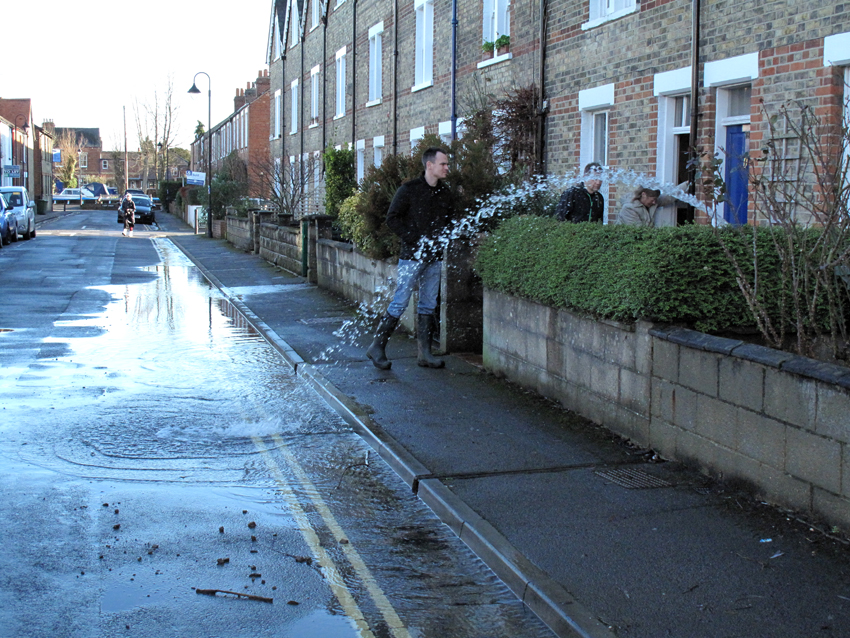
As well as these two options we also spent a lot of time looking at property-level resilience measures. Several steering group members made significant alterations to their homes to reduce the impact of floodwater in their property and speed up recovery after a flood. A number of us were allocated flood gates, air brick covers, and small submersible pumps by the City Council, funded by the EA. The pumps proved vital in Jan 2014 in keeping water out of vulnerable houses on Osney Island (see picture below).

There are things we can do at household level but these are only effective up to a certain scale of flooding. They are not a substitute for the flood scheme. Even with the scheme in place some properties still face risk and will need to deploy property-level defences. 

A decade on and a key decision point

We are expecting the County Council to decide on the planning application for the Oxford Flood Alleviation Scheme in the next few months. This is a major milestone for the project. Here’s a brief reminder of how we got here.

Back in the autumn of 2013 members of the OFA steering group met with the Environment Agency to discuss a list of ten ideas we had proposed for further reducing flood risk in the city. These ideas were additional to the ‘short-term measures’ already implemented following the 2007 floods.

The EA had analysed our suggestions. Some were discounted as the likely benefits were less than the cost, but some of the ideas they agreed would work. Their advice, however, was not to treat these as isolated projects, but to revisit the business case for a larger flood scheme capable of providing a much higher level of protection. The measures we had proposed would be more effective if they were part of such a scheme.

We agreed with this analysis and accepted that a further programme of short-term measures would bring limited benefit. The time had come to look to a more enduring solution.

The floods of January and February 2014 were a timely reminder of the risk the city faced and created the political momentum we needed to get the project moving, including strong support from national government. The plan which grew out of these discussions is the Oxford Flood Alleviation Scheme.

Large infrastructure projects start high level and become more and more detailed as they pass the hurdles set for each stage. OFAS has been developed in this way, with the output from each iteration subject to consultation, independent scrutiny, and approval by DEFRA and the Treasury. Over the past ten years the scheme has evolved, taking on board many suggestions from individuals and groups. This process has helped ensure the scheme is as good as it can be.

The project design for which the EA is seeking planning permission is the product of ten years of research, design, consultation, review and revision. We’re now at a point where we need a decision. The County Council planning officers have subjected the scheme to rigorous scrutiny. Elected councillors on the planning committee will make their decision, guided by the officers. This is the democratic process for agreeing how we go forward.

We very much hope the Council will decide for the project. Climate change is already increasing risk of flooding, and Oxford urgently needs a flood alleviation scheme.

Latest news on Oxford Flood Alleviation scheme

The Environment Agency recently submitted further information on its main planning application for the Oxford Flood Alleviation Scheme to Oxfordshire County Council. This was requested following a public consultation on the application last year. The council is expected to hold a consultation on the Environment Agency’s response shortly, after which it will determine the scheme application.

The Environment Agency will also be making a Compulsory Purchase Order (CPO) to acquire the land necessary to build and operate the scheme. We will share more information on the CPO process when it becomes available.

The scheme’s newsletter provides an update on these and other developments. You can read it below:

We are working with 9 partners on a major new flood scheme for Oxford, which will reduce flood risk to homes, businesses and vital transport routes into the city. The scheme will provide a long term solution to flooding in Oxford, helping protect the city in coming decades as flood risk increases with climate change.

The scheme will run through the existing floodplain west of Oxford. It will be formed of a new stream surrounded by a sloping floodplain of new wetland habitat and grazing meadow, to create more space for water away from built-up areas.

Scheme update

We submitted our planning application for the scheme to Oxfordshire County Council in 2022 and a consultation on our proposals was held. The council subsequently asked us to provide some further information, which is quite normal for a project of this size and complexity. We have now submitted our response to the request for further information and the council will organise a public consultation on our response. You will be able to find more details on the Oxfordshire County Council ePlanning system. The planning reference is MW.0027/22.

Our Compulsory Purchase Order (CPO) for the scheme has been finalised. We will issue notices to landowners shortly and the documents will then be submitted to the Secretary of State for Environment, Food and Rural Affairs. A CPO will ensure that all the land necessary to construct the scheme is available. The Secretary of State will determine the process for deciding the CPO and will set out the timetable for this in due course. We have engaged with landowners and will continue to do so throughout the planning and CPO process.

We will also be submitting a separate planning application to construct a temporary access track to the Hinksey Rail Sidings. We expect to submit this by May 2023. If this application is approved, the temporary access track will allow us to remove some of the material excavated during construction by rail. Use of the railway will depend on us gaining permission to access the sidings, their availability, and agreements with the operator of the sidings.

Protecting the City’s infrastructure

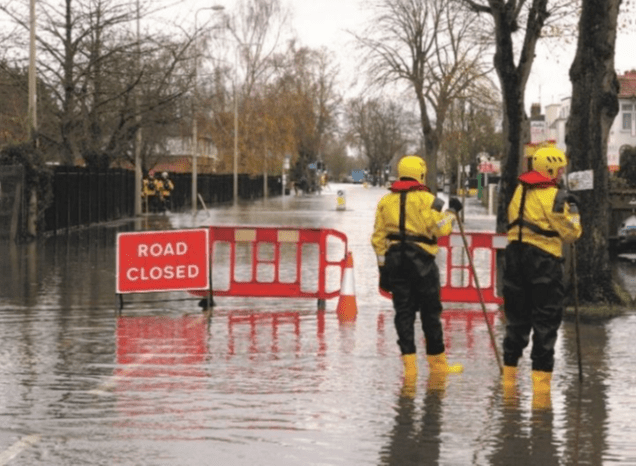
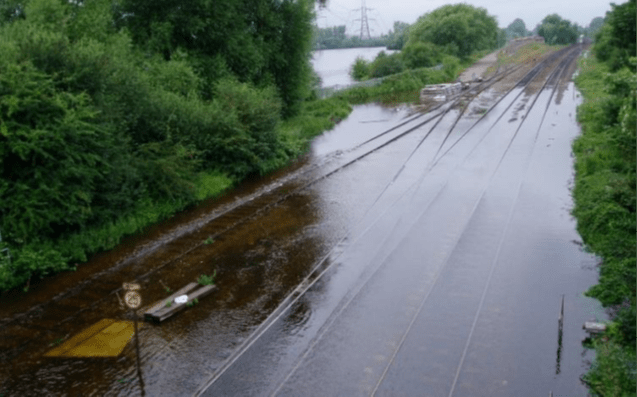
Significant floods in past decades have not only caused property damage to homes and businesses in Oxford, they have also closed the railway and major roads, bringing the city to a standstill. This level of disruption will be specifically memorable for people who experienced the floods of 2003, 2007 or 2013/2014. Floodwater cut off Botley and Abingdon Roads, closed the railway line and caused devastation to many homes and businesses.

Flooding and road closure on Abingdon Road in November 2012

The Oxford Flood Alleviation Scheme will help keep the main railway line, Abingdon Road, Botley Road and local roads open in floods. There will also be fewer flood related interruptions to utility services, including water, electricity, phone and internet, and less likelihood of schools and essential community services needing to close.

Flooded railway tracks in Oxford in 2007

Oxford relies on functioning and resilient infrastructure in order to stay open for business and to support its vibrant tourist economy. Oxford is known as a thriving centre of commerce. It is home to around 4,700 businesses and provides 135,000 jobs. Road closures, diversions and longer journey times due to flooding would impact the tens of thousands of people who commute into or travel through Oxford by bus or car every day. The scheme will significantly reduce the chance of this disruption due to flooding.

The scheme will also bring wellbeing benefits to communities in and around Oxford. Thousands of residents who are currently affected when the city floods will be able to enjoy improved peace of mind without the worry of flooding and the green spaces of the scheme will enhance the enjoyment of recreation in the local area for generations to come.

Keep safe from flooding

Polls as part of the Environment Agency Public Flood Survey in March 2021 suggest nearly 2 in 3 households at risk from flooding do not believe their homes could flood. But just because flooding hasn’t happened to you in the past, it doesn’t mean it won’t happen in the future.

In England there are over 5 million properties at risk of flooding. With climate change already causing more frequent, intense flooding and rising sea levels, we all need to know what to do should the worst happen.

Taking steps to prepare for flooding and knowing what to do in a flood can significantly reduce the risks to individuals and damages to homes and possessions.

Follow us to keep updated on the scheme – and please share this newsletter

www.facebook.com/oxfordscheme

twitter.com/OxfordFAS

oxfordscheme@environment-agency.gov.uk

www.gov.uk/government/publications/oxford-flood-scheme/oxford-flood-scheme