Natural flood management, storage and property-level defences

Some critics of the Oxford Flood Alleviation Scheme have talked about the need for a ‘catchment-wide’ approach as an alternative. There are certainly benefits to thinking about the whole upper Thames catchment, but could such an approach deliver results within a meaningful timescale?

One issue OFA looked at early on, once the Flood Alleviation project was underway, was the potential for natural flood management techniques to contribute to reducing flood risk in Oxford. In August 2015 we organized a seminar and heard from a range of experts on this subject.

The overall conclusion was that natural flood-management techniques can bring benefits in smaller catchments, especially in lower-order flooding events. Isolated projects in the upper Thames would, however, have no measurable impact on Oxford with its large catchment (about 2,500 km2 upstream).

A complete re-landscaping of the Thames catchment might, if it could be achieved, reduce flood peaks by 10–15% – so helping with the flood risk but not solving it fully. Achieving the transformations in land-use necessary to deliver this benefit would require radical new legislation and/or a new culture of approaches to land management, taking ‘around 40 years’ to implement.

We found that storage could potentially play some role, but the volume of water involved in a major flood cannot be contained upstream of Oxford. The Environment Agency has always been clear about this. An effective upstream storage area would need to store approximately 50 million m3 of water. This is equivalent to an area the size of Oxford under 1 metre of water. There’s not enough capacity in the floodplain to store that amount of water.

The Environment Agency is exploring options for some future element of storage to mitigate against worsening climate change. Storage is not a viable alternative to the flood scheme but could be a useful backup in the future, as could major changes to land use upstream.

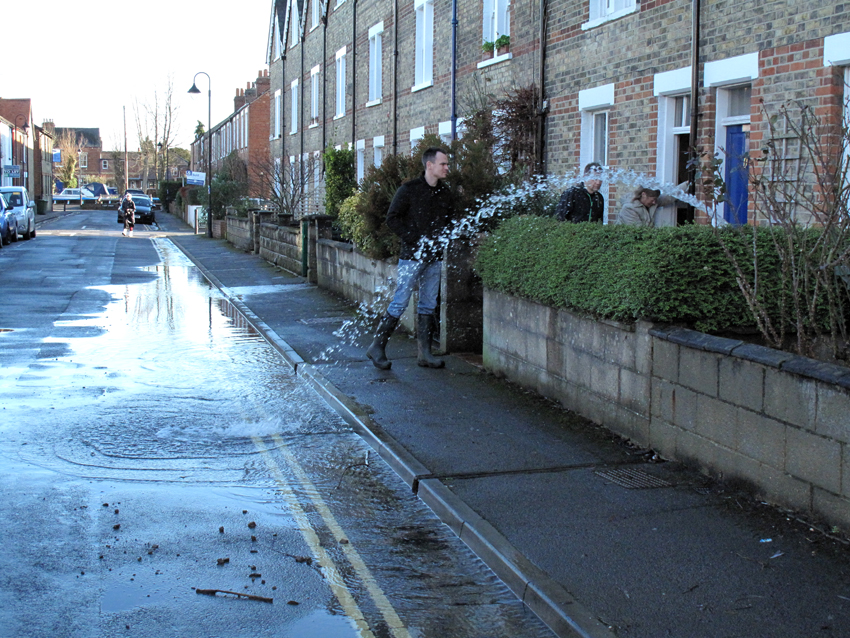
As well as these two options we also spent a lot of time looking at property-level resilience measures. Several steering group members made significant alterations to their homes to reduce the impact of floodwater in their property and speed up recovery after a flood. A number of us were allocated flood gates, air brick covers, and small submersible pumps by the City Council, funded by the EA. The pumps proved vital in Jan 2014 in keeping water out of vulnerable houses on Osney Island (see picture below).

There are things we can do at household level but these are only effective up to a certain scale of flooding. They are not a substitute for the flood scheme. Even with the scheme in place some properties still face risk and will need to deploy property-level defences. 
A decade on and a key decision point

We are expecting the County Council to decide on the planning application for the Oxford Flood Alleviation Scheme in the next few months. This is a major milestone for the project. Here’s a brief reminder of how we got here.

Back in the autumn of 2013 members of the OFA steering group met with the Environment Agency to discuss a list of ten ideas we had proposed for further reducing flood risk in the city. These ideas were additional to the ‘short-term measures’ already implemented following the 2007 floods.

The EA had analysed our suggestions. Some were discounted as the likely benefits were less than the cost, but some of the ideas they agreed would work. Their advice, however, was not to treat these as isolated projects, but to revisit the business case for a larger flood scheme capable of providing a much higher level of protection. The measures we had proposed would be more effective if they were part of such a scheme.

We agreed with this analysis and accepted that a further programme of short-term measures would bring limited benefit. The time had come to look to a more enduring solution.

The floods of January and February 2014 were a timely reminder of the risk the city faced and created the political momentum we needed to get the project moving, including strong support from national government. The plan which grew out of these discussions is the Oxford Flood Alleviation Scheme.

Large infrastructure projects start high level and become more and more detailed as they pass the hurdles set for each stage. OFAS has been developed in this way, with the output from each iteration subject to consultation, independent scrutiny, and approval by DEFRA and the Treasury. Over the past ten years the scheme has evolved, taking on board many suggestions from individuals and groups. This process has helped ensure the scheme is as good as it can be.

The project design for which the EA is seeking planning permission is the product of ten years of research, design, consultation, review and revision. We’re now at a point where we need a decision. The County Council planning officers have subjected the scheme to rigorous scrutiny. Elected councillors on the planning committee will make their decision, guided by the officers. This is the democratic process for agreeing how we go forward.

We very much hope the Council will decide for the project. Climate change is already increasing risk of flooding, and Oxford urgently needs a flood alleviation scheme.

Seacourt P&R flooded in just 8 hours

On Monday 3 April the Seacourt Park and Ride extension went from being largely dry in the morning to being underwater 8 hrs later. Here’s a picture of the car park taken by a local resident early on Monday morning:

This video clip, taken at around 10.30 the same morning, shows the rapidly rising water. You can see the water spreading across the car park in real time.

By 6.30 pm the car park looked like this:

And here’s a video clip which shows the flooded facility on Tuesday morning.

Oxford City Council shut the car park first thing on Monday morning, but the pedestrian and cycle pathway was not closed until 24 hours later, with many people trying to use it on the Monday. Some  turned back on encountering the flooding but others took their chances, ploughing through the floodwater in an attempt to access the bus stop.

The flood happened on a weekday. Given the speed of the rising water levels, there remains a question as to how promptly action would be taken at weekends, overnight, and on bank holidays, particularly to ensure the safety of pedestrians and cyclists. Water started to appear in the car park on the Saturday morning (1 April), when several cars were still parked there.

OFA identified safety issues as an area of concern during the planning process for the car park extension. River levels have not been especially high in this event. The level of the Seacourt stream at Minns estate, across the road from the Park and Ride, was 0.3 m below its peak in January this year.

Oxpens redevelopment flood compensation

OFA is pleased to note the approach being taken in the Flood Risk Assessment which forms part of the OXWED planning application. At the insistence of the Environment Agency the developers have  adopted a ‘level for level’ approach to flood compensation, meaning that any reduction in floodplain capacity at a given level has to be compensated for by an increase in capacity at that same level. This is the standard we would expect to see applied.

The development will also allow flood water to enter voids beneath some of the built structures.

Up to date flood modelling has been used in the assessment, and allowance has been included for the proposed new bridge over the Thames (which will be part of a separate planning application).

Calculations in the FRA show an overall net gain in flood plain capacity for all levels of flooding. This will help to reduce flood risk in the city. The EA is now reviewing these proposals and will provide its comments to the planning authority. OFA welcomes the robust approach being taken.

During 2021 OFA took part in several meetings between the OXWED developers and members of St Ebbe’s New Development Residents Association (SENDRA) where flood risk was being discussed. Community members highlighted concerns about continuing erosion of the riverbank at Oxpens Meadow. These concerns are acknowledged in the planning documents with provisions included to address them.

Some SENDRA members were also interested in the potential to improve the biodiversity of the meadow, an interest OFA shares. The planning application includes proposals for a net gain in biodiversity which is assessed to be in excess of 10%. This is achieved through additions to hedgerows, numbers of ecologically valuable trees, and sowing of the meadow with a richer mix of grasses.

Going forward we expect to see similarly robust approaches on flood risk being applied to other planned development in this area, especially Osney Mead. We also want to see areas set aside for biodiversity being linked so that green corridors continue to serve wildlife in the area. Protecting and enhancing the diverse habitat provided by the main river and its margins will be critical.