SOFLAG meeting on flood insurance

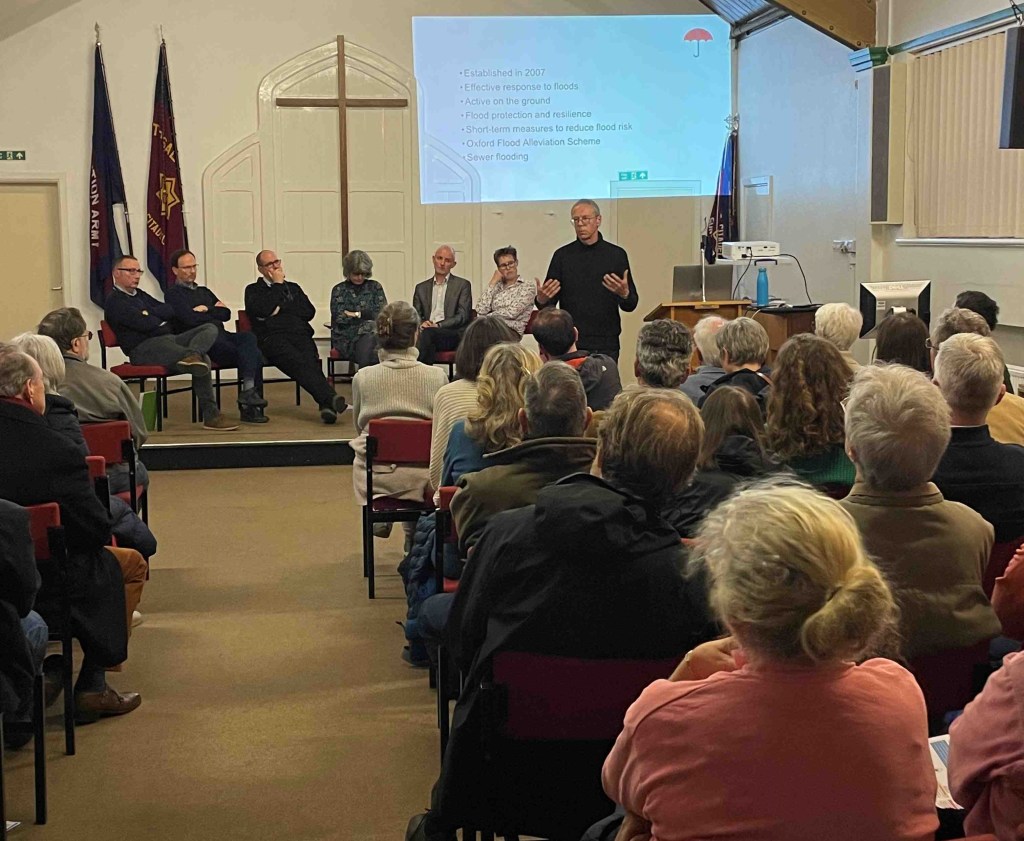
South Oxford Flood Action Group (SOFLAG) was formally launched yesterday evening (16 July) at a public meeting in St Luke’s Church in South Oxford. At the start of the meeting, Rachel Hastie and David Macdonald talked briefly about the groups aims, which are to raise awareness of flood risk in the area, and increase people’s understanding of their individual flood risk and what they can do about it.

The group identified flood insurance as an issue of concern for many local residents, so they invited Emma Holroyde from Flood Re to explain the current arrangements which ensure householders at risk of flooding can obtain affordable flood cover. Flood Re is a partnership between government and the insurance industry. The scheme allows insurers to pass on flood related elements of a policy to Flood Re. It is funded by a levy on the insurance industry. Anyone trying to get flood insurance should be able to obtain quotes from insurers signed up to the scheme.

Flood Re is also working on creating a market-based solution for the longer-term, where it is no longer needed. This includes promoting the Build Back Better initiative where insurers help those affected by a flood to make their homes more flood resilient, thereby reducing the likelihood of future claims. For more information see the Flood Re website.

Emma was followed by Adrian Porter, a resident of South Hinksey and a member of the OFA steering group. He talked about the devastating experience of flooding in 2007 and how he negotiated a cash settlement with his insurer so that he could make the house flood resilient. In 2014, when serious flooding again occurred, the inside of his home stayed dry even though the water outside was much higher than the floor level inside. He was later able to sell the house because it was protected against flooding.

Following the presentations the audience had an opportunity to ask questions, and there were was time also to talk to presenters and SOFLAG members after the meeting. Fifty-eight people attended the meeting, plus speakers and SOFLAG volunteers.

OFA worked with Project Groundwater to help set up SOFLAG and has acted as an advisor to the group. SOFLAG has funding from Project Groundwater to dig a borehole at St John’s Church, New Hinksey, and install gauge boards on streams in the area. These will be used to track changes in ground and surface water levels with the data being made available through a publicly accessible website. They are looking for local volunteers to monitor levels on the gauge boards during flood incidents. More information here.

Major step forward for flood alleviation scheme

The Secretary of State, at DEFRA, Steve Reed, has approved the compulsory purchase order for the Oxford Flood Alleviation Scheme. This now enables the Environment Agency to proceed with acquiring the land needed to build the scheme. The decision follows a public inquiry into the CPO held at the end of 2023. The planning inspector who chaired the inquiry rejected the arguments of objectors and recommended implementation of the scheme as proposed by the Environment Agency.

In making this announcement both Steve Reed and Emmy Hardy, the floods minister, make it clear the government is fully behind the scheme and are committed to seeing it delivered.This is hugely welcome news.

Here is the full text of the DEFRA/EA press release:

New scheme in Oxford to protect every home and business from risk of River Thames flooding

  • Environment Secretary Steve Reed approves purchase to allow new scheme to be built
  • The scheme is part of the record £2.65 billion being invested in flood protection over two years

All homes, businesses and crucial infrastructure in Oxford at risk of flooding from the River Thames will be better protected thanks to a major new flood defence.   This will provide vital reassurances for more than 160,000 residents in the face of our changing climate.  

In another step under the Government’s Plan for Change, Environment Secretary Steve Reed gave crucial approval to the Environment Agency and its partners to purchase land and grant rights within the flood scheme area, which has enabled the flood scheme to progress.  

This project is part of the Government’s record two-year investment of £2.65 billion to build and repair flood defences across the country.  

Floods Minister Emma Hardy said:  

“The role of Government is to protect its citizens, but flood defences were inherited in their worst condition on record.  

“Through our Plan for Change, a record £2.65 billion is going into building and repairing flood defences over the next two years.  

“The Oxford Flood Alleviation Scheme is a vital new piece of infrastructure that will deliver economic growth in Oxfordshire, better protect homes and businesses and deliver new jobs.”  

Robbie Williams, Project Director for the Oxford Flood Alleviation Scheme, said:  

“We’re delighted to have received approval to progress with purchasing the land needed for the Oxford Flood Alleviation Scheme to go ahead.  

“This is a major step forward for the project, ensuring we can bring this vital flood protection to the city. As we face increasingly unpredictable and extreme weather, the Oxford Flood Alleviation Scheme is more urgently needed than ever.  

“We can now all look forward to starting work on putting the scheme into place.”  

This follows the earlier good news that Oxfordshire County Council resolved to grant planning permission for the scheme – this decision is separate from the Compulsory Purchase Order.  

The Environment Agency made a Compulsory Purchase Order for the land, which – as there were objections from some of the landowners – went to a public inquiry. An independent Inspector listened to the objections and to the case for confirming the order and reported her recommendations to the Secretary of State to make a final decision.  

The new scheme is designed to cope with major floods of a scale Oxford last experienced in 1947. This is far bigger in size than any of the floods Oxford has experienced in recent decades. With a changing climate, it is expected there would be more frequent heavy rainfall leading to potential flooding.  

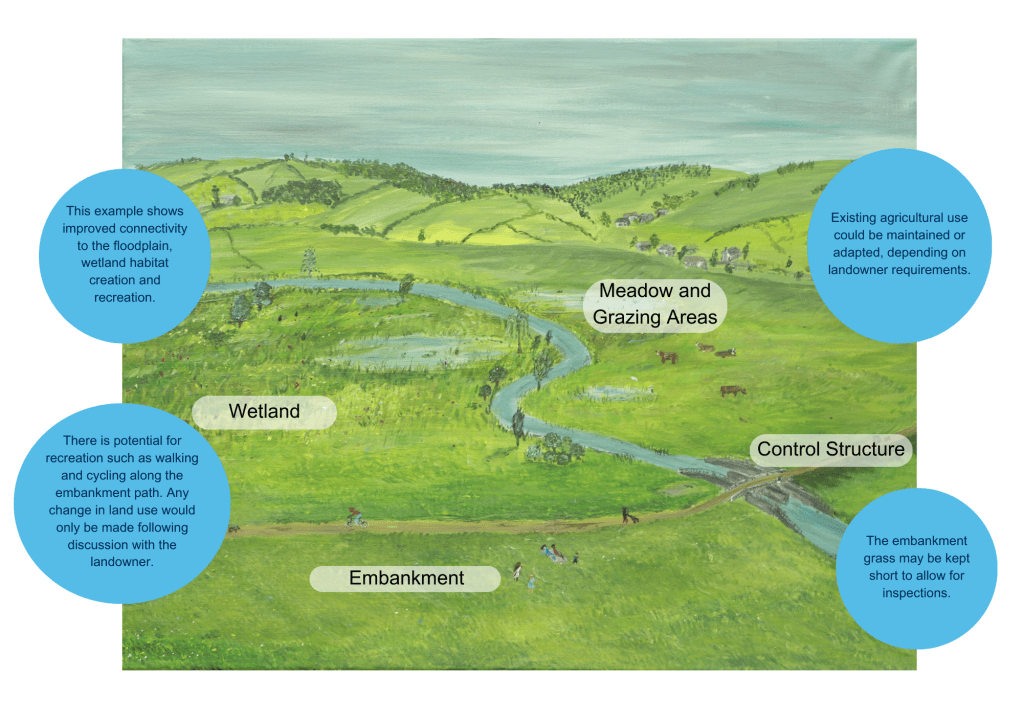
The Oxford Flood Alleviation Scheme is designed to work with the natural floodplain to the west of Oxford, which will be lowered to increase its capacity. A new stream will be created, fed by the River Thames, meandering through gently sloping grazing meadows. People will be able to walk and cycle alongside the new stream, with views of wildflowers and wetland.

The Oxford Flood Alleviation Scheme aims to enhance the natural floodplain to the west of Oxford by lowering it to increase its capacity.  

With the Compulsory Purchase Order confirmed, the Environment Agency can now exercise its statutory powers to acquire the rights and interests in the affected land. Once this process is complete, construction is expected to start in late 2026.  

Led by the Environment Agency, the Oxford Flood Alleviation Scheme is one of the biggest flood schemes currently proposed in England.  

Upstream storage hits a roadblock

An investigation by the Environment Agency into the potential to store flood water upstream in the catchment has concluded that the benefits are only marginally greater than the costs. Without changes to the methodology mandated by government for calculating cost-benefit ratios the proposal will not qualify for funding. The agency looked at more than 700 potential sites, narrowing these down to 17 viable sites with sufficient volume.

Upstream strorage is one of two approaches the Environment Agency has been exploring as part of the Thames Valley Flood Scheme launched in March 2021. The other approach is natural flood management. These are not alternatives to the Oxford Flood Alleviation Scheme, but additional measures which are likely to be needed because of global warming.

The conclusions of the flood storage study are clearly disappointing, but we understand that discussions have started with DEFRA about the methodology. Any change in policy will take time.

Meanwhile, the natural flood management projects continue. There is a lot of interesting work going on here, see for example the North East Cotswold Farm Cluster, which is part of the Evenlode Catchment Partnership.

Oxford Flood Alliance is a strong supporter of these nature-based initiatives which bring multiple benefits, not just flood-risk reduction.

What a flood storage area might look like (Environment Agency image)

Groundwater flood resilience South Oxford

Project Groundwater is seeking views from people in South Oxford who have experienced groundwater flooding. The insights of local residents will help the project understand how resilient the community is currently and what might be done to make it more resilient. The survey questionnaire can be found here. People who respond have the chance to qualify for a free flood resilience survey. It is open to residents in New Hinksey and Grandpont. There will be a public drop in at South Oxford Community Centre on 20 November, 4-7pm.

OFA has been working with Project Groundwater in helping set up a flood action group in South Oxford. The project is a government funded initiative managed by Bucks County Council which is working with a number of communities affected by groundwater. It has published 7 podcasts so far, most recently on insurance and on natural flood management techniques, which are worth a listen.

Symposium delegates visit South Oxford

Around 30 delegates to a British Hydrological Society (BHS) symposium in Oxford took part in a field trip to South Oxford on 24 September. Oxford Flood Alliance member Simon Collings, Richard Harding of the Environment Agency and David Macdonald, hydrogeologist and South Oxford resident, co-hosted the visit, which they helped design.

The delegates had spent two days discussing developments in flood modelling and forecasting in the UK and internationally. Predicting the impacts of flood hazards is complex and takes into account many elements. These include the nature of the catchment, the ground conditions, groundwater levels, surface-water runoff, volume and intensity of rainfall, and sewer infrastructure.

Researchers are working to improve our understanding of each of these components and build integrated models to help better represent what happens during an event. The field visit provided an opportunity to learn about a specific flood-affected community, the measures being taken to reduce flood risk, and to think about the future application of some of the monitoring and forecasting tools presented at the symposium.

One topic of discussion was groundwater monitoring. In South Oxford this is currently very limited, with scope to improve data collection and potential benefits in using river data to indicate the likelihood of groundwater-related flooding. Some work is about to start on this with support from Project Groundwater, a government-funded initiative aiming to fill some of the gaps in our understanding of groundwater flooding. OFA is currently working with Project Groundwater to set up a flood group in the South Oxford area.

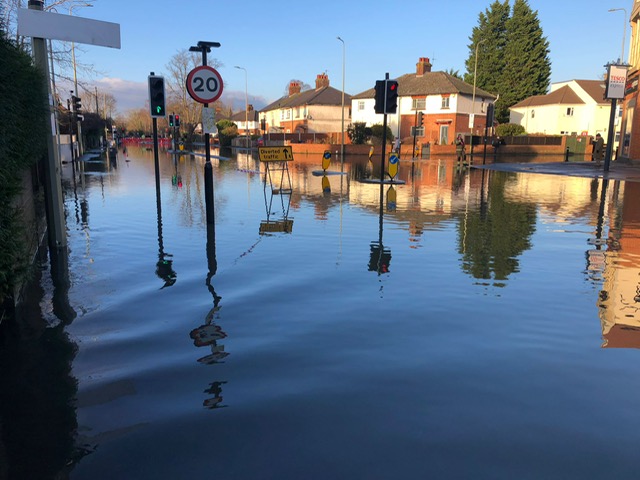
Abingdon Road 7 January 2024

South Oxford flood meeting well attended

Last night’s meeting on flooding in South Oxford attracted around 70 local residents interested to learn more about what can be done to reduce flood risk. The meeting was hosted and introduced by Cllr Anna Railton, who set the scene by describing the floods of January and February this year and issues arising.

David Macdonald, a geo-hydrologist who lives locally, gave an overview of groundwater flooding which is a particular problem in South Oxford. Rising river levels push up groundwater, and one way to reduce risk, he said, is to lower river levels.

This is what the Oxford Flood Alleviation Scheme aims to achieve, and Richard Harding from the Environment Agency gave a quick overview of the project. Mat Lloyd, also from the EA, spoke briefly about community flood preparedness.

Karen Fisher and Jed Ramsay then talked about Project Groundwater, a Defra funded initiative which aims to build resilience in communities particularly affected by groundwater flooding. South Oxford is one of the areas they are specifically targeting with advice and support. One issue Jed talk about was early warning systems for groundwater using advanced technologies.

Simon Collings spoke finally about Oxford Flood Alliance and gave an example from January this year of the way community organisation prevented flooding.

At the end of the meeting a number of people expressed interest in learning more about becoming a flood warden and about developing a flood plan. OFA will working in partnership with Project Groundwater in helping to create enhanced community organisation around flooding in South Oxford. The resources which Project Groundwater bring to this venture provide a great opportunity for improving the community’s resilience.

Oxford Flood Alleviation Scheme, of course, remains critical to reducing flood risk in the city. Several people said they would be writing to the County Council urging them to give planning consent for the scheme.

Public meeting South Oxford 21 March 2024

Oxford Flood Alliance will be speaking at a public meeting on flooding in south Oxford and what can be done about it. This area of Oxford has particular issues with groundwater though the neighbourhood is also affected by river flooding.

David Macdonald, a hydrologist and local resident, will explain how groundwater flooding occurs, Jed Ramsay from Project Groundwater, a government funded initiative which is working with the community, will talk about local resilience and mitigation, Richard Harding from the Environment Agency will talk about the Oxford Flood Alleviation Scheme and how this will benefit local residents, and Simon Collings from OFA will talk about the work of the alliance.

The meeting has been organised by the local city councillors, Anna Railton and Naomi Waite, and will be chaired by Cllr Railton. Information about flood insurance, Project Groundwater and the Oxford Flood Alleviation Scheme will be available at the event.

The meeting will take place on 21 March, 7pm, at South Oxford Christian Centre, Wytham Street, OX1 4TW.