The latest issue of the Oxford Flood Alleviation Scheme newsletter, available from the project website, provides updates on progress on the scheme. This includes plans to create a Stakeholder Advisory Group, mentioned in our last blog. The group will provide ‘advice and local insights’ as the project team prepares for and starts construction and will be formed in January. If you wish to learn more about this group you can register your interest at OxfordScheme@environment-agency.gov.uk.
The Environment Agency (EA) says it expects construction of the Oxford Flood Alleviation Scheme to start in late 2026. Following approval of the Compulsory Purchase Order by the Secretary of State in May 2025, the EA is in the process of acquiring the land, and rights over land, needed to construct the scheme. Over the summer the Agency tendered for a construction partner and they expect to announce the company selected by the end of the year.
Outstanding issues
The project still needs to secure some approvals, including the formal planning permission. Oxfordshire County Council’s Planning and Regulation Committee resolved to grant planning permission last year, subject to the EA signing a Section 106 Agreement relating to biodiversity and habitat management and monitoring. The project team is working closely with the council to conclude this agreement, which they expect to do before the end of the year. The project will then need sign off on the Full Business Case from HM Treasury.
Community relations
The EA is planning to launch a Stakeholder Advisory Group to support engagement with residents. This group will be made up of local individuals who represent the community. They will provide advice and local insights as the project prepares for and begins construction.
The new construction partner will be appointing a Community Liaison Officer to ensure there is a named contact who can respond to immediate concerns relating to the construction site and escalate matters to the site manager and project team, as necessary.
On site activity
The project has been installing additional groundwater monitoring devices to collect groundwater data, and gauge boards to measure surface water levels. These will allow them to chart water levels before, during, and after construction of the scheme.
In August, a team surveyed for underground utilities, including electric cables and water and sewage pipes to prevent any disturbance of those assets while installing the new monitoring points.
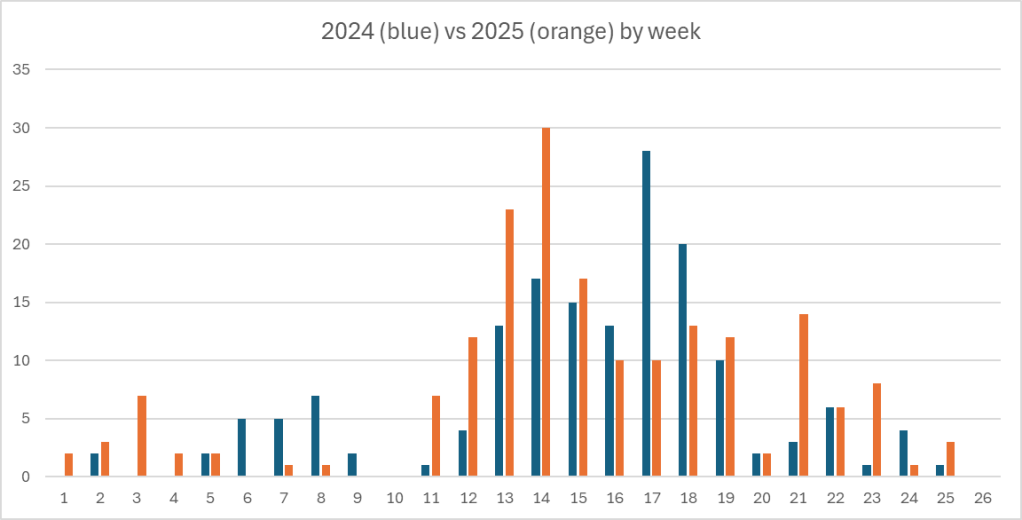
As part of our commitment to ensuring the Oxford Flood Alleviate Scheme delivers a benefit for wildlife we have continued to survey butterflies in the Oxford floodplain this year. A group of us take turns to record butterflies along a fixed route each week from 1 April to 30 Sept. The route, called a ‘transect’ , is registered with the UK Butterfly Monitoring Scheme. Our surveying follows the methodology set out by UKBMS and we submit data to it.
This year saw an increase in the number of butterflies recorded compared to 2024 which was a poor year nationally. Also, many species emerged earlier than is normal because of the warm spring and summer. The number of species recorded was similar to last year, but with a few differences in the species list.
Numbers of butterflies recorded by week 2024 vs 2025
The transect is divided into six sections each of which represents a different type of habitat. The main difference in results this year was the big increase in butterflies recorded in section2, along the southern edge of the Bulstake Stream just south of Osney Mead. Most of the butterflies in this section were recorded in areas close to telegraph poles and a hedge where the grass was not cut all year. This suggests that a different management of the meadows, with some areas left uncut, would boost butterfly numbers.
The grass in the meadow was mowed three times this year, with an impact which can be seen in the low numbers in section 3. Sections 5 and 6 are scrub and meadow at Hogacre Eco-park were we see the highest numbers and a greater range of species.
This data has been shared with the Environment Agency with whom we are talking about ways to enhance butterfly numbers as they acquire land for the scheme (sections 1-3), begin to manage it differently, and plant more hedgerows and trees. We also share our data with the Hogacre trustees with whom we collaborate.
We have access to data from transects at Chilswell Valley, across the A34 from South Hinksey, and Oxford University Farm at Wytham. Butterflies are far more abundant on these other transects compared with the floodplain, which again suggests significant room for improvement.
The first stage of the flood monitoring project being implemented by South Oxford Flood Action Group (see post of 1 June 2025 ) was completed on Friday 1 August with the installation of a borehole in the grounds of St John the Evangelist Church, Vicarage Road. This will allow groundwater levels in the area to be measured and the data fed to a publicly accessible web portal.
Over the coming months gauge boards will be installed to measure water levels in streams and rivers and in Hinksey Lake, as well as other flood-prone areas of South Oxford. Community volunteers will take readings from the boards during flood events and the data will be shared through the web portal. The initiative is supported by Project Groundwater.
SOFLAG members (left to right) David Radford, David Macdonald and Cllr Anna Railton at the new borehole, with Bertie (the dog) looking on. Photo credit: Willem Macdonald.
South Oxford Flood Action Group (SOFLAG) was formally launched yesterday evening (16 July) at a public meeting in St Luke’s Church in South Oxford. At the start of the meeting, Rachel Hastie and David Macdonald talked briefly about the groups aims, which are to raise awareness of flood risk in the area, and increase people’s understanding of their individual flood risk and what they can do about it.
The group identified flood insurance as an issue of concern for many local residents, so they invited Emma Holroyde from Flood Re to explain the current arrangements which ensure householders at risk of flooding can obtain affordable flood cover. Flood Re is a partnership between government and the insurance industry. The scheme allows insurers to pass on flood related elements of a policy to Flood Re. It is funded by a levy on the insurance industry. Anyone trying to get flood insurance should be able to obtain quotes from insurers signed up to the scheme.
Flood Re is also working on creating a market-based solution for the longer-term, where it is no longer needed. This includes promoting the Build Back Better initiative where insurers help those affected by a flood to make their homes more flood resilient, thereby reducing the likelihood of future claims. For more information see the Flood Re website.
Emma was followed by Adrian Porter, a resident of South Hinksey and a member of the OFA steering group. He talked about the devastating experience of flooding in 2007 and how he negotiated a cash settlement with his insurer so that he could make the house flood resilient. In 2014, when serious flooding again occurred, the inside of his home stayed dry even though the water outside was much higher than the floor level inside. He was later able to sell the house because it was protected against flooding.
Following the presentations the audience had an opportunity to ask questions, and there were was time also to talk to presenters and SOFLAG members after the meeting. Fifty-eight people attended the meeting, plus speakers and SOFLAG volunteers.
OFA worked with Project Groundwater to help set up SOFLAG and has acted as an advisor to the group. SOFLAG has funding from Project Groundwater to dig a borehole at St John’s Church, New Hinksey, and install gauge boards on streams in the area. These will be used to track changes in ground and surface water levels with the data being made available through a publicly accessible website. They are looking for local volunteers to monitor levels on the gauge boards during flood incidents. More information here.
The page provides information out about the flood alleviation scheme, including the benefits it will bring to the local area and how its design will create valuable new wetland habitat. The content will be updated as the OFAS project progresses. You can click ‘Subscribe’ to get notified about news updates from the EA.
The page also provides a link to all the information and documents relating to the Compulsory Purchase Order (CPO). If you live in the local area you may see notices put up around the scheme area, and the EA will be writing to everyone affected by the CPO. No one is being asked to leave their home for the flood scheme to be built.
The newly formed South Oxford Flood Action Group (SOFLAG) has secured a grant of just under £20,000 to set up a local flood monitoring system in the South Oxford area. This includes a borehole and gauge boards on local streams and ditches. Local residents will be involved in gathering data on water levels.
The funding comes from Project Groundwater, a government-funded initiative to improve management of groundwater flooding in the UK. Oxford Flood Alliance has been supporting Project Groundwater since the beginning of the initiative. Project Groundwater identified South Oxford as a community it wished to engage with.
Recipients of funds have to be formally registered bodies so West Oxford Community Renewables (WOCoRe) will manage the funds on behalf of SOFLAG. OFA facilitated contact with WOCoRe to help SOFLAG secure the grant.
David Macdonald, a hydrologist and south Oxford resident who helped set up SOFLAG, said: ‘We plan to make data about water levels available to residents through an accessible website. We hope this will raise local awareness of how flooding happens in our community and enable people to respond more effectively.’
Residents of Earl Street in West Oxford are to receive additional flood protection under a small grants scheme run by Oxfordshire County Council. The grant of £600 will pay for a small petrol/diesel mobile pump to be deployed as required in a rear garden into which flood water flows from the gardens to the north. This will reduce the risk of ingress of water into properties on the western side of Earl Street, comprising 34 terraced houses and 1 ground floor flat. A sump is already in place in the garden where the pump will be deployed.
The grant application was made by Nick Hills, an OFA Steering Group member, via the Earl Street Residents Association (ESRA). The association is working in partnership with the City Council who will administer the funds.
The ESRA was set up in 2017 to secure funding for a large mobile pump from Scottish and Southern Energy Network’s Community Resilience Fund. The residents association was later successful in winning grants from the City Council to install sumps in three gardens in the street and the pumps to go in them.
Nick Hills said: ‘This additional pump will provide extra protection and reassurance to Earl Street residents during a flood. We are grateful to Cllr Susanna Pressel for making us aware of the opportunity to apply for this funding, and for the support of the County and City Councils.’
That’s TV, the internet-based broadcaster, has aired interviews with Jon Mansbridge of the Environment Agency (22 May) and Simon Collings of OFA (27 May) about the government’s approval of the compulsory purchase order for the Oxford Flood Alleviation Scheme. Scroll through the posts on their That’s TV Oxfordshire Facebook page to view these. The interviews are also available on X.
Regional and local media have been reporting on the announcement of government backing for the Oxford Flood Alleviation Scheme. BBC South Today ran a report yesterday (16 May) including an interview with Robbie Williams of the Environment Agency. The item starts around 8:50 minutes into the programme.
Earlier in the day Simon Collings gave OFA’s reaction to the news on BBC Radio Oxford, and there’s a written report on the BBC News blog about the decision.
The Oxford Mail also covered the story and there’s a paragraph in this week’s Oxford Clarion.
Oxford East MP, Annelise Dodds, tweeted on X: BREAKING NEWS: Local residents will be relieved that the @OxfordFAS CPO has now been “approved”. Along with Oxford Flood Alliance, residents and Labour Councillors I’ve been pushing for this and welcome this decision.
Oxford West and Abingdon MP, Layla Moran, tweeted: Welcome news of progress on the long-awaited Oxford flood alleviation scheme to protect homes and businesses.