OFAS planning application approved

The planning application for the Oxford Flood Alleviation scheme has been approved by Oxfordshire County Council’s Planning and Regulation Committee with eight votes ‘for’ and one abstention.

The committee heard from 13 objectors, 16 supporters, the Environment Agency, and the County’s planning team before debating the scheme and making their decision. The Secretary of State at the Ministry of Housing, Communities and Local Government will be given an opportunity to call in the application because the scheme is in the greenbelt, but this is normal procedure.

The decision should now clear the way for approval of the compulsory purchase order (CPO) which was the subject of a public inquiry at the end of last year. The CPO approval follows a separate process and is currently with DEFRA. Consideration of the planning inspector’s report was delayed because of the general election.

We understand the environmental concerns of objectors and are committed to ensuring the scheme delivers on its biodiversity net gain targets.

Oxford Flood Alliance is grateful to all the people, local residents and councillors, who spoke in support of the scheme. Also to the team at the Environment Agency. This is a huge achievement after 10 years of work.

15 July planning meeting will decide OFAS planning application

We now have formal confirmation that the Oxford Flood Alleviation Scheme will be decided by Oxfordshire County Council Planing and Regulation Committee on 15 July. The officers report recommends approval of the scheme. Copies of the agenda and the officer’s report area available online here.

The 160 page report includes a detailed review of all aspects relevant to the planning application which the committee needs to consider. The full text of the recommendation to support is as follows:

The application has been considered against the development plan, taking account of material considerations including statutory and non-statutory consultation responses and public representations. It is recommended that, subject to the application first being referred to the Secretary of State to consider
whether he wishes to call it in for his own determination and to conditions to be determined by the Head of Strategic Planning, including those listed in Annex 1, and the signing of a Section 106 Agreement to secure 30 years Habitat Management and Monitoring Plan for offsite Biodiversity Net Gain and a monitoring fee, the application is approved.

Oxford Flood Alliance will be at the planning meeting and expects to address the committee. We very much hope they will approve the application. This is the culmination of ten years of work on the scheme. If planning consent is granted it will leave only one further hurdle to clear, approval of the Compulsory Purchase Order by the new Secretary of State at DEFRA, Steve Reed. A public inquiry into the CPO concluded in January this year but a decision on the inspectors report was delayed by the calling of the general election. We hope approval will be given in the next couple of months.

OFAS planning decision likely to be July

We have been told that the OFAS planning application will not be going to the 3 June meeting of the County Council’s Planning and Regulation committee as we had hoped. The Council officers are still writing their report and we are expecting a special meeting to be arranged in July at which a decision on the application will be made.

More wet winters on the way

Analysis by climate scientists working as part of the World Weather Attribution group shows that the heavy rain and storms seen last Autumn and Winter were 10 times more likely in a world with global warming of 1.2C. This is the latest of hundreds of studies which clearly point to observable changes in our weather being linked to human-created global warming.

As well as making such rainfall events more likely, global warming also means the rain is 20% more intense. The Met Office predicts that wet winters like the one we’ve just seen could occur once every five years, and it warns that could be every three years if global temperatures rise by 2C.

The rapidly changing climate makes it imperative that more is down to build resilience so that communities can better cope. Less well off households are particularly vulnerable, the scientists say, as they are much less likely to have insurance and cannot afford the costs of repairs following flooding.

More information of the report, published by the Met Offices, is here.

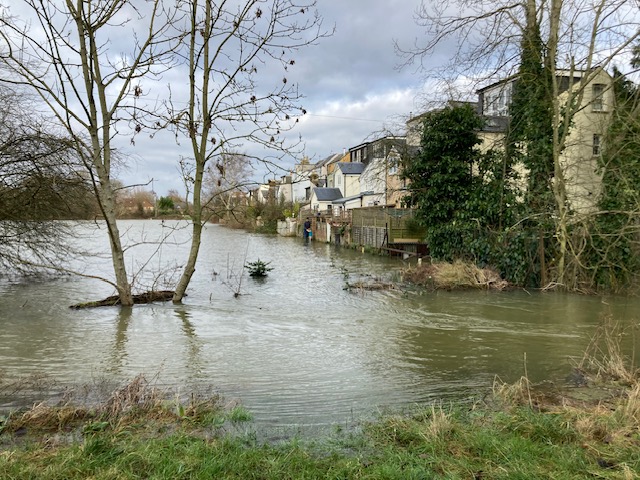
Flood water in meadow behind Marlborough Road, Oxford, January 2024

County ecologist supports OFAS biodiversity plan

Beccy Micklem, Landscape and Nature Recovery Team Leader at Oxfordshire County Council has confirmed that she is now satisfied the OFAS scheme can meet its targets in relation to biodiversity net gain. This follows the submission of ‘letters of comfort’ by the Environment Agency and three landowners confirming that land is available to provide offsite biodiversity compensation.

Ms Micklem’s updated response to the case officer says: ‘Following delivery of off-site habitat creation, the scheme will result in net gains of 11.24% area habitats, 11.66% hedgerows, and 15.22% watercourses. Provision of letters of comfort from landowners with whom the applicant is engaging with regards delivery of offsite BNG (Blenheim Estate, the Earth Trust and Oxford City Council) have recently been submitted, providing increased certainty that the necessary provision of offsite BNG will be deliverable.
Should you be minded to grant planning permission, a number of planning conditions and obligations will be needed to secure measures to conserve biodiversity and deliver a net gain.’

The document goes on to set out the specific conditions which should be attached to planning consent. This would appear to unblock the final obstacle to the scheme securing planning permission. We are hoping the application will now go to the 3 June meeting of the County Council planning committee.

The updated response and the letters of comfort are on the County planning portal.

Reducing flood risk by improving biodiversity

Can improving biodiversity in Oxfordshire contribute to reducing flood risk? We think it can and there are conversations taking place across the county which could move this forward.

Oxfordshire County Council is developing a Local Nature Recovery Strategy (LNRS) for the county. This flows from the 2021 Environment Act and government commitments to improve biodiversity across the UK. Oxford Flood Alliance has been participating in consultation meetings on the strategy. We’re interested in ways natural flood management in the catchment can help reduce flood risk.

The County is using expert advice alongside wide-ranging public consultation. Twelve workshops were held in March involving more than 300 participants, including conservationists, farmers and local government officers. A survey of local people received 650 responses. Results of these engagement activities were presented in an online meeting on 9 May attended by more than 100 people.

What matters most?

The two issues that gained the widest support from these consultations were improving the quality of our rivers and freshwater habitats and stopping river pollution from sewage and agricultural runoff. Benefits expected to come from this included reduced flooding (number 2 for the workshops and 3 in the survey result). There was also strong support for an end to building in the floodplain.  Thames Water cleaning up its act is critical to reducing pollution.

Simon Collings from OFA asked how reducing flood risk would be reflected in the priorities for  the strategy. Chloe Edwards, who leads on this work at the County Council, said this would be through identifying habitat improvements which included natural flood management to benefit properties and/or farmland. She said she expected this to be a significant component of the strategy.

How could this reduce flood risk?

LNRS is not the only county-wide strategy for dealing with flood risk, or even the main one, but slowing runoff and improving storage upstream across the Thames catchment could help. To see an example of this in action watch this video about the Evenlode Catchment Project. (The section of flood management starts around 9 mins in.)

Another example is outlined in the Bernwood, Otmoor, and Ray (BOR) strategy developed by BBOWT. The River Ray drains into the Cherwell, which joins the Thames in Oxford. The BBOWT plan is to create wetland areas which would slow the discharge of water from the Ray into the wider river system. Working with farmers will be critical in achieving this. The LNRS will incorporate existing initiatives like these as building blocks.

What does it mean for OFAS?

These strategies are not an alternative to the Oxford Flood Alleviation Scheme but they could help as climate change takes effect. They are also important for the survival of our wildlife. Connecting up areas of surviving biodiversity is seen as a key objective of the strategy. The OFAS scheme is designed to deliver biodiversity net gain as well as flood protection. The project could contribute to the creation of more joined-up habitat across the county.

The LNRS is intended to provide a focus for government funding decisions and a basis for various actors to collaborate. But it won’t be the only game in town. It is envisaged that there will still be a lot of other activity taking place over and above what’s included in the strategy.

OFA featured in podcast about flood resilience

Project Groundwater has just released the first of a new series of podcasts looking at different aspects of groundwater flooding. Episode 1 focuses on ‘resilience’ and features interviews with two academic experts on the topics, Dr Karen Potter and Dr Sarah Fitton, plus Simon Collings from Oxford Flood Alliance.

The term ‘resilience’ appears with increasing frequency in the literature about flooding, but what precisely is understood by this word is far from clear. It can mean a number of different things, and is often used to denote what is in fact a complex topic. Without being clear what we mean in any given context evaluating the success of actions to improve resilience could be difficult, and well-meaning interventions may in fact bring no benefit. There is also a risk that an emphasis on ‘community resilience’ in government policy could shift the burden of responding to floods onto communities, and away from the state. Getting he balance right will be critical.

There are things which those directly affected by flooding can do to protect their businesses and homes, and ensure they can recover quickly from a flood. But such measures need to be complemented by actions from the Environment Agency, local authorities and others, both at times of flooding and in modifying the built environment to reduce risk of property flooding.

The degree to which a group of residents has the ability, time and resources to improve their personal resilience as well as influence their wider environment, will vary from one location to another. There are risks of less well-off communities being left behind, and the degree to which ‘capacity’ can be built in vulnerable communities remains little understood.

The podcast, hosted by Katie Hargrave-Smith, lasts 40 mins and can be accessed here.

(OFA is working with Project Groundwater to try to establish a flood action group in South Oxford, an area of the city which has particular issues with groundwater.)

Flood group meeting for South Oxford

A follow up meeting of people who expressed interest in forming a flood group for South Oxford will take place this coming Monday at South Oxford Community Centre (see poster below). This follows the successful public event in South Oxford on 21 March which focused on groundwater flooding, a particular risk in this area of the city.

Monday’s meeting will bring together interested local residents to discuss what a flood group might focus on, and what support they need from Project Groundwater, Oxford Flood Alliance and others. Our hope is that this will result in the formation of a group which will begin to map out a series of activities to raise awareness of flood risk in the neighbourhood, what people can do about it, and to provide advice and information during flood events.

The ongoing saga of Seacourt P&R extension

Tuesday 9 April marks the 100th day of 2024 and Seacourt Park & Ride extension has not been open to the public for a single one of those days. Following flooding in January the council cleaned it on 2 February, presumably with an intention of opening it to the public. It had been free of all flooding and pooled water for about a week.  However, it had been raining in the preceding days, and the car park started to flood once more on 3 February, the very day after it had been cleaned. It has been underwater to a greater or lesser extent ever since.

Oxford Flood Alliance warned the council in 2016 that the proposed car park extension lay in Flood Zone 3b, the functional floodplain, and it was not suitable development for that location. National planning policy (the NPPF and its accompanying Technical Guidance) stipulates that a Flood Zone 3b location is only suitable for ‘water-compatible’ development and for ‘essential infrastructure… that would remain operational and safe for users in times of flood.’

We submitted at the time that the developer underestimated the extent to which the site flooded. Their consultants had projected that it would be shut on average for 10 days every year due to flooding, a conclusion they had reached by leaving the years of most extensive flooding out of their assessment. We argued at the time that this was an inaccurate representation of the true nature of the site, and did not account for climate change. So far this year alone, it has been shut for 10 times that anticipated duration.

By comparison, the Oxford Flood Alleviation Scheme is an example of the type of development in a Flood Zone 3b location that is compatible with the NPPF, since it remains operational in times of flood (to serve its very purpose) and also is ‘essential infrastructure’, helping to reduce the impact of flooding across Oxford. Oxford Flood Alliance supports this example of responsible development in the floodplain.

On this 100th day of 2024, the 100th day of the year on which the Seacourt Park & Ride extension remains closed to the public, we urge the council to give national and local planning policies the weight they deserve, in particular in relation to flooding. National planning policy exists for a good reason. It is a material consideration for planning committees, and they ignore it at their peril.

South Oxford flood meeting well attended

Last night’s meeting on flooding in South Oxford attracted around 70 local residents interested to learn more about what can be done to reduce flood risk. The meeting was hosted and introduced by Cllr Anna Railton, who set the scene by describing the floods of January and February this year and issues arising.

David Macdonald, a geo-hydrologist who lives locally, gave an overview of groundwater flooding which is a particular problem in South Oxford. Rising river levels push up groundwater, and one way to reduce risk, he said, is to lower river levels.

This is what the Oxford Flood Alleviation Scheme aims to achieve, and Richard Harding from the Environment Agency gave a quick overview of the project. Mat Lloyd, also from the EA, spoke briefly about community flood preparedness.

Karen Fisher and Jed Ramsay then talked about Project Groundwater, a Defra funded initiative which aims to build resilience in communities particularly affected by groundwater flooding. South Oxford is one of the areas they are specifically targeting with advice and support. One issue Jed talk about was early warning systems for groundwater using advanced technologies.

Simon Collings spoke finally about Oxford Flood Alliance and gave an example from January this year of the way community organisation prevented flooding.

At the end of the meeting a number of people expressed interest in learning more about becoming a flood warden and about developing a flood plan. OFA will working in partnership with Project Groundwater in helping to create enhanced community organisation around flooding in South Oxford. The resources which Project Groundwater bring to this venture provide a great opportunity for improving the community’s resilience.

Oxford Flood Alleviation Scheme, of course, remains critical to reducing flood risk in the city. Several people said they would be writing to the County Council urging them to give planning consent for the scheme.