Seacourt P&R – Key Point 4: Oxford City’s Planning Strategy

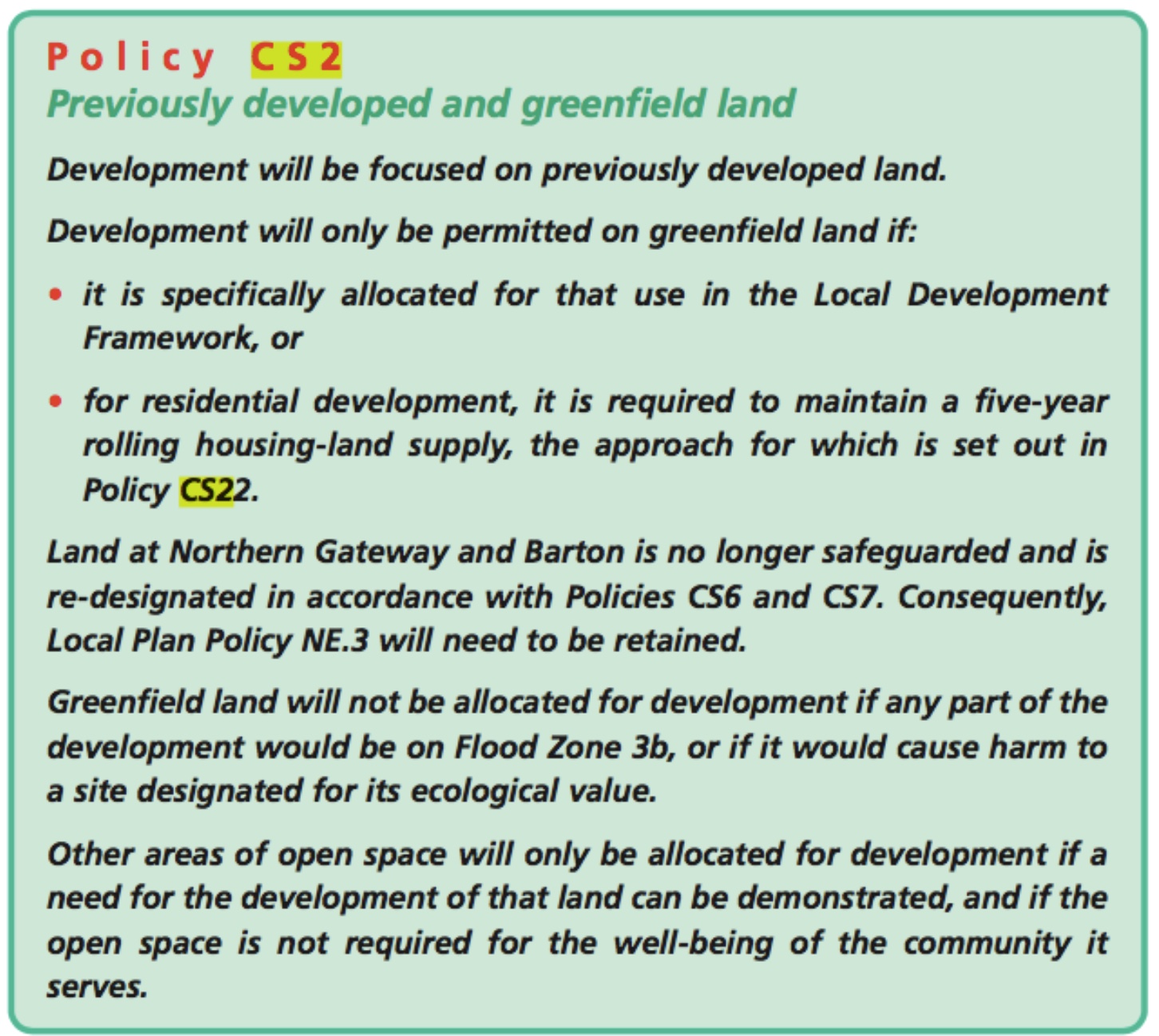
cs2

Within Oxford City Council’s main strategic planning document, the Core Strategy, Core Strategy 2 (CS2, see above) states:

‘Greenfield land will not be allocated for development if any part of the development would be on Flood Zone 3b.’ 

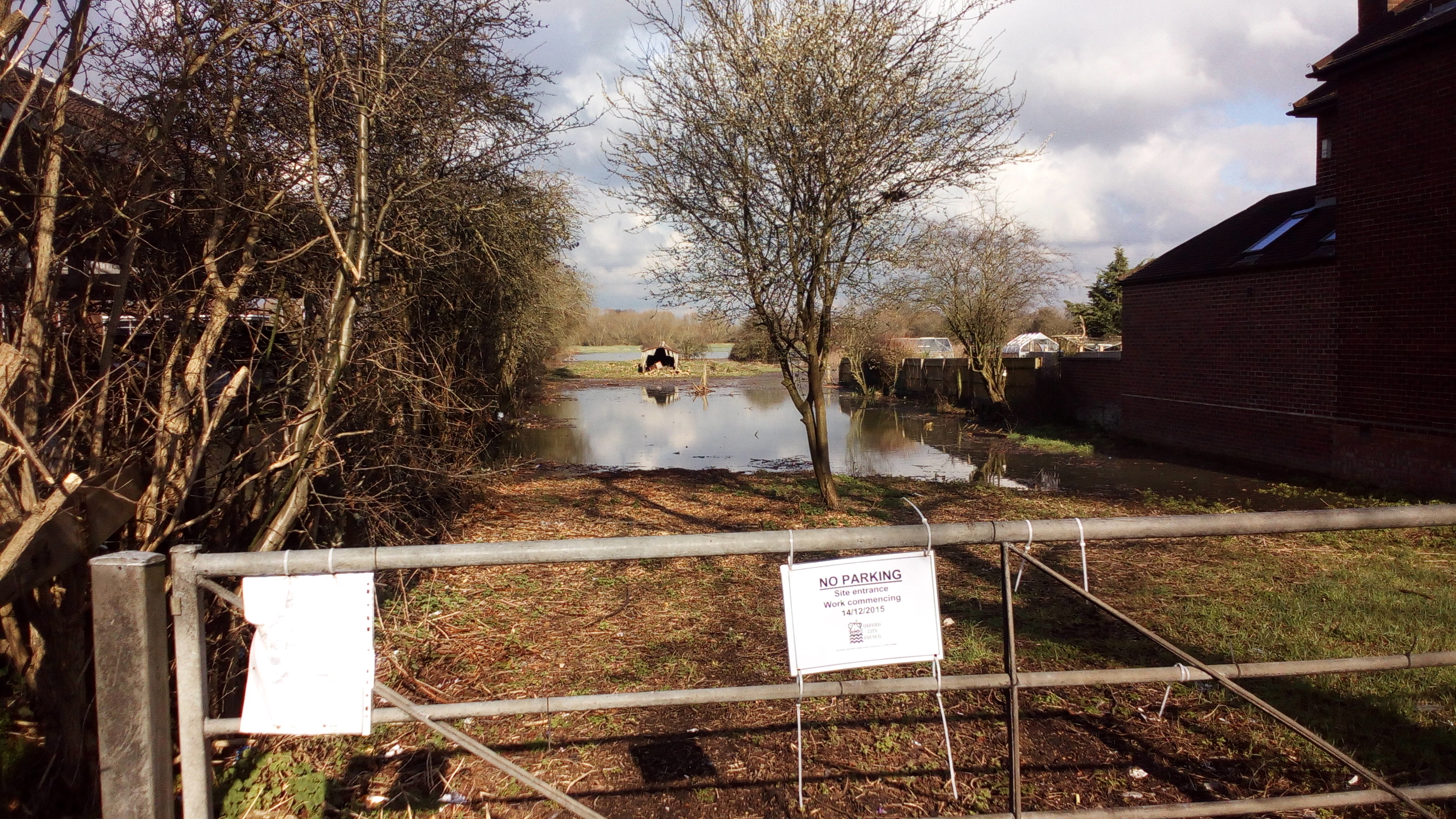
Our comment: The proposed site for the new car park is greenfield, and in functional Flood Zone 3b.

CS2 also says that ‘development will only be permitted on greenfield land if it is specifically allocated for that use in the [Oxford City Council’s] Local Development Framework’.

Our comment: This site is not so allocated.

Core Strategy 11 (CS11) says:

‘Planning permission will not be granted for any development in the functional flood plain (Flood Zone 3b) except water-compatible uses and essential infrastructure.’

Our comment: The proposed site is neither ‘water-compatible’ (a category intended for developments such as marinas), nor ‘essential infrastructure’ (which includes projects such as water treatment works, or roads which have to pass through a floodplain).

In our view the position could not be clearer – this proposal is, in fact, precisely the kind of development that the Council’s own strategic planning policy is there to prevent.

Seacourt P&R – Key Point 3: NPPF


National planning policy framework (NPPF) guidelines strongly recommend against the positioning of developments that are categorised (in this case according to the Environment Agency) as ‘less vulnerable’, in Flood Zone 3b, functional floodplain.

Sir Michael Pitt’s report on the severe and widespread summer floods of 2007 said there should be ‘a presumption against building in high flood risk areas in accordance with PPS25’ [now NPPF]  (Pitt Review; ‘Implementation and Delivery Guide, 2008: Final Recommendation 7). The guidance should be ‘kept under review and strengthened if and when necessary’ (Final Recommendation 8).

The title of Sir Michael Pitt’s report is ‘Learning Lessons from the 2007 Floods’. This development is far from being essential and NPPF should be adhered to. To do otherwise would set a very dangerous precedent.

See Key Point 1 and Key Point 2

Dedicated pump for Earl Street

http://www.itv.com/news/meridian/2017-01-13/oxford-street-gets-dedicated-flood-pump-after-securing-grant/

The link provides an excellent report, including a video, about the arrival of a new pump, dedicated to flood protection for Earl Street.  In case that stops being available online here is an extract from the report, with acknowledgement and thanks to ITV:

“Today residents in Earl Street were shown a new, dedicated, mobile pump that will be available to them in the event of future floods.

Nick Hills, an Earl Street resident and member of the Oxford Flood Alliance Steering Group, applied for a grant to pay for the pump after becoming aware of Scottish and Southern Energy Network’s Community Resilience Fund. The energy company awards grants of up to £20,000 to community projects. His bid was successful and SSE awarded the full cost of the pump, which had been reduced to £19,830 by Stuart Pumps Ltd, which provides the City Council with its pumps.

Whilst we in Earl Street have been extremely well served by the local authorities in terms of flood avoidance, protection and resilience, there have been occasions in the early stages of a flood when we were desperately waiting for a decision to be made by both the Environment Agency and the City Council as to where they should deploy their limited number of mobile auxiliary pumps.
Understandably, it was impossible for either of these agencies to guarantee that we would have a pump deployed here in Earl Street while the situation was still evolving.
Now we have our own pump, as soon as the water starts to rise, we can say ‘can we have our pump?’ and it guarantees that it will be here when we need it.  – Nick Hills

 
Local MP, Nicola Blackwood, attended the pump’s unveiling today. She said while shorter-term flood projects like this are crucial, a planned flood relief channel will be a ‘game-changer’ when it comes to reducing flooding risk in the long-term.The £120m project would work by diverting flood water across the open flood plain and away from properties which currently flood.”

Finally, a big thanks from all concerned to Scottish & Southern Electricity Networks, who very generously funded the pump from their Community Resilience Fund.
 

Another letter about Seacourt P&R

Our letter published in the Oxford Times, 29 December 2016

We wrote recently about Oxford City Council’s proposal to extend the Seacourt Park & Ride into the flood plain, providing 658 extra parking spaces.

Now we read that the very same council wishes to abolish 270 parking spaces at Redbridge in order to develop a recycling facility. The core argument put forward by the City Council to justify their proposal at Seacourt is that extra car parking is so badly needed that it should be allowed even though the expansion site is in Green Belt and functional floodplain, and despite the fact that it is clearly contrary to national planning guidance and could put vehicles and people at risk during a flood. The Redbridge plans now make nonsense of the special case being advanced for Seacourt.

If that is not enough, the budget for construction of an extension at Seacourt has recently doubled from about £2 million to £4.1 million. The City Council Executive Board papers for 15 December 2016 show projected net revenue from the Seacourt Park & Ride extension of £160,000 a year, and this relies on an increase in parking charges from £2 to £3 possibly starting in autumn 2017.

At this rate the investment would take more than 25 years to pay back. If this figure assumes that the car park remains fully operational and doesn’t ever flood, when in reality it will do so virtually every year causing closure and expensive maintenance, the payback time will be even longer than 25 years.

We are discussing our concerns with the City Council as we believe that their proposal is ill-conceived and unjustifiable and that it should be abandoned before any more money is spent.

Maintenance of Weirs Mill Stream

Environment Agency contractors have been working on the Weirs Mill Stream and nearby this month. We helped identify the need for this maintenance (see 2015 APM report para 3). The work will  improve conveyance of water through this important part of the Oxford river network. It is above and beyond the usual annual maintenance programme and is being paid for using additional funds which the Environment Agency received from The Treasury following last winter’s flooding.


Seacourt P&R – Key Point 2: Covenant, what covenant?

The Planning Statement for the application to extend Seacourt P&R states (para. 6.74):

” Consideration was given at an early stage in the design development to provision of a decked car park on the existing P&R site. This is not feasible because the existing P&R site is not within the Applicant’s freehold ownership and there is a legal covenant on the land which prohibits the construction of any buildings…”

That is to say, the rationale for an extension being needed, as opposed to raised decking on the existing car park, is that there is a covenant on the existing car park land which prevents the latter. We have asked the applicant if we can see the reported covenant but no such has been produced. Nor can we find one on searching the Land Registry. What we have been shown is an extract of what seems to be a form of lease agreement (not a covenant) on the existing car park. Such an agreement could potentially be varied by negotiation with the landlord.

See Key Point 1 and Key Point 3

National Flood Forum

Conference

The NFF is organising a one-day conference and evening reception ‘Are We Planning to Flood?’ in London on Wednesday 1 February 2017. See http://www.nationalfloodforum.org.uk/nff-conference-2/

Bulletins

The November and December 2016 NFF bulletins are now available on our Library page.

Letter to the Oxford Times (8 Dec)

Letter from us published in the Oxford Times of 8 December 2016

The proposed extension to Seacourt Park & Ride is one of the worst planning proposals we’ve seen for some time. In 2013, after much public consultation, the City Council adopted a Core Strategy to guide development in the city over the next period. Core Strategy 2 includes the statement: “Greenfield land will not be allocated for development if any part of the development would be on Flood Zone 3b.” The proposed extension to the Park & Ride is a greenfield site in Flood Zone 3b, the functional flood plain. How can this be? The planning documents don’t explain. Although the documents include a review of relevant local policies, Core Strategy 2 mysteriously doesn’t get a mention. What’s driving the application is a worry about short-term problems with traffic congestion on the Botley Rd pending completion of new Park & Rides at Eynsham and Cumnor. How does this short-term need justify departing from core strategy? National planning policy is designed to encourage local authorities to take a strategic approach to planning, thereby avoiding the need for this kind of last minute quick-fix nibbling away at the floodplain.

Apart from the obvious conflict with planning policy, the application is riddled with errors. The Flood Risk Assessment says that the most recent flooding event at the site was 2008, ignoring the major disruption in the winter of 2012/13, and the serious floods in early 2014. The FRA completely fails to take account of the fact that the site floods frequently, and proposes a design which will quickly degrade as a results of flood damage and silting. There is serious risk in the event of a major flood of large sections of the car park breaking up and washing into the flood channel. It’s a nonsense and needs to be stopped.

Seacourt P&R – Key Point 1: a clash with OFAS?


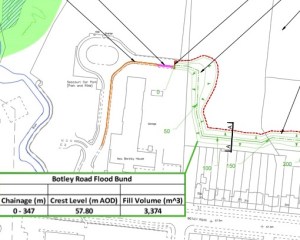
The first image is a part of a plan, from the Environment Agency, of the proposed Oxford Flood Alleviation Scheme (OFAS) north of the Botley Road. This shows (as at 16 September 2016) that a key flood defence bund is planned for that scheme, running through the area where the car park extension is proposed.

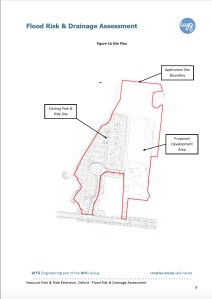
The second image shows the area for the proposed extension to the Seacourt P&R.

It is not clear that the bund and the car park extension could co-exist. OFAS will reduce the risk of flooding in Oxford, vital for people and the future prosperity of the city, not least in the face of climate change. The car park extension proposal is flawed in many ways;  the plan should be dropped.

See Key Point 2 and Key Point 3

Seacourt P&R planning application vs. proposals for Redbridge P&R – comment

We have made further comments (our fourth) on the Seacourt P&R planning application to the Planning Officer today, 19 December 2016:

Planning Application 16/02745/CT3

We wrote to you earlier with regard to the validity of the so called ‘sequential test’ carried out for the Seacourt P&R extension. In addition to our previous argument about the existence of an option of negotiating with the landlord to erect decking on the current site, we have further grounds for objection to the ‘sequential test’.

The City Council Executive Board papers for 15 December 2016 include proposals for removing 270 parking spaces at Redbridge to accommodate a new waste transfer facility. It appears there is excess capacity at Redbridge P&R. The analysis of occupancy of Redbridge and Seacourt P&Rs included in the Executive Board papers, show that there is existing spare capacity at Redbridge, and but for the planned waste facility this could relieve Seacourt during the week. There is also capacity at both car parks sufficient to adsorb expected increases in weekend traffic once the Westend development completes.

The Planning Statement for the Seacourt extension makes no mention of the surplus capacity available at Redbridge. The review of Redbridge in the ‘sequential test’ simple says that there is limited scope to ‘expand’ Redbridge. This is deeply misleading. There is clearly scope to redirect surplus traffic from Seacourt to Redbridge, which might be achieved at no cost simply by use of differential pricing – i.e. making Seacourt more expensive. In the Seacourt application we’re told Seacourt has to expand because there isn’t an option at Redbridge. But the Redbridge proposal is using the possible expansion of Seacourt to justify closing parts of Redbridge. So the need to expand Seacourt is at least in part being created by the Council’s wish to re-purpose part of the Redbridge site. This is clearly an unacceptable justification for the Seacourt extending into the floodplain on Green Belt land.

Given the existence of sufficient capacity to deal with any increased weekend traffic related to the Westend, the arguments for the extension, contained in 3.20 of the Planning Statement, appear extremely general. Is this really the best justification the Council can offer for breaching its own core strategy, national policy on Green Belt, and guidance on development in the floodplain? The justification for this move appears to rely wholly on longer term projections about potential increases in traffic resulting from a growth in the city and county during the next 15 years. Such needs should be addressed through a strategic planning process.

We understand that the Council has to increasingly rely on the revenue it earns, and perhaps the real, unstated reason why this proposal has come forward is financial. But even this doesn’t make sense. The capital cost has now doubled from the original budget to £4.1m. Extra income from the extension, assuming rates increase from £2 to £3 a day, is projected at £160,000 a year according to the Executive Board papers. Even assuming this revenue is achievable the investment would take more than 26 years to pay back, and that is without discounting for the cost of capital. If, as we believe is likely, the site floods regularly, has to be closed part of the year, and faces significant maintenance costs, the payback period will be much longer.

This scheme is a nonsense and should not proceed.