Butterfly monitoring – year 2 results

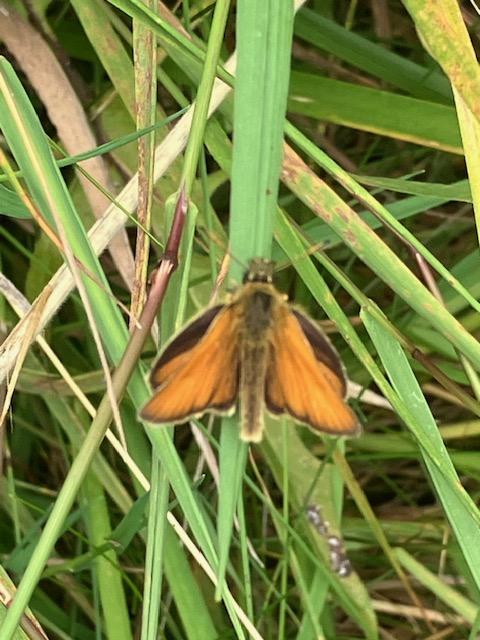
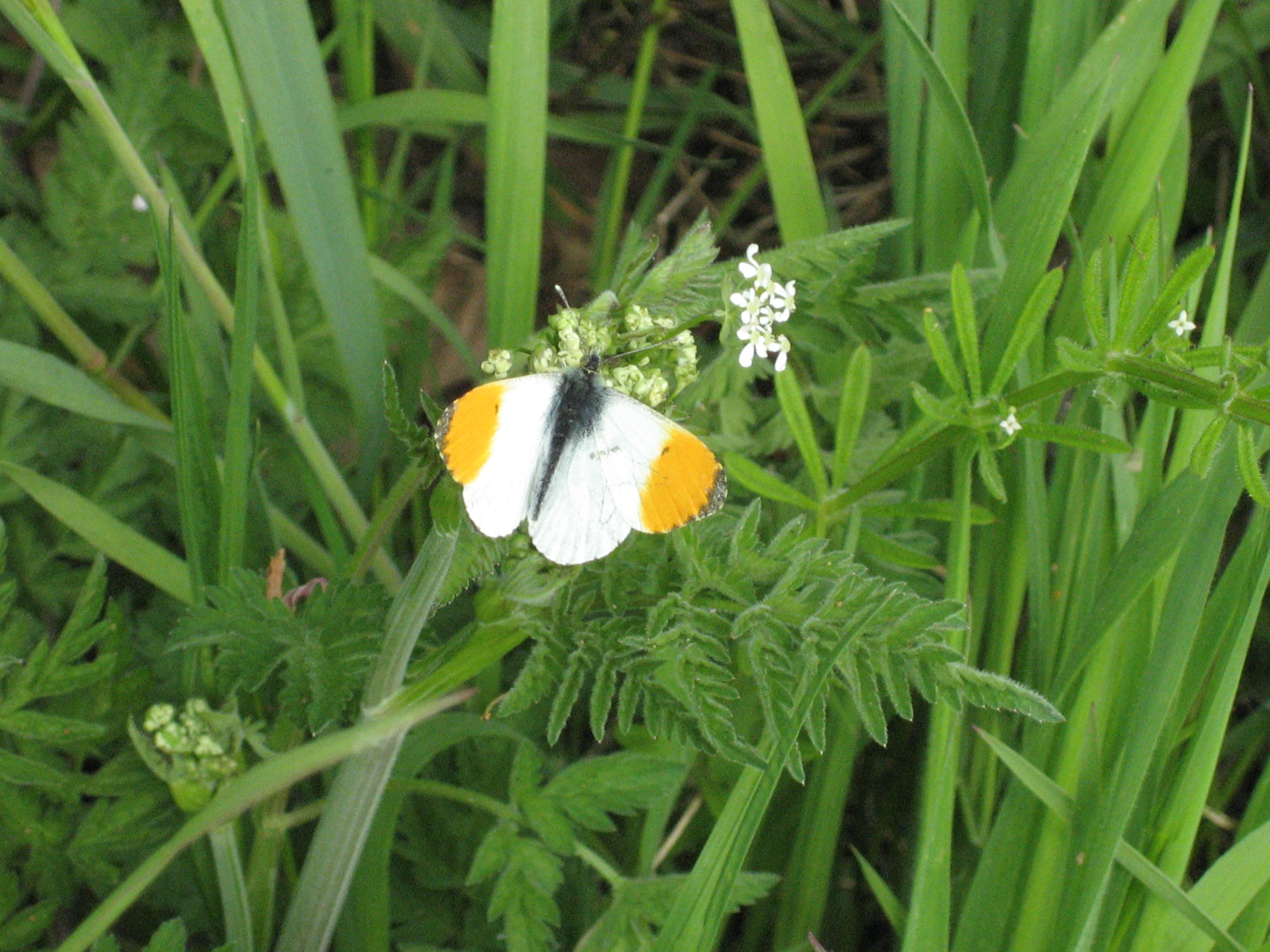
As part of our commitment to ensuring the Oxford Flood Alleviate Scheme delivers a benefit for wildlife we have continued to survey butterflies in the Oxford floodplain this year. A group of us take turns to record butterflies along a fixed route each week from 1 April to 30 Sept. The route, called a ‘transect’ , is registered with the UK Butterfly Monitoring Scheme. Our surveying follows the methodology set out by UKBMS and we submit data to it.

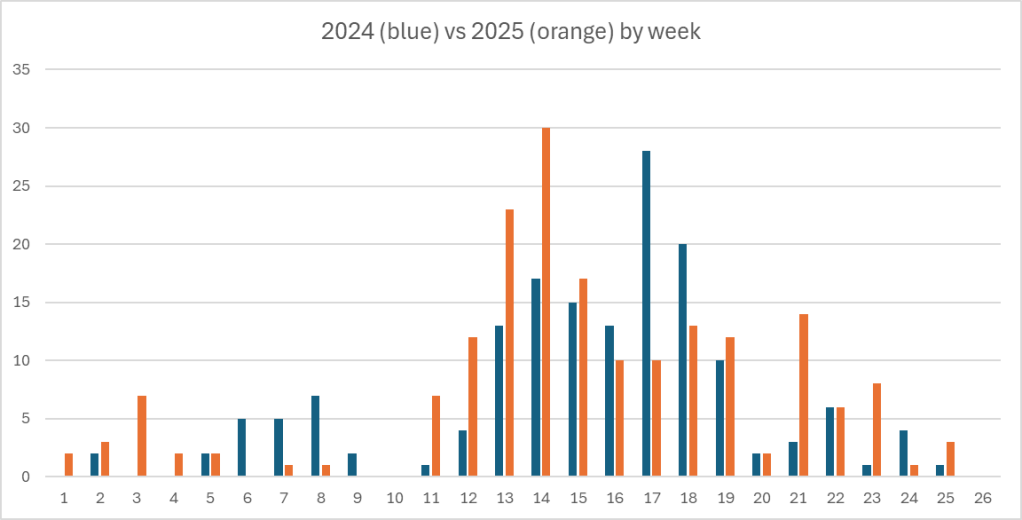
This year saw an increase in the number of butterflies recorded compared to 2024 which was a poor year nationally. Also, many species emerged earlier than is normal because of the warm spring and summer. The number of species recorded was similar to last year, but with a few differences in the species list.

Numbers of butterflies recorded by week 2024 vs 2025

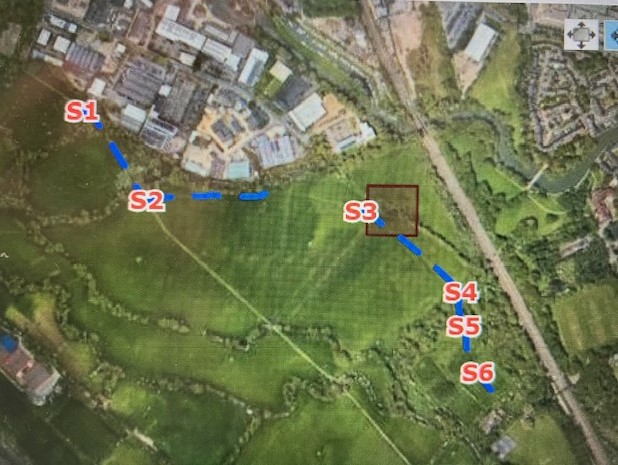
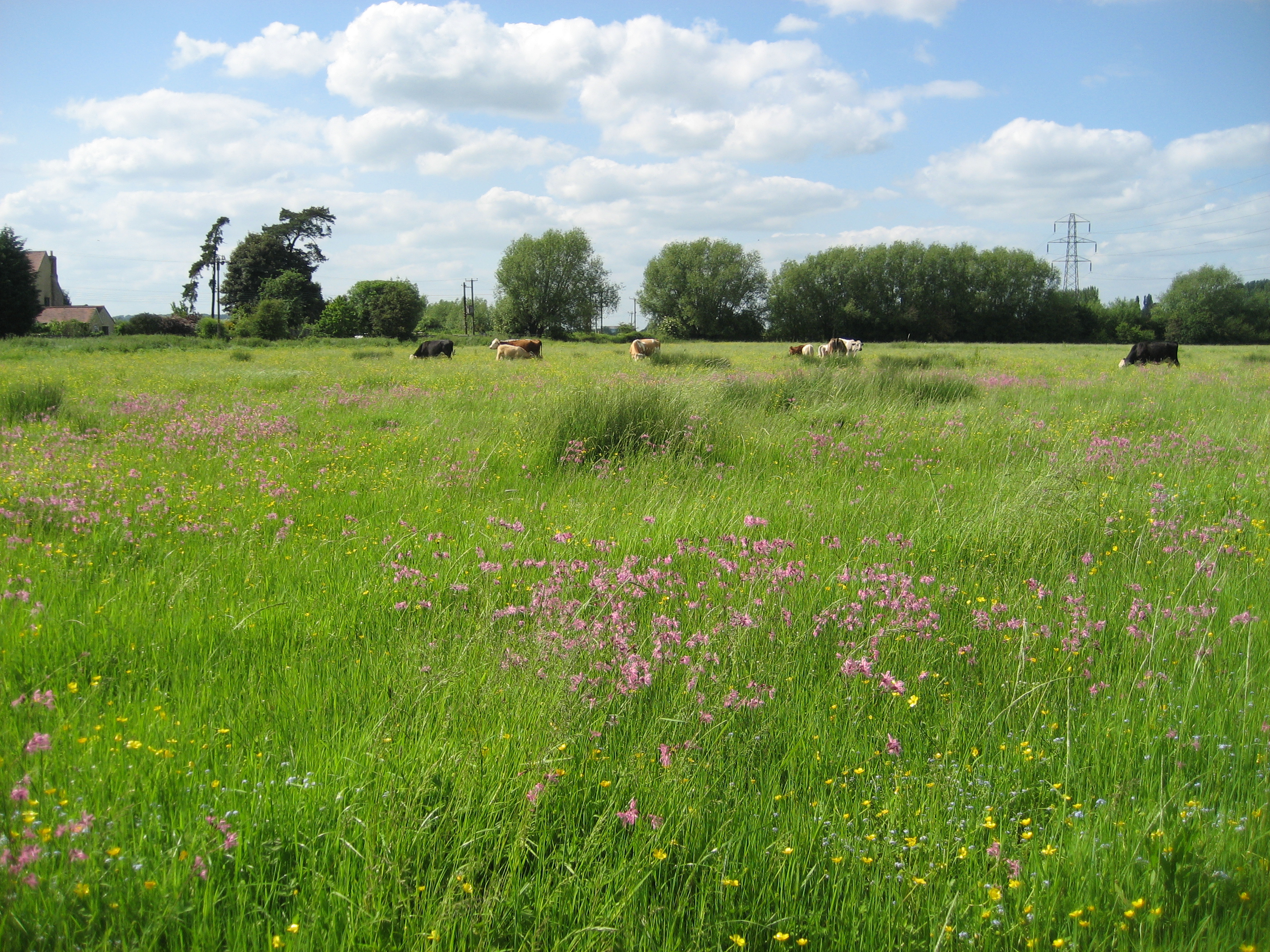
The transect is divided into six sections each of which represents a different type of habitat. The main difference in results this year was the big increase in butterflies recorded in section2, along the southern edge of the Bulstake Stream just south of Osney Mead. Most of the butterflies in this section were recorded in areas close to telegraph poles and a hedge where the grass was not cut all year. This suggests that a different management of the meadows, with some areas left uncut, would boost butterfly numbers.

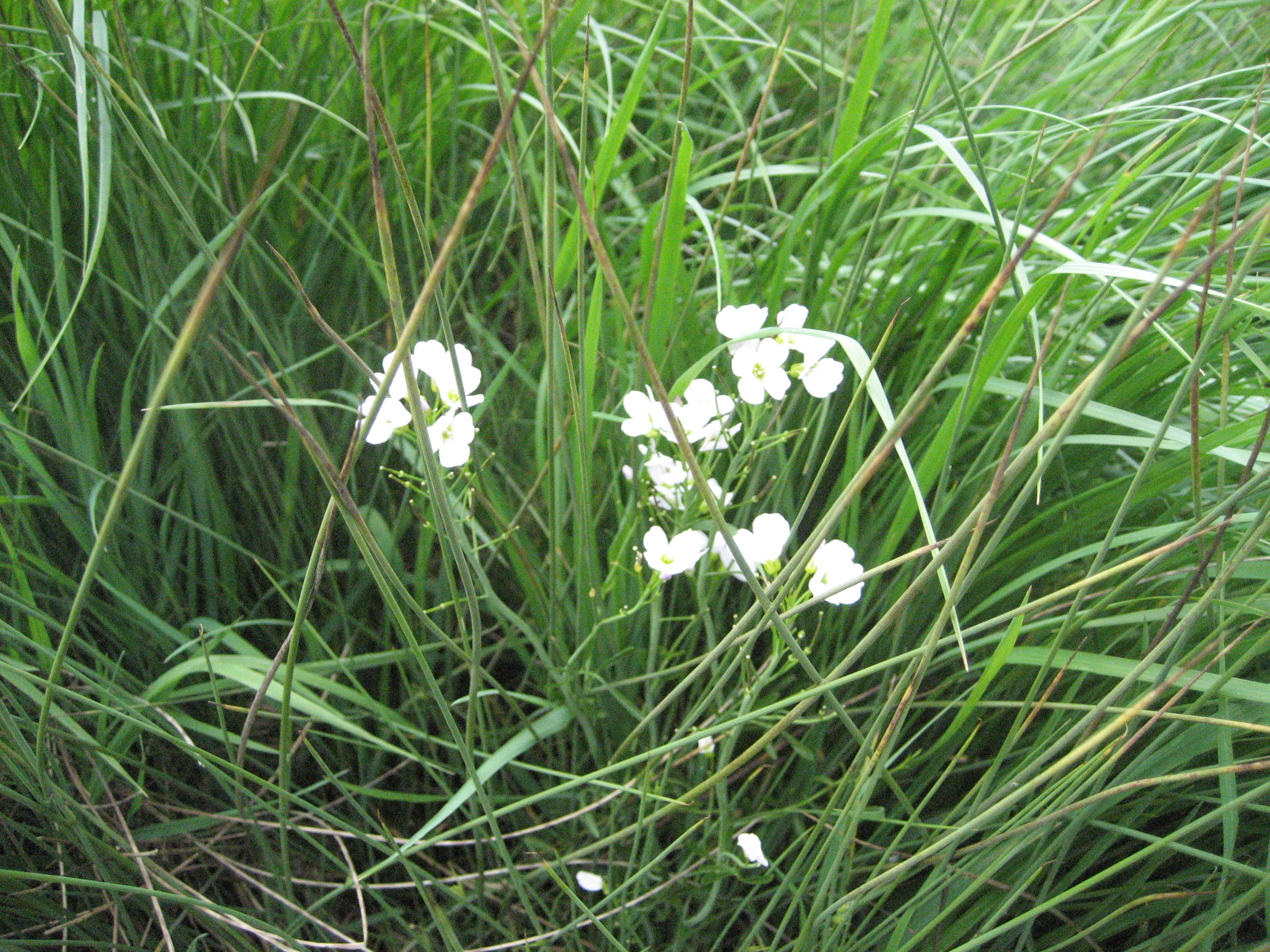
The grass in the meadow was mowed three times this year, with an impact which can be seen in the low numbers in section 3. Sections 5 and 6 are scrub and meadow at Hogacre Eco-park were we see the highest numbers and a greater range of species.

This data has been shared with the Environment Agency with whom we are talking about ways to enhance butterfly numbers as they acquire land for the scheme (sections 1-3), begin to manage it differently, and plant more hedgerows and trees. We also share our data with the Hogacre trustees with whom we collaborate.

We have access to data from transects at Chilswell Valley, across the A34 from South Hinksey, and Oxford University Farm at Wytham. Butterflies are far more abundant on these other transects compared with the floodplain, which again suggests significant room for improvement.

A Common blue butterfly

Major step forward for flood alleviation scheme

The Secretary of State, at DEFRA, Steve Reed, has approved the compulsory purchase order for the Oxford Flood Alleviation Scheme. This now enables the Environment Agency to proceed with acquiring the land needed to build the scheme. The decision follows a public inquiry into the CPO held at the end of 2023. The planning inspector who chaired the inquiry rejected the arguments of objectors and recommended implementation of the scheme as proposed by the Environment Agency.

In making this announcement both Steve Reed and Emmy Hardy, the floods minister, make it clear the government is fully behind the scheme and are committed to seeing it delivered.This is hugely welcome news.

Here is the full text of the DEFRA/EA press release:

New scheme in Oxford to protect every home and business from risk of River Thames flooding

  • Environment Secretary Steve Reed approves purchase to allow new scheme to be built
  • The scheme is part of the record £2.65 billion being invested in flood protection over two years

All homes, businesses and crucial infrastructure in Oxford at risk of flooding from the River Thames will be better protected thanks to a major new flood defence.   This will provide vital reassurances for more than 160,000 residents in the face of our changing climate.  

In another step under the Government’s Plan for Change, Environment Secretary Steve Reed gave crucial approval to the Environment Agency and its partners to purchase land and grant rights within the flood scheme area, which has enabled the flood scheme to progress.  

This project is part of the Government’s record two-year investment of £2.65 billion to build and repair flood defences across the country.  

Floods Minister Emma Hardy said:  

“The role of Government is to protect its citizens, but flood defences were inherited in their worst condition on record.  

“Through our Plan for Change, a record £2.65 billion is going into building and repairing flood defences over the next two years.  

“The Oxford Flood Alleviation Scheme is a vital new piece of infrastructure that will deliver economic growth in Oxfordshire, better protect homes and businesses and deliver new jobs.”  

Robbie Williams, Project Director for the Oxford Flood Alleviation Scheme, said:  

“We’re delighted to have received approval to progress with purchasing the land needed for the Oxford Flood Alleviation Scheme to go ahead.  

“This is a major step forward for the project, ensuring we can bring this vital flood protection to the city. As we face increasingly unpredictable and extreme weather, the Oxford Flood Alleviation Scheme is more urgently needed than ever.  

“We can now all look forward to starting work on putting the scheme into place.”  

This follows the earlier good news that Oxfordshire County Council resolved to grant planning permission for the scheme – this decision is separate from the Compulsory Purchase Order.  

The Environment Agency made a Compulsory Purchase Order for the land, which – as there were objections from some of the landowners – went to a public inquiry. An independent Inspector listened to the objections and to the case for confirming the order and reported her recommendations to the Secretary of State to make a final decision.  

The new scheme is designed to cope with major floods of a scale Oxford last experienced in 1947. This is far bigger in size than any of the floods Oxford has experienced in recent decades. With a changing climate, it is expected there would be more frequent heavy rainfall leading to potential flooding.  

The Oxford Flood Alleviation Scheme is designed to work with the natural floodplain to the west of Oxford, which will be lowered to increase its capacity. A new stream will be created, fed by the River Thames, meandering through gently sloping grazing meadows. People will be able to walk and cycle alongside the new stream, with views of wildflowers and wetland.

The Oxford Flood Alleviation Scheme aims to enhance the natural floodplain to the west of Oxford by lowering it to increase its capacity.  

With the Compulsory Purchase Order confirmed, the Environment Agency can now exercise its statutory powers to acquire the rights and interests in the affected land. Once this process is complete, construction is expected to start in late 2026.  

Led by the Environment Agency, the Oxford Flood Alleviation Scheme is one of the biggest flood schemes currently proposed in England.  

Tracking future biodiversity trends

As part of OFA’s commitment to improving biodiversity in the west Oxford floodplain, steering-group member Simon Collings has been recording butterflies in the area. In 2023 he carried out a survey of species present in the floodplain and shared the results with the Environment Agency ecologists working on the Oxford Flood Alleviation Scheme. This year (2024) Simon set up a transect under the UK Butterfly Monitoring Scheme (UKBMS) . He and two volunteers conducted weekly surveys from April to September. Results have been shared with the EA.

The 1 km transect route starts on the Electric Road near Osney Mead, follows informal paths across the meadow to the south of the Bulstake Stream, and finishes at Hogacre Eco Park. The route was planned with the directors of the Eco Park, and with the EA ecologists.

Why is OFA doing this?

‘The idea was to establish a baseline prior to the EA building the flood alleviation scheme,’ Simon explains. ‘I knew from surveying in 2023 that Hogacre is relatively rich in butterflies. The Hogacre trustees are keen to gather more data on biodiversity at the site and the formal methodology of the transect helps provide some of that. The first three sections of the transect, in contrast, are across land where the EA will be introducing improved species-rich grassland, hedges and trees. Over time the butterfly population here should increase.’

This year has not been good for butterflies, with numbers down hugely across the UK. This is reflected in the results obtained locally compared with Simon’s observations in 2023. A total of 161 butterflies, representing 18 species, were recorded along the transect. Of these 122 (76%) were in the scrub and meadow at Hogacre. The most commonly recorded species were meadow brown (48) and gatekeeper (45).

How does it help improve biodiversity?

The transect methodology gives a measure of relative abundance which can be compared with other sites and which can be tracked annually to show increases or declines in populations and species. Butterflies are highly sensitive to changes in the environment and for this reason are used nationally as an indicator of environmental health.

Surveying on the transect uses a precise methodology and the records submitted to UKBMS are checked by an expert. Simon’s 2023 sightings were submitted to iRecord where again records are verified by experts.

‘OFA sees the biodiversity elements of the flood alleviation scheme as an opportunity to support wildlife in the area,’ Simon says. ‘To maximise this we want to engage local people in citizen science and conservation activity, working in partnership with the EA.’

Landowners in the area, including some Oxford University colleges, are already involved in floodplain-meadow restoration. There are a lot of resources in the city to draw on. OFA believes we could create something significant here which connects up with other biodiverse areas in the county. The river system is an obvious wildlife corridor.

Simon is a member of Butterfly Conservation and also records on a 4.5 km UKBMS transect at Wytham run by the Centre for Ecology and Hydrology. More information on butterflies at Hogacre can be found here.

County ecologist supports OFAS biodiversity plan

Beccy Micklem, Landscape and Nature Recovery Team Leader at Oxfordshire County Council has confirmed that she is now satisfied the OFAS scheme can meet its targets in relation to biodiversity net gain. This follows the submission of ‘letters of comfort’ by the Environment Agency and three landowners confirming that land is available to provide offsite biodiversity compensation.

Ms Micklem’s updated response to the case officer says: ‘Following delivery of off-site habitat creation, the scheme will result in net gains of 11.24% area habitats, 11.66% hedgerows, and 15.22% watercourses. Provision of letters of comfort from landowners with whom the applicant is engaging with regards delivery of offsite BNG (Blenheim Estate, the Earth Trust and Oxford City Council) have recently been submitted, providing increased certainty that the necessary provision of offsite BNG will be deliverable.
Should you be minded to grant planning permission, a number of planning conditions and obligations will be needed to secure measures to conserve biodiversity and deliver a net gain.’

The document goes on to set out the specific conditions which should be attached to planning consent. This would appear to unblock the final obstacle to the scheme securing planning permission. We are hoping the application will now go to the 3 June meeting of the County Council planning committee.

The updated response and the letters of comfort are on the County planning portal.

Reducing flood risk by improving biodiversity

Can improving biodiversity in Oxfordshire contribute to reducing flood risk? We think it can and there are conversations taking place across the county which could move this forward.

Oxfordshire County Council is developing a Local Nature Recovery Strategy (LNRS) for the county. This flows from the 2021 Environment Act and government commitments to improve biodiversity across the UK. Oxford Flood Alliance has been participating in consultation meetings on the strategy. We’re interested in ways natural flood management in the catchment can help reduce flood risk.

The County is using expert advice alongside wide-ranging public consultation. Twelve workshops were held in March involving more than 300 participants, including conservationists, farmers and local government officers. A survey of local people received 650 responses. Results of these engagement activities were presented in an online meeting on 9 May attended by more than 100 people.

What matters most?

The two issues that gained the widest support from these consultations were improving the quality of our rivers and freshwater habitats and stopping river pollution from sewage and agricultural runoff. Benefits expected to come from this included reduced flooding (number 2 for the workshops and 3 in the survey result). There was also strong support for an end to building in the floodplain.  Thames Water cleaning up its act is critical to reducing pollution.

Simon Collings from OFA asked how reducing flood risk would be reflected in the priorities for  the strategy. Chloe Edwards, who leads on this work at the County Council, said this would be through identifying habitat improvements which included natural flood management to benefit properties and/or farmland. She said she expected this to be a significant component of the strategy.

How could this reduce flood risk?

LNRS is not the only county-wide strategy for dealing with flood risk, or even the main one, but slowing runoff and improving storage upstream across the Thames catchment could help. To see an example of this in action watch this video about the Evenlode Catchment Project. (The section of flood management starts around 9 mins in.)

Another example is outlined in the Bernwood, Otmoor, and Ray (BOR) strategy developed by BBOWT. The River Ray drains into the Cherwell, which joins the Thames in Oxford. The BBOWT plan is to create wetland areas which would slow the discharge of water from the Ray into the wider river system. Working with farmers will be critical in achieving this. The LNRS will incorporate existing initiatives like these as building blocks.

What does it mean for OFAS?

These strategies are not an alternative to the Oxford Flood Alleviation Scheme but they could help as climate change takes effect. They are also important for the survival of our wildlife. Connecting up areas of surviving biodiversity is seen as a key objective of the strategy. The OFAS scheme is designed to deliver biodiversity net gain as well as flood protection. The project could contribute to the creation of more joined-up habitat across the county.

The LNRS is intended to provide a focus for government funding decisions and a basis for various actors to collaborate. But it won’t be the only game in town. It is envisaged that there will still be a lot of other activity taking place over and above what’s included in the strategy.

OFAS: Environmental meeting

OFA attended a briefing yesterday (22 May 2018) on the Environmental Statement which forms part of the OFAS planning application. This was organised by the Environment Agency (EA) specifically for local environmental groups. Penny Burt, Phil Marsh and Graham Scholey for the EA covered different aspects of the scheme, and provided updates on the various environmental assessments being conducted.

The scheme will result in the creation of a continuous area of marshy meadow either side of the new channel with various scrapes and ponds to enhance the habitat value. Overall biodiversity should be improved and strengthened.

But there are downsides. Rich grassland meadow in some areas will be lost, and while there are plans to create more of this habitat elsewhere in the scheme this is not without risk. Trees will be lost in some areas, though compensated for elsewhere. Some views will change significantly, e.g. along Willow Walk, and at Kendal Copse just north of Kennington.

Several useful comments were made by participants in the meeting about ways to enhance environmental benefits from the scheme which the EA will think about.

Ongoing effective management of the project will be critical and the Environment Agency is now exploring detailed proposals around this with various local wildlife organisations. OFA welcomes the idea of collaboration between the EA and local bodies, but is arguing that whatever arrangements are set up there needs to be a mechanism of accountability to the public, so that local interested parties can understand what is being undertaken, and what achieved – both for flood relief and for wildlife.