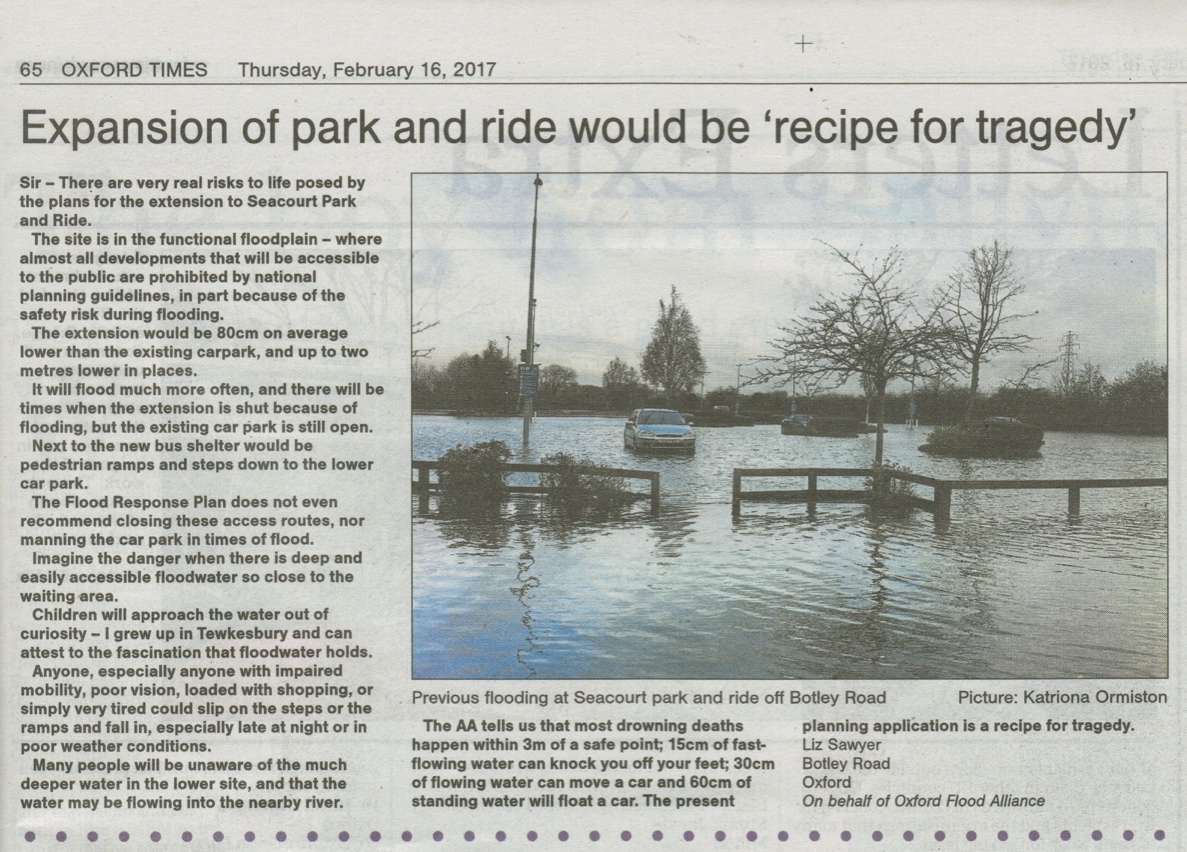
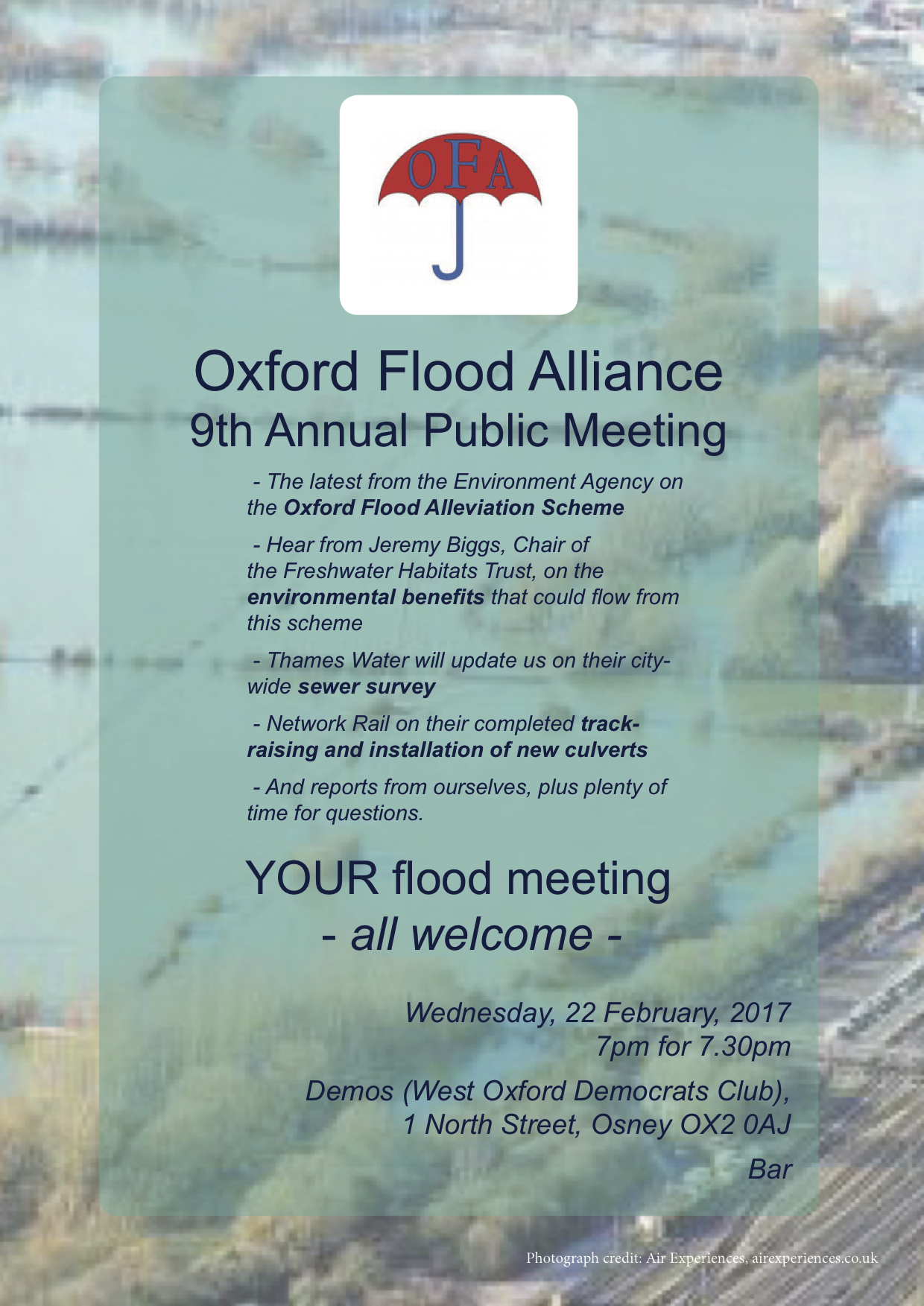
We have a letter published in this week’s Oxford Times (click image to enlarge)
Seacourt P&R in the Oxford Mail; smart signs, plus risk to life
This article in the Oxford Mail talks about the possibility of ‘smart signs’ – electronic boards – on the ring road, to alert drivers to where there are empty park and ride spaces around Oxford. This could obviate the (claimed) need to increase the number of spaces at Seacourt, instead pointing drivers to (say) nearby Redbridge. According to an earlier report in the Oxford Mail there is apparently so much spare capacity at Redbridge that the City Council proposes to remove 270 parking spaces, and is quoted in the newspaper as saying that the loss of these spaces would be ‘marginal’.
It seems to us to be inconsistent for the City Council to argue that removing 270 spaces at Redbridge is perfectly ok, while at the same time arguing a burning need to build new spaces at Seacourt – in the floodplain, on Green Belt land, contrary to local and national planning guidance and, as far as the present application goes, creating a potential risk to life (see towards the end of the first newspaper article and our previous post). Never mind the cost, which has already risen from about £2million to over £4 million.
Our Annual Public Meeting, 22 February
Seacourt P&R extension proposal: potential risk to life
- Flood damage in Tewkesbury in 2007, wall demolished, tarmac torn up. .Photograph by kind permission of Steve Goodchild.
Liz Sawyer, who recently joined the OFA Steering Group, addressed Oxford City’s Full Council on 6 February 2017, about the potential risk to life posed by the proposed extension to Seacourt P&R.
There is also, as the photograph above shows so vividly, the potential for damage to the car park itself – and of course to vehicles. The Automobile Association’s ‘Flood Facts’ quoted in Liz’s address set out the risks of floodwaters very clearly.
Liz’s address can be downloaded here (pdf).
Seacourt P&R – Key Point 5: Green Belt
The proposal is inconsistent with both national and local Green Belt policy:
- The site is in the Oxford Green Belt where the presumption is that development is inappropriate. Preservation of ‘openness’ is a key objective of Green Belt policy, The NPPF places great emphasis on it. Attempting to hide the development from view by landscaping does not constitute preserving openness.
- The proposal will also clearly breach Oxford City’s own Core Strategy key policy CS4 for the protection of Green Belt land.
South Hinksey ‘barrier-ready’ works all but complete
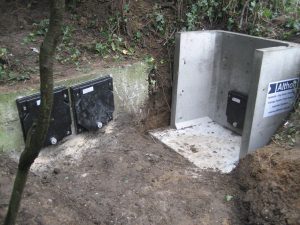
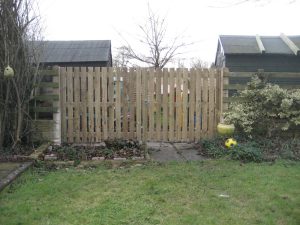
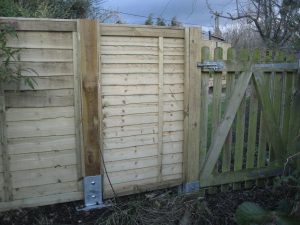
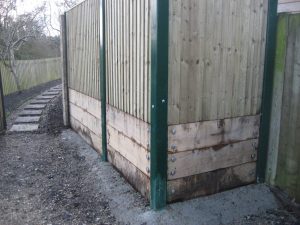
In South Hinksey, the works designed to make deploying temporary defences, should flooding threaten, quicker and easier, are almost complete.
Three flap valves have just been installed on pipes which connect into field ditches. These non-return valves will allow water out from within any temporary barrier but not allow it back in from the flooded area outside.
Elsewhere wide garden gates have been installed, reinforced fences built, and removable fence panels fitted.
A very few minor snagging items remain, but the scheme is otherwise complete and fully ready for temporary barriers. Many thanks to the Vale of White Horse District Council for funding and to the Environment Agency for organising the work – not least to engineer Magnus Williams who has managed the scheme from its inception to its completion. Thanks too to farmer Nick Frearson, and to the horse owners for their cooperation during the works.
- South Hinksey: preparing to fit non-return flap valves
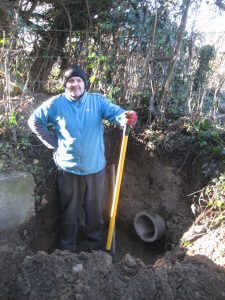
- Site around a pipe which drains a ditch cleared, preparatory to installing a pre-cast header wall with integral flap valve
- Job done
- New gate, wide enough to accomodate temporary barriers
- New garden gates, again wide enough to take a barrier
- Removable fence panel and posts to accommodate a barrier
- Reinforced fence, forming a permanent barrier at this point
Seacourt P&R – Key Point 4: Oxford City’s Planning Strategy
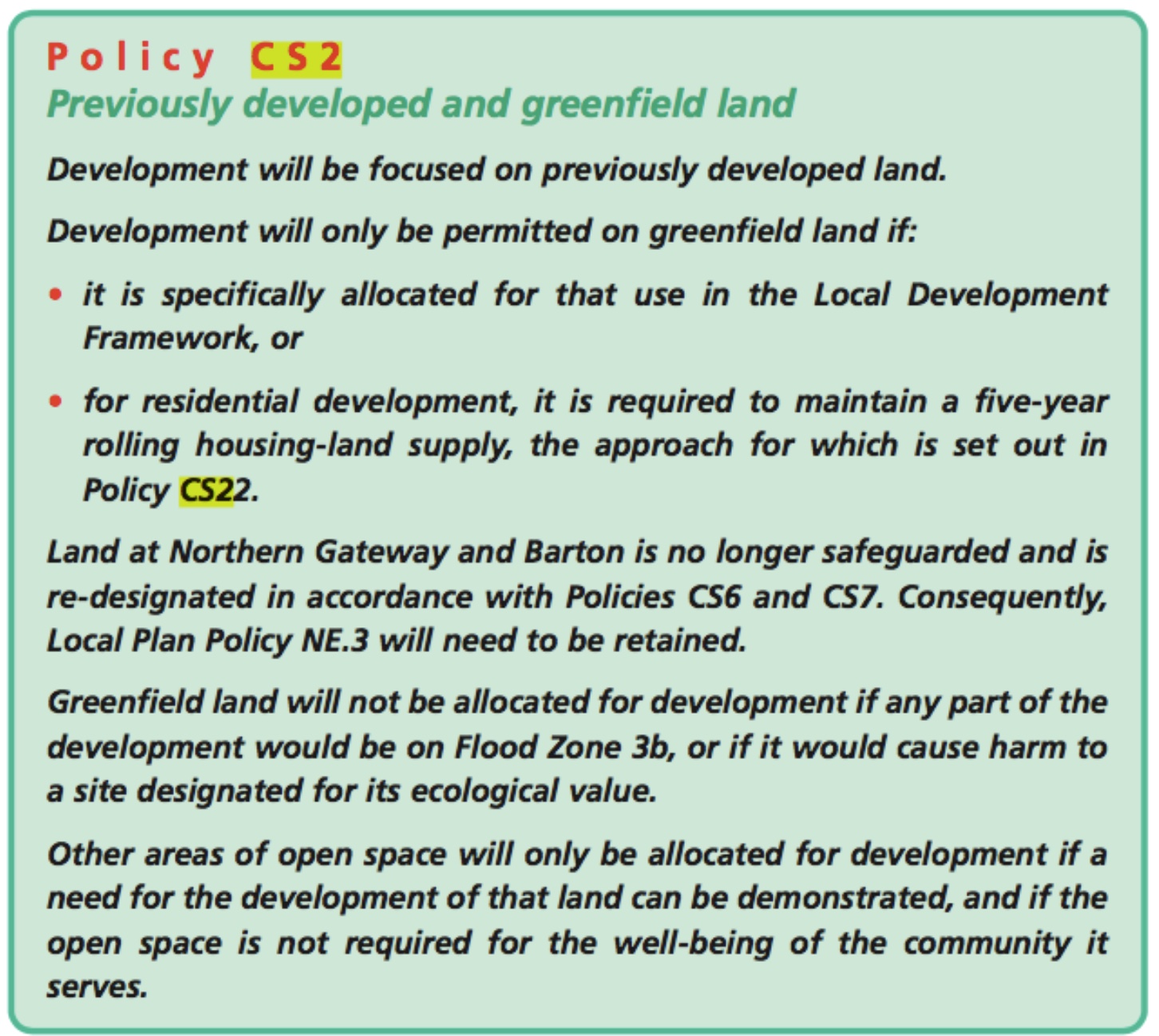
Within Oxford City Council’s main strategic planning document, the Core Strategy, Core Strategy 2 (CS2, see above) states:
‘Greenfield land will not be allocated for development if any part of the development would be on Flood Zone 3b.’
Our comment: The proposed site for the new car park is greenfield, and in functional Flood Zone 3b.
CS2 also says that ‘development will only be permitted on greenfield land if it is specifically allocated for that use in the [Oxford City Council’s] Local Development Framework’.
Our comment: This site is not so allocated.
Core Strategy 11 (CS11) says:
‘Planning permission will not be granted for any development in the functional flood plain (Flood Zone 3b) except water-compatible uses and essential infrastructure.’
Our comment: The proposed site is neither ‘water-compatible’ (a category intended for developments such as marinas), nor ‘essential infrastructure’ (which includes projects such as water treatment works, or roads which have to pass through a floodplain).
In our view the position could not be clearer – this proposal is, in fact, precisely the kind of development that the Council’s own strategic planning policy is there to prevent.
Seacourt P&R – Key Point 3: NPPF
- Entrance to the proposed site, 12 Feb 2016. There was not generalised flooding elsewhere, this area floods very early
- North end of the proposed site, 12 Feb 2016
National planning policy framework (NPPF) guidelines strongly recommend against the positioning of developments that are categorised (in this case according to the Environment Agency) as ‘less vulnerable’, in Flood Zone 3b, functional floodplain.
Sir Michael Pitt’s report on the severe and widespread summer floods of 2007 said there should be ‘a presumption against building in high flood risk areas in accordance with PPS25’ [now NPPF] (Pitt Review; ‘Implementation and Delivery Guide, 2008: Final Recommendation 7). The guidance should be ‘kept under review and strengthened if and when necessary’ (Final Recommendation 8).
The title of Sir Michael Pitt’s report is ‘Learning Lessons from the 2007 Floods’. This development is far from being essential and NPPF should be adhered to. To do otherwise would set a very dangerous precedent.
See Key Point 1 and Key Point 2
Dedicated pump for Earl Street
- L to R: Nick Hills, resident and OFA; Lord Mayor, Councillor Mohammed Altaf-Khan; Nicola Blackwood, MP; Duncan MacDonald, Scottish & Southern Electricity Networks; the pump.
- The new pump
The link provides an excellent report, including a video, about the arrival of a new pump, dedicated to flood protection for Earl Street. In case that stops being available online here is an extract from the report, with acknowledgement and thanks to ITV:
“Today residents in Earl Street were shown a new, dedicated, mobile pump that will be available to them in the event of future floods.
Nick Hills, an Earl Street resident and member of the Oxford Flood Alliance Steering Group, applied for a grant to pay for the pump after becoming aware of Scottish and Southern Energy Network’s Community Resilience Fund. The energy company awards grants of up to £20,000 to community projects. His bid was successful and SSE awarded the full cost of the pump, which had been reduced to £19,830 by Stuart Pumps Ltd, which provides the City Council with its pumps.
Another letter about Seacourt P&R
Our letter published in the Oxford Times, 29 December 2016
We wrote recently about Oxford City Council’s proposal to extend the Seacourt Park & Ride into the flood plain, providing 658 extra parking spaces.
Now we read that the very same council wishes to abolish 270 parking spaces at Redbridge in order to develop a recycling facility. The core argument put forward by the City Council to justify their proposal at Seacourt is that extra car parking is so badly needed that it should be allowed even though the expansion site is in Green Belt and functional floodplain, and despite the fact that it is clearly contrary to national planning guidance and could put vehicles and people at risk during a flood. The Redbridge plans now make nonsense of the special case being advanced for Seacourt.
If that is not enough, the budget for construction of an extension at Seacourt has recently doubled from about £2 million to £4.1 million. The City Council Executive Board papers for 15 December 2016 show projected net revenue from the Seacourt Park & Ride extension of £160,000 a year, and this relies on an increase in parking charges from £2 to £3 possibly starting in autumn 2017.
At this rate the investment would take more than 25 years to pay back. If this figure assumes that the car park remains fully operational and doesn’t ever flood, when in reality it will do so virtually every year causing closure and expensive maintenance, the payback time will be even longer than 25 years.
We are discussing our concerns with the City Council as we believe that their proposal is ill-conceived and unjustifiable and that it should be abandoned before any more money is spent.