Clean Water for Wildlife


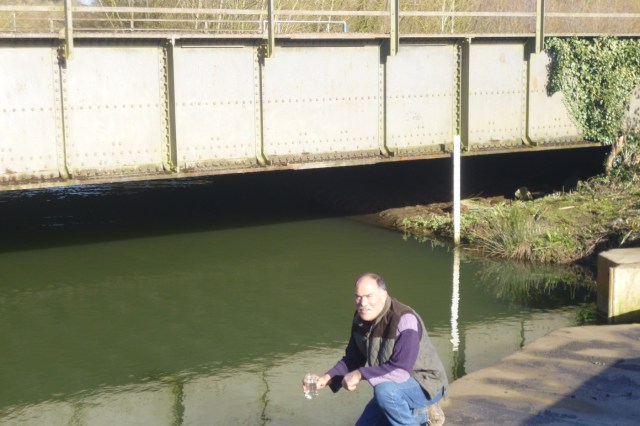
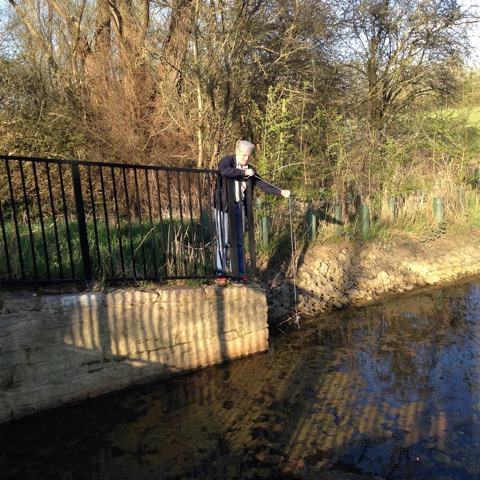
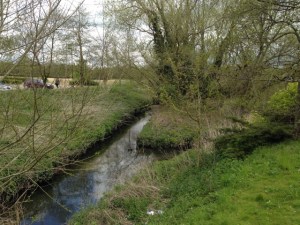
We’ve been lending a hand with the Freshwater Habitats Trust’s ‘Clean Water for Wildlife’ survey. This part of their survey covers the ‘Ock catchment’ which (bizarrely) includes Oxford.

We believe that the Oxford FAS can provide benefits to wildlife alongside the flood risk reduction. Quality of water is important to any such aspiration, so work such as this survey is very important.

Anyone wanting to help can find out more at freshwaterhabitats.org.uk/projects/clean-water.

Network Rail’s planning application for track-raising

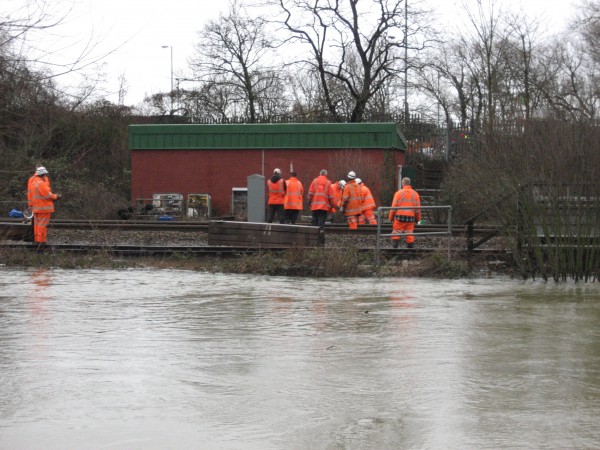
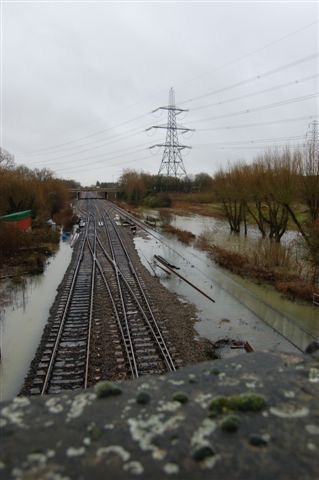
Network Rail (NR) has applied for planning permission in relation to its plan to raise a particularly low area of the mainline track to London, beneath and either side of the old Abingdon Road bridge (Redbridge) near Kennington, to reduce the risk of the line flooding. Doing only this would increase the risk of flooding to the west of the line by raising the height of what is already a dam to the free flow of flood water. So NR propose a new culvert beneath the railway to compensate for this.

We have no objection to this plan in principle, but it must be done properly to ensure that the flood risk to properties and roads is not increased. If the mitigating culvert is too big areas to the east would be affected, too small and those to the west would suffer.

NR then need to convince the planning authority that their proposal gets the balance right and does not increase anyone’s flood risk. This is done mainly by modelling of flood flows and levels and reporting the results as part of a Flood Risk Assessment (FRA) which is at the heart of the planning application. This was first submitted in February. We went over this with a fine-tooth comb and found gaps and serious inconsistencies in the data presented. We did not believe that the document allowed the necessary judgement to be made, indeed it raised more questions than it answered. We made a submission to the planning authority, Oxford City Council, suggesting that, on the available evidence, it would be unwise to allow the application. The FRA, our comments, and many other documents can be seen on the council’s planning website – application number 15/03703/FUL. Our comments: OFA comments on 15/03703/FUL – Construction of a culvert.

A revised FRA (Revision AO1) was tabled by NR on 25 February in response to comments made by the Environment Agency to them. Because of the timing this revision  did not deal with our questions. We submitted further comments on AO1, reiterating and expanding on key points, on 9 March. We again gave our opinion that the evidence presented in the FRA was such that it could not allow a safe and proper decision to be made. This submission: 15:03703:FUL OFA Comments on the revised FRA (revision AO1, Feb 2016) F

After making our second submission to the planners we met with representatives of NR and their advisers. They confirmed that there were indeed the errors we had drawn attention to, in both the original and AO1 revision of the FRA. They said they had identified the reason for these errors and explained this. We understand that they will be filing a further revision, plus an amended version of an associated document, GRIP3, which is referred to in the FRA.

We have discussed our concerns with the planning officer at the Council who has been helpful and attentive to our arguments. A decision on the application has now been deferred to allow time for the revised documents from NR to be reviewed by the public and by Council planning staff.

Postscript: we were later asked to review the maps associated with the FRA, to compare what the model suggested with what we know ‘on the ground’. Our comments: 15:03703:FUL – OFA Review of flood model maps.

Oxford FAS and the Weirs Mill Stream boating community

On 20 February one of us joined local councillors and others on a visit to the residential boat community at Weirs Mill Stream, on the weir pool below Donnington Bridge Road.

Residents are  understandably concerned that one of the options (Area 7, Option A) for the Oxford Flood Alleviation Scheme in this part of Oxford would mean them being displaced from their homes for many months, destruction of part of the land where their boats are legally moored and resultant loss of moorings.

There are alternatives which would avoid this: Option C, which crosses open land and would disrupt no one, seems likely to be the best and very likely the cheapest. We therefore oppose Option A.

http://www.oxfordmail.co.uk/news/14294465.Flood_alleviation_scheme_could_spell_the_end_of____our_fanastic_lifestyle____warn_boaters/

Brainstorm meeting: maintaining OFAS

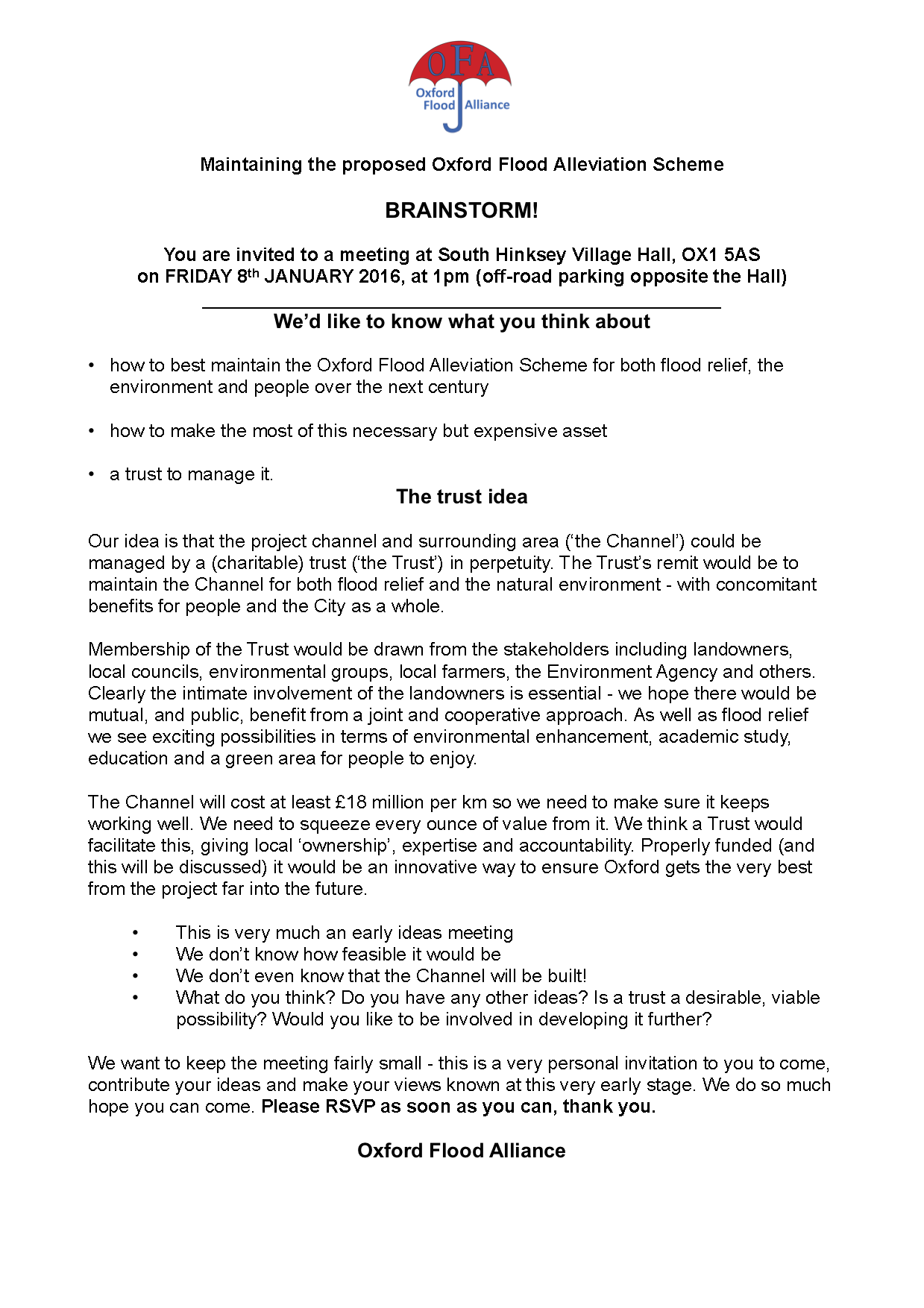
We hosted a meeting today to discuss how we could maintain the Oxford Flood Alleviation Scheme for both flood relief and the environment over the next century. We had an excellent meeting: in attendance were Rodney Rose (County), Chris Brown (County), Bob Price (City). Penny Burt (EA), Emma Formoy (EA), Giles Strother (BBOWT), Jeremy Biggs (Freshwater Habitats Trust), John Mastroddi (OFA), Nick Hills (OFA), Adrian Porter (OFA), Tim Treacher (SOFAG), Rachel Sanderson (OPT), Judy Webb (ecologist and Ashmolean Rare Plants Group), Peter Rawcliffe (OFA), Simon Collings (OFA), Peter Thompson (Civic Society), Peter Lefort (CAG).

The main question: ‘How might we best organise things to keep the channel working well and make the best of all the benefits over the next 100 years?’ There was excellent discussion with the following conclusions:

There was a general agreement with the idea of coordinating management of OFAS, and that this could bring cost savings and enhanced benefits from the scheme.

It is currently unclear what form the coordinating body would take but it is clear that riparian owners will continue to own their land and will be responsible for managing that land. Their participation in the coordinating structure is therefore key.

More detail about exactly what the required maintenance will be, and how this splits across hard physical assets, the stream and the secondary channel is needed before a further discussion.

In the meantime it was agreed that work to consolidate the ecological vision for OFAS was needed. Conversations are already going on with various stakeholders about this and a draft set of ambitions exists. It was agreed that we should build on these.

Further public drop-in meetings for Oxford Flood Alleviation Scheme

Further public drop-in sessions are now arranged for the Oxford Flood Alleviation Scheme. These are for people to see and comment on the various options developed for the channel, ask questions and make comments and suggestions. The consultation will be available online as well.

All are from 2:30 to 7 pm – come when you like:

  • Tuesday 19 January          Oxford Town Hall, OX1 1BX
  • Wednesday 20 January   Abbey House (Council Offices), Abingdon, OX14 3JE
  • Friday 22 January             South Oxford Community Centre, OX1 4RP
  • Wednesday 27 January    Kennington Village Centre, OX1 5PG
  • Thursday 28 January       West Oxford Community Centre, OX2 0BT.

The Paris Agreement, December 2015

COP21Nearly 200 countries, developing and developed, and including oil and gas producers, reached agreement at the COP21 conference in Paris to address climate change. This looks like the beginning of the end for fossil fuels.

The deal requires that countries should stem greenhouse gas emissions, with the goal of peaking emissions as soon as possible and continuing the reductions as the century progresses. The aim is to keep global temperatures from rising more than 2°C by 2100, ideally keeping the rise below 1.5°C.

The deal will encourage trillions of dollars to be spent adapting to the effects of climate change – including of course flooding – and developing renewable energy. Developed countries are to send at least $100 billion each year to developing countries beginning in 2020.

The agreement gives countries leeway in determining how to cut their emissions but they must report how they are doing. Progress will be reviewed every five years.

Some elements, like reporting requirements, are legally binding, others, such as the setting of emissions targets for individual countries, are non-binding.

This is potentially a game-changing agreement and has been widely welcomed. Hopefully the catastrophic possibility of irreversible and escalating change can be averted. Nevertheless, climate change is here with us and we can expect to see its effects on weather patterns continuing for the foreseeable future, with increased flooding a prominent result.

Let us hope that the implementation of the Paris agreement is as good as promised.

Storm Desmond, flooding and climate change

corporation road carlisleCorporation Road, Carlisle (Photo: North News)

There has been widespread and severe flooding in Lancashire and Cumbria due to unprecedentedly heavy rainfall in a short period from Storm Desmond. One feels for the people affected, many not for the first time.

‘The 405mm of rain that fell in Thirlmere in the 38 hours to 8am on Sunday marked a record amount of rain ever to fall in a 48-hour period while the 341.4mm recorded at Honister Pass on Saturday broke the highest rainfall record for any 24-hour period.’

‘Dame Julia Slingo, the Met Office’s chief scientist, said the “extraordinary” conditions were likely the result of climate change. Her comments were echoed by Liz Truss, the Environment Secretary, who told MPs: “Climate change is factored into all the modelling work the Environment Agency does but clearly in the light of this extreme weather we are going to have a look at that modelling and make sure it’s fit for purpose.” ‘http://www.telegraph.co.uk/news/weather/12038356/Floods-caught-ministers-by-surprise.html

‘Prof Hall [Professor Jim Hall, director of the Environmental Change Institute at the University of Oxford] said there was always a trade off between costs and risks. Nevertheless, he added that the latest floods “should be a trigger for a revaluation of protection standards”.’ http://www.ft.com/cms/s/0/57b91e9c-9cf1-11e5-8ce1-f6219b685d74.html#axzz3tiucxtde

There is more on the relation between flooding and climate change here http://www.belfasttelegraph.co.uk/news/uk/heavy-rain-and-flooding-fit-with-climate-change-predictions-34268682.html

Extreme weather events associated with climate change are already more common: we need to make sure the assumptions used in the modelling of the Oxford Flood Alleviation Scheme (Oxford FAS) sufficiently take into account the effects of climate change.

Climate change – Paris 2015

COP21There is lots of attention on climate change just now with the United Nations conference COP21* coming up next week. Whether governments will agree enough, and then do enough, to hold any increase in global warming to 2˚C remains to be seen. Limiting the average global surface temperature increase to 2°C over the pre-industrial average has generally been regarded as an adequate means of avoiding dangerous climate change – though there is some doubt about whether this is sufficiently stringent.

Whatever happens, we can expect an increasing frequency of extreme weather and we need to be investing in ways of mitigating the impact. As far as Oxford and the threat of flooding is concerned that, in our view, means the Oxford Flood Alleviation Scheme (Oxford FAS). See too a previous post on Oxford FAS and climate change .

* COP21 is the 21st Conference of the Parties, i.e. the annual meeting of all countries which want to take action for the climate. It will be held in France, from 30 November to 11 December http://www.cop21.gouv.fr/en/.