
See it here (pdf)
Category Archives: Publications
County Council’s Flood Risk Management Strategy
The County’s Flood Risk Management Strategy was formally adopted by the County Council Cabinet this week following the consultation earlier this year.
For more information please follow the link : http://mycouncil.oxfordshire.gov.uk/ieListDocuments.aspx?MId=4039&x=1&
The draft Strategy can be found here
https://www.oxfordshire.gov.uk/cms/content/oxfordshire-local-flood-risk-management-strategy
The final Strategy and the associated Action Plan will be available online in due course.

Hinksey Stream, weed building up, clearance will be needed fairly soon – but who will do it??
The Strategy mentions the role of riparian owners in maintenance – one of our two key concerns currently. See here too about the responsibilities of riparian owners. We have spoken today to County and expressed our keen interest in helping make this happen and how we think that could be done by County, EA and ourselves working together. Getting this under way has been our aim for a long time – and we will get there.
Our MPs’ views
May 2014
Oxford MPs Nicola Blackwood (Oxford West & Abingdon) and Andrew Smith (Oxford East) have been very active on flooding, both in supporting people and in lobbying for action to reduce it. Flooding does not recognise political boundaries and our MPs have worked together when appropriate, to good effect. They have both supported our own efforts, for which we thank them. Here they give us their current views:
Joint Statement from Nicola Blackwood MP (Oxford West & Abingdon) and Andrew Smith MP (Oxford East)
The human and economic cost of the flooding our local communities must endure every year is totally unacceptable. Our city and surrounding villages urgently need long-term, sustainable flood defences to protect homes and keep Oxfordshire open for business, rain or no rain. The Western Relief Channel will protect families and businesses from flooding and we hope that government, local authorities and business alike will work together to make it happen. At the same time, we must ensure that nearby towns at significant flood risk, like Abingdon, also get the long-term, strategic defences they need, and we will keep the pressure up to ensure that all residents in our constituencies can know that everything possible is being done to mitigate flood risk in the area.
Nicola Blackwood MP for Oxford West & Abingdon writes:
Overflowing Sewers
We need urgent action on our drainage infrastructure, a point which I have raised repeatedly with both Thames Water and the Environment Secretary. Hard-working local groups such as Oxford Flood Alliance and the Ock Valley Flood Group have done a great deal to highlight these problems. I held a half-day meeting with Thames Water in February to discuss the problems that have arisen in each part of my constituency and how this appalling state of affairs can be more effectively prevented in the future.
On flood prevention more widely
I am pleased that local flood defence measures implemented since 2007 have been successful this year in protecting people and property. But other properties have not escaped and countless residents have been affected in other ways such as disruption of road and rail transport, and loss of business. I continue to put pressure on local and central Government, response agencies and utility companies to improve and strengthen local defences further.
Watercourse maintenance
I have raised with the Secretary of State and the Environment Agency the issue of establishing more regular maintenance of key watercourses around Oxford, including the Hinksey and Osney Stream areas. Riparian owners must be encouraged to carry out maintenance along their river banks to keep the river working well. The Environment Agency can play a key role in advising and encouraging landowners to do this.
Dredging
I have sent a series of written Parliamentary Questions to the Secretary of State for Environment, Food and Rural Affairs, asking that his Department look again at the importance of dredging.
Flooding is a very serious problem for Oxfordshire and what we need now are long-term solutions. I have been raising all of these issues locally and in Parliament and I will continue to do so. I will also remain in close contact with local people, flood action groups, Thames Water and the Environment Agency, vigorously representing the concerns of my constituents.
Andrew Smith MP for Oxford East writes:
Thanks. Throughout the flooding crises, I have kept in touch with residents and taken up concerns with the relevant agencies as well as raising questions in Parliament. I have greatly valued the advice and dedicated work of the South Oxford Flood Action Group and the Oxford Flood Alliance.
Sewerage problems
The worst impact of both episodes of flooding this year has been on residents unable to use toilets because of flood water – surface flooding and groundwater – inundating the sewerage system. I visited residents in both of the areas affected in my constituency: the Weirs Lane area and Western Road area. I took this up with Thames Water at the time and subsequently, and have held a residents meeting. Thames Water have undertaken to clear up any sewerage residue in gardens, and to complete a general clean up of silt from affected sewers, coordinated with the councils responsible for a prior clean-up of surface water drains. The latter has to be done first, as matter from the council clean up often ends up in the sewers! Thames Water have confirmed to me that they will complete a catchment area study of sewers in Oxford. I will continue to press for improvements.
The severity of problems in the Weirs Lane area was such that the City Council put Portacabin toilets and washing facilities in affected streets, and moved some vulnerable residents into alternative accommodation.
Other flood prevention measures
Each time there are floods lessons are learnt. Properties have been saved from flooding thanks to the barrier and pumping operation in Vicarage Road and Lake Street, applying lessons of the 2007 floods. It was noticeable the impact this year which the fire service pumping operation had in clearing water from Abingdon Road. It raises the question of whether a bund alongside the allotments coupled with more pumping might reduce the flooding risk in the Weirs Lane area, and the City Council have assured me this will be investigated with the Environment Agency.
Insurance
I have raised with government and the insurance industry the availability and affordability of household insurance for properties affected by flooding risk. I have also helped individual constituents having difficulty with getting cover. I support the need of businesses also to have access to affordable insurance.
‘Enough is Enough’
19 March 2014
‘Enough is Enough’ – read more about Oxford’s flooding and the Western Conveyance proposal.
Caveat and disclaimer: this article is written in good faith as our best understanding at the time of writing, March 2014. However very little is decided for sure, and things can and will change, the scheme may never even happen, so nothing said here should be taken as gospel or relied on for taking important decisions.
Guide to flooding and what to expect from your insurer
17 July 2013
A new (to us, but published July 2012) guide, from the Association of British Insurers (ABI), to flooding and what to expect from your insurer: ‘Responding to Major Floods’ is in our Library.
Flood insurance
29 June 2013
For months there have been cries from the back seat of ‘Are we there yet?’ and the reply ‘Very, very nearly’ from the government and the insurance industry. At long last an agreement has been reached, see Flood Re Briefing Note from the Association of British Insurers (pdf download). Both Oxford MPs, Andrew Smith and Nicola Blackwood, have been active in the House of Commons and behind the scenes in pushing for this. So has Brian Durham, member of the OFA Steering Group and Co-chair of the South Oxford Flood Action Group, SOFAG. Our thanks to them all.
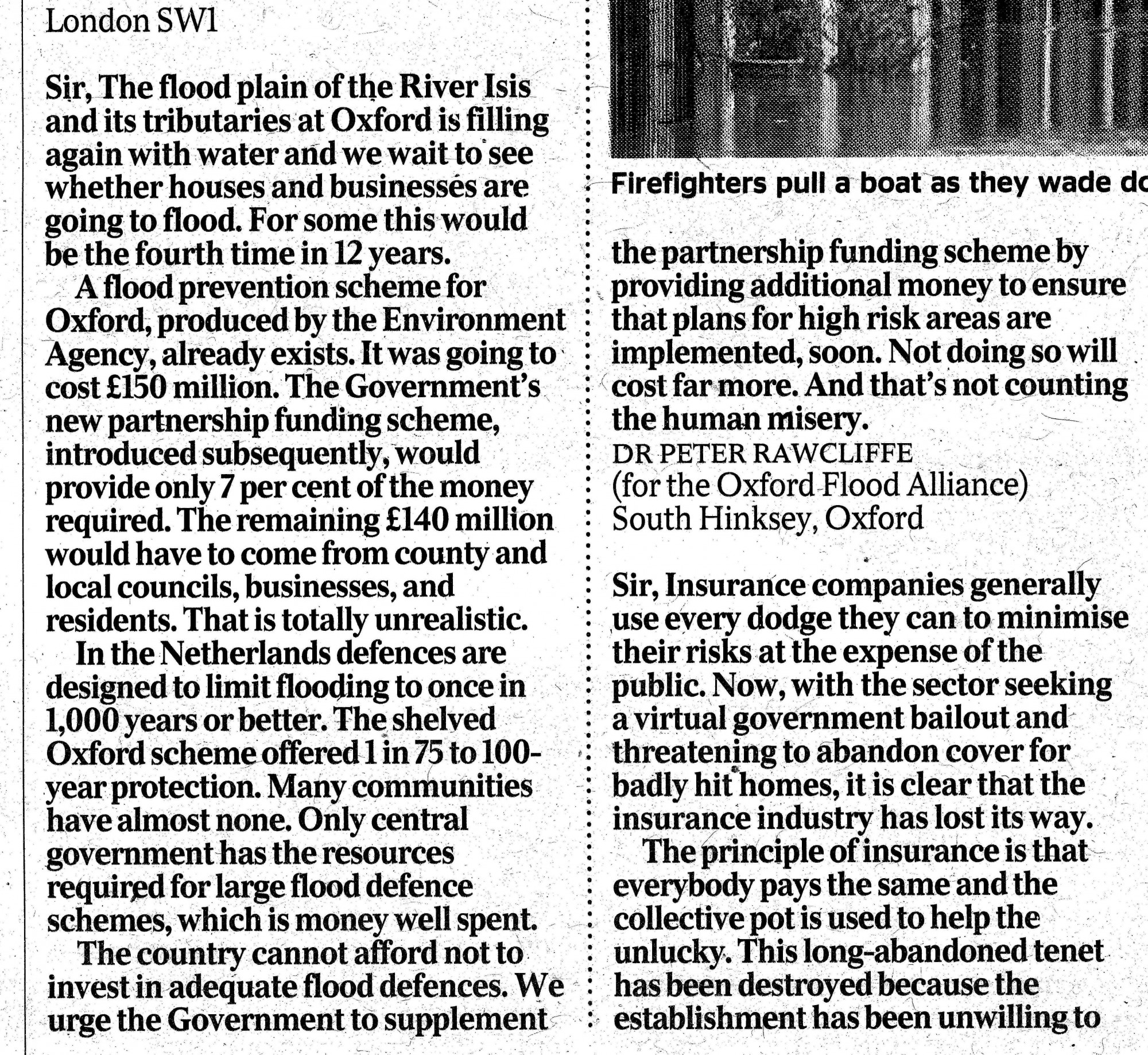
Letter in the Times
4 December 2012
Our letter about flood defence funding published in the Times of 28 November 2012.
LLFA and PFRA
Lead Local Flood Authority (LLFA)
Oxfordshire County Council is now our Lead Local Flood Authority (LLFA).
Their Preliminary Flood Risk Assessment (PFRA), April 2011, is in our Library.
PPS25
The government wants to rewrite planning guidance – we’re concerned that the current guidance (PPS25) controlling building in floodplains may be weakened or lost – so we’ve contributed to the consultation and written letters to the Oxford Times http://www.oxfordtimes.co.uk/news/opinions/letters/9274193.Serious_future_risk/ and our two MPs.
Our response to the EA on their proposals for further short-term measures for Oxford
14 July 2010
Oxford Short Term Measures 2
Thank you for asking for comments on your proposals. Here are ours:
Willow Walk – fine.
Hinksey Stream – welcome. We hope the work will include removal of the trees which seem to be actually in the stream upstream of the bridge.
Wareham Stream – we think that it is hardly worth maintaining the stream if the sluices are not renovated. Both inlets from Castle Mill Stream are useless, and the sluice at the brewery is not operated. Therefore in a flood there is not much flow.
Other ideas
We are disappointed that other, more ambitious, options were not pursued. We believe there are many things in our document “Building on Success – Suggestions for medium-term measures to further reduce the risk of flooding in Oxford and the surrounding area” launched this March, which would be well worth doing and we look forward to discussing them with you soon.
Lamarsh Road
In the meantime, our top priority remains to achieve a new flood route via Lamarsh Road in the now very limited time available. We understand that you share this wish and are working hard at it, which we appreciate. For now we would rather achieve this than anything else, as we made plain at our meeting in South Hinksey in March. If funding is not possible in any other way then we think money should be diverted from one or other of the Short Term Measures 2. They could be done later, whereas Lamarsh can’t.
It would be dreadful to fail to implement the Lamarsh scheme. Doing so, on the other hand, would be a great success and improve the lot of many people who have been flooded repeatedly and remain at high risk.
Oxford Flood Alliance, July 13th 2010.
 oxford flood alliance