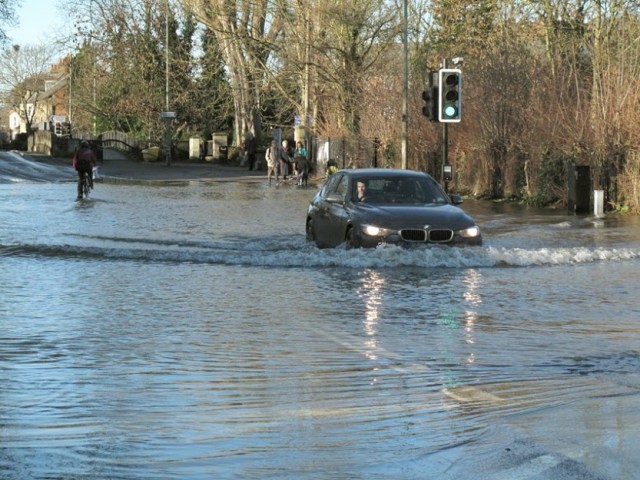
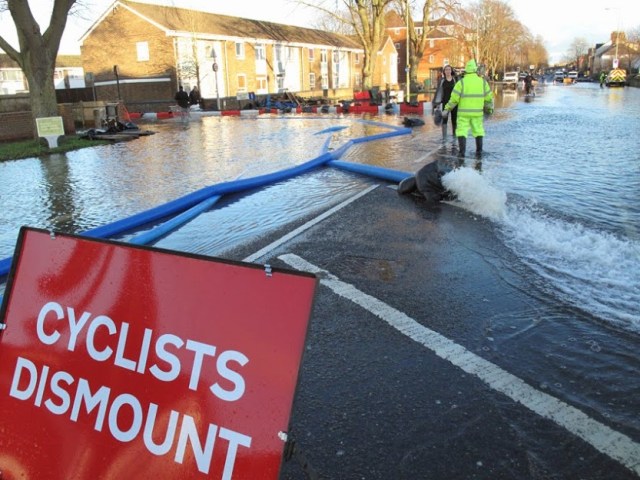
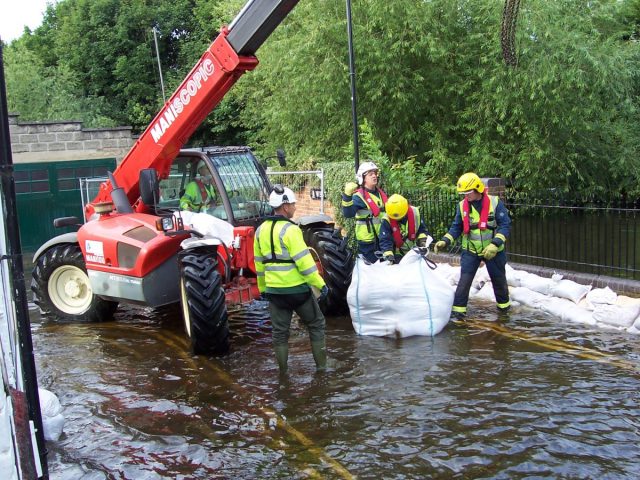
- Osney Island, July 2007
Oxfordshire County Council has a useful “flood toolkit” at www.oxfordshirefloodtoolkit.com. The site has a great deal of information on how to prepare for flooding and so on. If you think you might be at risk, take a look.
Fat poured down drains causes fatbergs, solid blockages in the sewers.
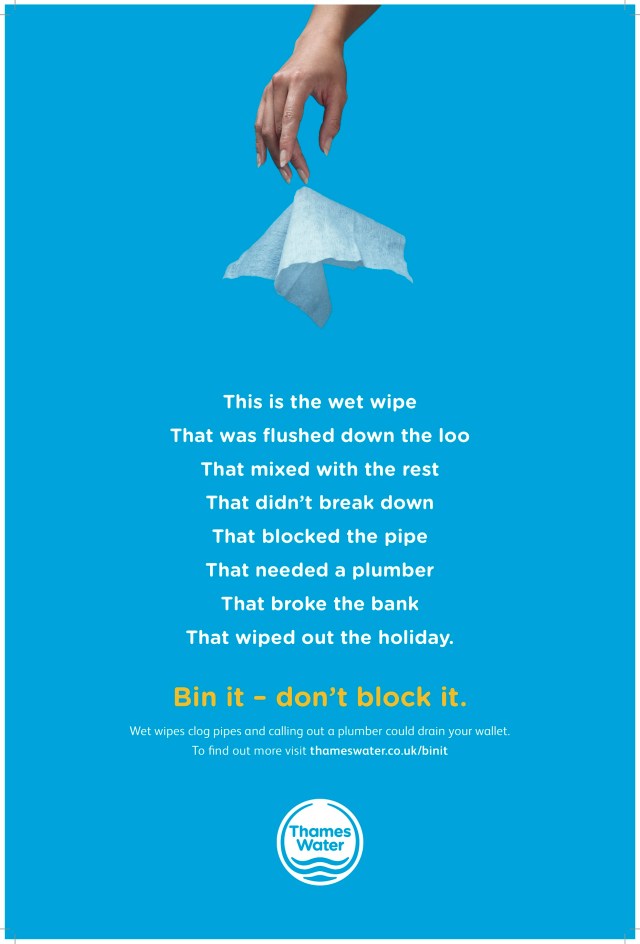
Many other things are put down the drains which shouldn’t be and again cause blockages with potential sewer overflow. Such things include wet wipes, tampons, nappies, tights and cotton buds – none of these should be flushed down the loo, they should go into a bathroom bin.
There’s a pdf leaflet with more detail (but alternate pages are upside down as it’s designed to be printed into a foldable leaflet).
An article in the Oxford Mail yesterday
We met with the Environment Agency (EA) and Jeremy Biggs of the Freshwater Habitats Trust (FHT) today.
We talked about articulating an environmental vision for the Oxford Flood Alleviation Scheme (the Scheme) which brings together the various initiatives which are planned and how these will be managed and maintained. This included possible bodies/corporate structures that might be involved in overseeing maintenance in the long-term, to deliver both flood risk reduction and benefits for wildlife. We are working towards a preferred option for the future management arrangements.
FHT is hoping to facilitate community involvement in the conservation of freshwater habitats within the Scheme area – for example by employing someone to liaise with local people, including schools, so they can be involved in wildlife science in the floodplain. Part of the funding has been secured by a generous offer of funding from Thames Water, and FHT and EA will now approach other bodies together.
OFA is about to send letters asking local businesses to contribute funding to help close the small funding gap that remains for the Scheme.
We have ‘A letter from the Oxford Flood Alliance (OFA)’ in the Autumn 2017 Oxford City ‘Flood Update’ which you may have received. In case you wondered why there was no comment by us on the planning application to extend Seacourt Park and Ride, we did include such comment in our letter but it was not published. It read as follows:
Seacourt Park & Ride
We have opposed the application by Oxford City Council to extend this P&R into the flood plain. The present application does not, in our view, show that flood risk will not be increased. We believe that a revised application will be advertised in the not too distant future and we will scrutinise this with care.
Revisions to the application have since appeared. You can find the application by going to https://www.oxford.gov.uk/info/20066/planning_applications/328/view_and_comment_on_planning_applications and searching for Seacourt. Ref. No. is 16/02745/CT3. The closing date for comments is 4 October 2017.
We are consulting with Oxford MPs Anneliese Dodds and Layla Moran on this. We believe that if this is allowed to go ahead in the functional floodplain, and being (we believe) contrary to the National Planning Policy Framework (NPPF), it would set a most dangerous national precedent.
We met Anneliese Dodds, new MP for Oxford East earlier this week. We had a very useful discussion on a variety of flooding topics, including the Oxford Flood Alleviation Scheme, that we are going to be approaching local firms for financial support for the Scheme, our interest in environmental enhancement as part of the Scheme and in establishing a local body responsible for its maintenance in perpetuity.
We explained our serious reservations about the proposed extension of Seacourt P&R into the functional flood plain (Flood Zone 3b) and what we see as a flawed Flood Risk Assessment. Such an extension could not only affect flood risk itself but set a precedent which might lead to further encroachment onto the floodplain with potential further increase in flood risk. Anneliese will look at the revised planning application which is expected in due course.
We look forward to working with Anneliese in the future.
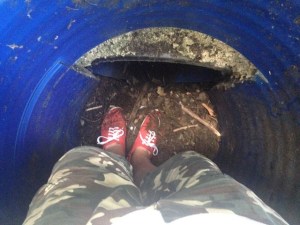
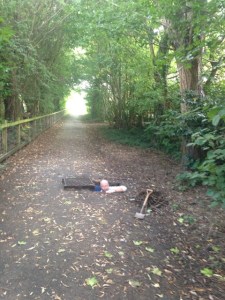
An alert resident has reported to us that a large drain on the path from the end of Duke Street to King George’s Field is partially blocked. Our intrepid Nick Hills has investigated and whilst he was able to remove sticks and twigs that were probably stuffed into the drain by children, there is still a considerable amount of debris that needs to be cleared from the connecting pipe. We think that the County Council installed this drain (to help with flood relief) and we’re asking them to look into it (pun intended).
We’re happy to receive reports of obstructions in drains, trees in waterways and so on. It can be difficult to know who is responsible – we can usually help with that and with reporting the problem. Details of where the problem is are obviously essential and photos are very useful.
Oxford Local Plan 2036
“Oxford City Council is producing a new Local Plan for Oxford. The Local Plan is important because it will shape how Oxford develops.” (from the ‘Preferred Options’ document for the Plan, Oxford City Council). The Council called for comments and we wrote recently as follows:
We wish to submit the following comments in relation to the proposed Oxford Local Plan 2036. Our comments all relate to flood risk.
If Preferred Option 38A is adopted as proposed we wish to state for the record that we interpret this to mean that NPPF will be strictly applied. It is clear in Table 2 and 3 in this Guidance Note what ‘Water Compatible’ and ‘Essential Infrastructure’ mean. We are therefore interpreting the Council’s policy to mean what the NPPF guidance says it means. This does not include car parks.
We have just sent this to the people on our mailing list:
The Oxford Flood Alleviation Scheme (OFAS) Sponsoring Group met earlier this month. This group provides high-level oversight of the project and is made up of representatives from the several partner organisations. One topic discussed was the shortfall of £4 million of the £121 million cost of the scheme. As the local ‘grass roots’ community organisation we’re now exploring ways we might engage support from local businesses.