Oxford’s floods and climate change: our article in Oxford Civic Society’s newsletter

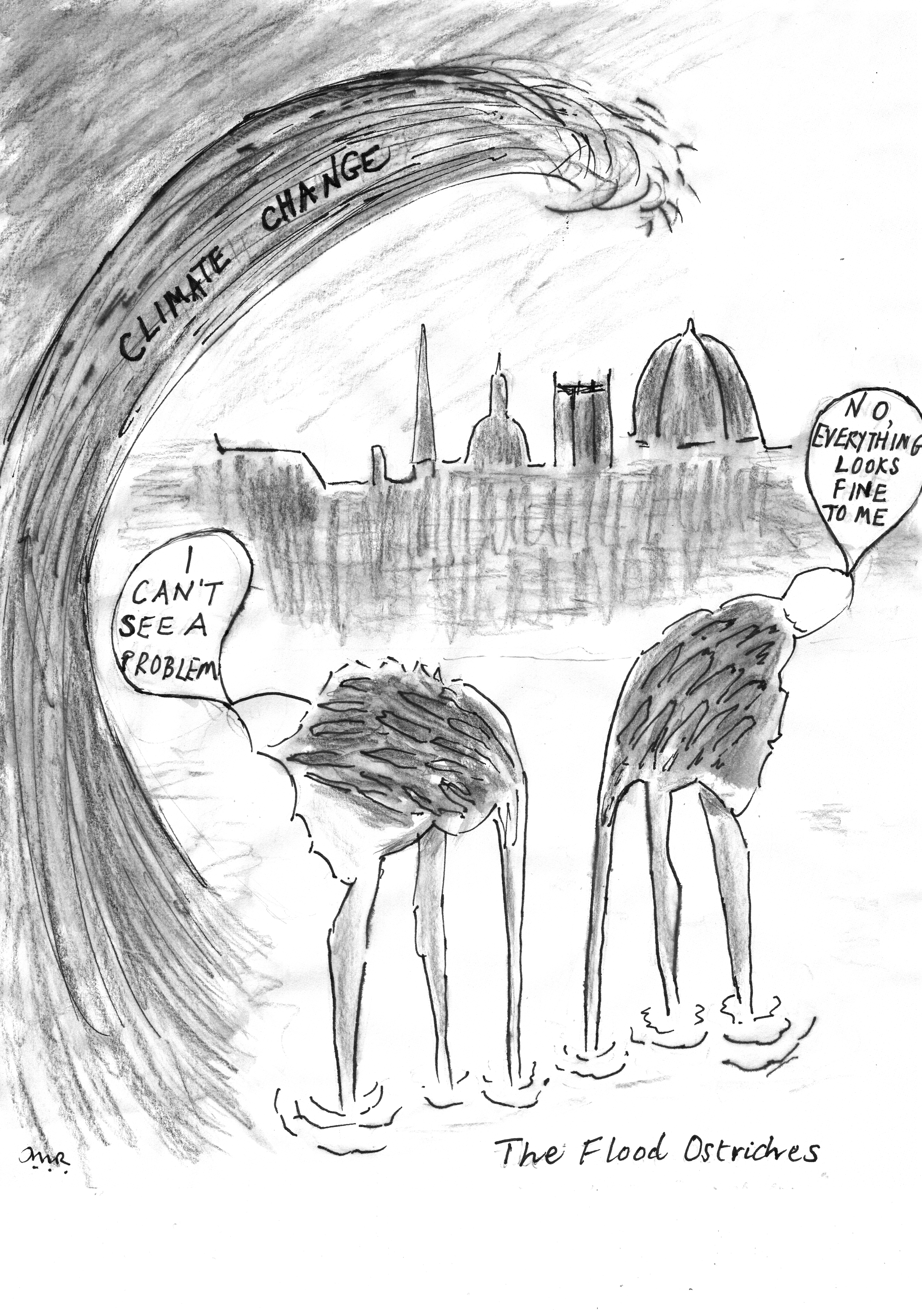
The Flood Ostriches and climate change

We’ve an article in July 2015 edition of ‘Visions’, the newsletter of the Oxford Civic Society.

It sets out our views on the threat posed to Oxford by flooding, with emphasis on the possible effects of climate change, and the relative merits of the possible options for combating that threat.

Meeting in South Hinksey

South Hinksey concrete flood wall, March 2014, post-floodOn Thursday evening 16 July,  30 or so parishioners met in South Hinksey Village Hall with Peter Collins and Magnus Williams from the Environment Agency (EA). We were pleased that local farmer Nick Frearson and a land agent on behalf of landowner Oxford City Council, were present too: they are important stakeholders in the project.

Groundwork
Engineer Magnus Williams presented his initial design ideas for groundwork to support deployment of temporary barriers for the village when flooding threatens. Magnus is talking to individual householders to ensure that everyone is happy with the specifics of the proposals.
We’re grateful to the Vale of White Horse District Council for providing £60k for the works and to the EA for providing the engineering design input, obtaining of permissions and so on.
We hope that things can move ahead as fast as possible as winter approaches and the risk of our flooding increases yet again.

Oxford FAS
Peter Collins, EA’s Asset Management Performance Team Leader for the Oxford area updated us on the aims and progress of the scheme.

Many thanks to Magnus and Peter for giving up their evening to meet us, much appreciated.

Working to reduce sewer flooding

Simon Collings represented OFA at the second meeting of Oxford City Council Scrutiny Panel on sewer flooding. Thames Water (TW) gave an update on where they are with a) Grandpont and b) the Oxford Catchment Study:

At Grandpont they have identified the most likely causes of sewer flooding and TW will now work with the City Council and residents to improve things. Local resident Brian Durham of OFA and SOFAG has been closely involved in this work.

On the Catchment Study they are engaged in two parallel processes:

  • a physical inspection of assets across the city – with any issues they identify being fixed as they go along (where the business case is obvious). This includes an inspection of both main trunk sewers.
  • customer surveys to help them understand where problems arise during a flood and how these manifest themselves.

So far they haven’t encountered anything which would suggest they need major capital investments, though they do plan to upgrade the pumps at Littlemore.

TW are talking to the Environment Agency (EA) team working on the Oxford Flood Alleviation Scheme, and the two modelling teams are going to share data and work together. By good luck the option development phases of both projects are working to similar timetables. EA will help TW understand how the river flooding affects the sewers, and TW will contribute to that work.

There will be one more meeting of the Scrutiny Panel in November/December but from then on formal reports will be given through the Oxford Area Flood Partnership, to avoid duplication of meetings.

Thames Water sewer flooding surveys under way

Heard from Thames Water today that their Oxford flooding questionnaire team has been out and about making visits and gathering information from householders – by the end of today all Oxford Phase 1 sites should have had at least one visit: three visits will be made in total to try to catch people that are out.  So far, 126 Sewer Flooding Questionnaires have been completed.

Phase 2, to follow, comprises Lower Wolvercote, North Hinksey Lane, South Hinksey and Upper Road.

Great that this is moving ahead – we look forward to hearing the results in due course.

Final OFAS public consultation events

This week saw the last two public drop-in events of this series, at the Town Hall and South Oxford Community Centre. Again they seemed well-received by visitors and valuable comments were made and recorded. The partners in the scheme, including OFA, have enjoyed meeting the many visitors, hearing their views and concerns. Hopefully people have been reassured by what they have learnt: certainly that has been our predominant impression.

Meanwhile, consultants have recently begun work on the next step – of preparing more detailed plans. The comments and suggestions received at these drop-in events are being collated and will be used in this planning.

Expect more public events in the autumn.

ICE President David Balmforth visits Oxford

David Balmforth, newly elected President of the Institute of Civil Engineers, visited Oxford on 12 June to learn for himself about the Oxford Flood Alleviation Scheme (OFAS). The event began at the Environment Agency offices at Osney with a presentation by Peter Collins of the Environment Agency, followed by a Q&A session. David asked about the ongoing maintenance of the proposed scheme (see the Oxford Mail article): it was made clear that the lifetime maintenance of the scheme was a critical part of the planning process and that Treasury approval would not be sought without it.
Peter Collins pointed out that of the total project duration, half was likely to be spent on consultation, planning and approval; the earliest that work on the ground would begin would be April 2018.

The entourage then went to the Seacourt Stream on the Botley Road for a site visit. Here Oxford Flood Alliance’s Adrian Porter talked to David Balmforth about some of the key challenges caused by flooding in the Oxford area, including:

  • How properties, families and communities are affected
  • The increasing frequency of flood events due to changing weather patterns
  • The importance of ongoing maintenance of existing watercourses.

David was particularly interested in property-level defence and how the insurance industry needs to change to properly support affected homes and business premises.

The visit was well received and hopefully David Balmforth left Oxford with a good understanding of OFAS and how it fits into the wider strategy for protecting Oxford from flooding.

Public consultation events continue

Following on from the first meeting in Kennington, there have been meetings in Abingdon and the West Oxford Community Centre. Partners in the schemes, including OFA, have listened to concerns and suggestions from members of the public and explained, as far as is known at this stage, what the Oxford and Abingdon Flood Alleviation Schemes aim to achieve and what they may consist of. Generally those attending have been very positive about the schemes.

Oxford Mail report on the meeting at WOCC

The final two events are this afternoon, 30 June, at Oxford Town Hall and on Friday, 3 July, at South Oxford Community Centre, both 2.30-7.30 pm.

First OFAS drop-in session, Kennington

First OFAS drop-in session, KenningtonThe first OFAS drop-in session in Kennington this afternoon.

Representatives from the Environment Agency, the County Council, Thames Water, consulting engineers, and three of us from Oxford Flood Alliance, were there to explain the scheme, answer questions and listen to suggestions.

The event was really popular, with a steady stream of visitors from 2.30 to close of play at 7.30 pm. There was a lot of discussion, and many valuable suggestions based on local or specialised knowledge (from concerns about particular local flood risk, to ecology, to canoeing) were made. Hopefully too people left with a good idea of the rationale for the scheme and what it may entail. Certainly many said that they had appreciated the event and hoped there would be more – and indeed the plan at the moment is to run similar events in the autumn.

Report in the Oxford Times

The next events in the present series are this Thursday in Abingdon and Friday at the West Oxford Community Centre (see two posts back).