
27 November 2012
Updates on the present flooding from the Oxford Mail
27 November 2012
Updates on the present flooding from the Oxford Mail
24 November 2012
Today we’re watching river levels rise and fields flooding; it‘s still raining and more is forecast. Will properties flood again?
The Oxford Flood Strategy flood prevention scheme, produced by the Environment Agency after years of work, was going to cost £150 million. The government’s new partnership funding scheme, introduced subsequently, would provide 7% of the money required. 93%, about £140 million, would have to come from the County, the City, the Vale, businesses, and residents. That’s totally unrealistic.
Every flood costs a huge amount. Only government has sufficient capital to invest to stop this recurring problem. But the government doesn’t seem to appreciate that money spent on flood defences is money exceedingly well spent. In economic terms alone it’s TEN TIMES better value than the controversial HS2 rail scheme.
Changing weather patterns look set to make flooding more and more common. Throughout Holland defences are designed to limit flooding to once in 1000 years or better. The Oxford Flood Strategy offered 1 in 75-100 year protection; at present we have almost none.
This country could afford adequate flood defences if the political will were there. The government must grasp the issue, supplement the present funding scheme, and invest serious money. Failure to do so will cost far, far more. And that’s not counting the human misery.
9 November 2012
We held our fifth Annual Public Meeting last night. Each year we wonder if attendance will drop off as we get further from the last flood. That’s 5 years ago, but again we had an excellent turnout. We work by public consent, so it’s important to us that we have strong public support – we’re ready to go for another year. We were delighted to welcome both our local MPs, Nicola Blackwood and Andrew Smith, and Rodney Rose, Deputy Leader of the County Council, who has responsibility for flooding. The County is now the Lead Local Flood Authority and Rodney Rose represents the County on the important DEFRA Thames Regional Flood and Coastal Committee.
Thank you to everybody who came.
22 September 2012
Thames Water is about to begin work to sort out the area of Munday’s bridge under the railway in Kennington. As well as dealing with local flooding in Kennington, the work will allow the whole western floodplain to drain better, to the benefit of all in our area upstream. All credit, and thanks, to Thames Water for doing this substantial and important work. See http://www.oxfordtimes.co.uk/news/yourtown/oxford/9883845.Flood_prevention_scheme_goes_on_show/
We have been concerned about this area since we formed in 2007. That concern arose from the special local knowledge of John Mastroddi, a founder member of OFA’s Steering Group, who had been concerned for many years before that. His garden backs onto the site, although his house has never flooded. The local flooded community owes a debt to John and his wife, and their neighbours, for the sacrifices they are making so this work can be done: see our recent letter to the Oxford Times:
http://www.oxfordtimes.co.uk/forum/letters/9928463.Sacrifices_to_save_flood_misery/
15 September 2012
The main waterways in the western flood plain, Hinksey Stream, Drain, Bulstake Stream etc. have been cleared of vegetation and a good deal of silt by the EA in the past few years. Clearly, to make the most of them and the new associated structures (such as the large new flood culverts under the railway access road) they need to be kept clear. We have already set up a monitoring system, but it is for dealing with local problems or isolated matters such as fallen trees, see Maintenance. For longer stretches of weed and silt, we need a different approach. We will talk to our partners – the Environment Agency, Oxford City and the Oxford Area Flood Partnership, to see how we can best ensure proper maintenance in the years ahead. We have begun this, and will be pursuing it in the coming weeks and months. We may be able to report some progress by our Annual Public Meeting in November – let’s hope so anyway!
10 July 2012
OFA is hosting a meeting with our partners, to develop proposals for further flood relief for Oxford
There have been significant changes in recent months in the way flood risk management is funded. Partners are being encouraged to work together to find cost effective solutions and to tackle all types of flood risk in a joined up way. Oxford had been identified as a priority area for attention based on the potential number of homes at significant risk. OFA has learned that the Thames Regional Flood and Coastal Committee (RFCC) is keen to promote flood risk management measures in areas such as Oxford and that funding to assist in the development of schemes is potentially available.
The Committee, which approves the programme of schemes in the Thames region, has invited proposals large or small where the cost-benefit analysis can be shown to be positive. The Committee is receptive to proposals from the lead local flood authority, which for Oxford is Oxfordshire County Council, to understand and address surface water risks and the relationship with river flooding. It is also interested in re-examining work undertaken as part of the Oxford Flood Risk Management Strategy to establish whether any of the works can be taken forward under the new funding regime. Collaboration between local agencies and cost sharing are being encouraged under new government rules.
In response to this opportunity OFA has convened a meeting of the County, City and Vale Councils, the Environment Agency and Network Rail to discuss potential schemes which might be put forward. The meeting will take place on 27 July in South Hinksey.
A considerable amount of time and money went into modelling the aborted £100m Oxford Flood Risk Management Scheme. We believe elements of this scheme could be turned into fundable proposals. Also a number of measures suggested by OFA over the last few years could be taken up.
We have had a very positive response from the various local bodies to the idea of a meeting and are looking forward to working with them. We will keep you informed of the outcomes of the meeting.
13 May 2012
During the recent heavy rain water levels rose a good deal on the Bulstake Stream. A Flood Alert (the lowest degree of concern) was issued by the Environment Agency.
The new flood culverts under Willow Walk were filled to capacity, not with water coming off the meadow to the north, but from the channel running along the ditch on the north side of Willow Walk from the Bulstake Stream. Water also flowed into King George’s Meadow and Oatlands Road Recreation Ground at quite an alarming rate. In fact there was no control of water flows from the Thames into the Bulstake Stream at Tumbling Bay as the fixed height weir at Tumbling Bay had been over-topped. The Thames had breached the west bank upstream of Tumbling Bay (it does this very early), so this water was filling the fields and then working its way back into the Bulstake Stream by Helen Road. The Seacourt Stream was also pushing water down the Botley Stream into the Bulstake.
The Thames at Donnington was well down; the flood plain upstream from the A34 was empty and so was the flood plain above Swinford Bridge. The new sluice gate (allowing water from the Thames into Osney Stream) on the corner of North Street and East Street remained shut and certainly the Osney Stream could have taken more water.
Some questions:
What is the philosophy on how the Thames is controlled at high levels? Why was the Thames at Donnington low yet the Thames above Osney was bank high? Why was the flood plain above the A34 empty?
Should the west bank above Tumbling Bay be repaired, so stopping water getting into the flood plain at this near-property point until later, not at the beginning of an incident?
How does this last relate to the lack of control at Tumbling Bay, where there is (now) a fixed weir? If more water had been allowed to flow through Osney Lock down towards Donnington the bank at Tumbling Bay may not have been breached.
Should the new gate at North Street have been opened?
We note there is no control of water entering the Seacourt at its origin from the Thames: the weir there is now fixed (it used to have movable boards for control).
In the event, all ended well this time, the water subsiding before any properties were flooded. Our observations and questions are, nevertheless, reasonable and merit consideration by the flood risk management authorities.


22 March 2012
Work is well advanced in rehabilitating a ditch on the west edge of the Ferry Hinksey trading estate, at the east end of Willow Walk. We pointed out some time ago that this ditch had deteriorated to the extent of disappearing in places, and being completely cut off in others. Oxford City Council, led by engineer Steve Smith, designed and obtained government funding for the work. About 90% is now complete, but finishing is delayed by finding two high voltage cables that are not shown on any utility company records. Once this is sorted out the work will be completed. Well done to all concerned.
Just for interest, we do not necessarily agree with everything in the article.
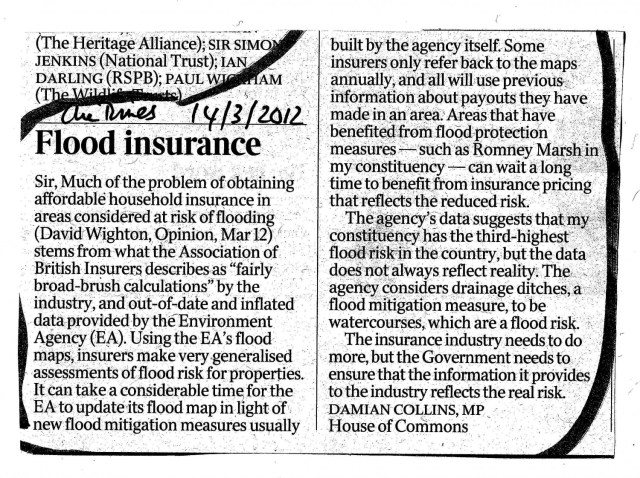
Just for interest, we do not necessarily agree with everything in the article.
 oxford flood alliance