An exciting time!

20 January 2011

This is an exciting time!

Things in the Botley Road area which we have promoted and campaigned for for a long time are coming to fruition. The works will reduce flooding of properties by surface water. They result from cooperation between various bodies, including OFA.
At the end of 2008 we suggested setting up an inter-agency working party to concentrate on the Botley Road area. This was immediately taken up by the EA and agreed by the Oxford Area Flood Partnership in January 2009. Things began to move. Oxford City came up with the suggestion of a road hump at the top of Earl Street to redirect flood water; which fitted well with our suggestion that flood water be directed down Lamarsh Road instead of Earl Street, by lowering part of Lamarsh Road. The Earl Street hump is now going in – the result of work by County, City, EA and ourselves.

Very soon we expect work to start in Lamarsh Road, to lower the far end of the road. Here, as well as those already mentioned, developer Kingerlee has played a key role. A new flood route will in due course take floodwater away through the Kingerlee site to the flood meadows beyond.

Not far away, work is starting on another OFA-initiated project: the installation of flood culverts under Willow Walk. Much of the assessment and planning has been done by Oxford City in conjunction with the EA.

Earl Street road hump – work starts

20 January 2011

Work is under way to put a raised road hump across the north end of Earl Street. It can be supplemented with sandbags when necessary. This will prevent flood water running down Earl Street as it has in the past. The County is carrying out the work, but the City, the EA and OFA have been involved throughout.

New culverts under Willow Walk, North Hinksey

16 December 2010

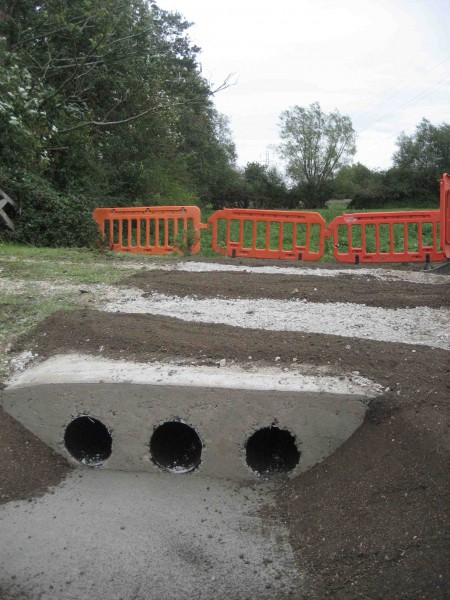
Oxford City and the Environment Agency have worked together towards getting new flood culverts installed here. We have now heard that work is expected to start around 10 January 2011 (weather permitting).

This should help keep flood water moving, not allowing it to build up so badly.

It is something we suggested and have pressed for for some time. Thank you EA and City.

OFA’s Annual Public Meeting, 2010

25 November 2010

Our third Annual Public Meeting was held at the West Oxford Democrats Club, Osney Island today.

Very many thanks to the Club for once again providing us with a warm and comfortable venue – not to mention the bar!

The meeting was attended by over 80 people. We had had some concern that numbers might be down as it is now 3 years since a major Oxford flood, but thanks to Andy Webber’s efforts in distributing flyers, that did not happen. A big thank you to everyone who came out on a very cold night.

It was good to see Andrew Smith, MP for Oxford East, who represents many flooded people along the Abingdon Road and elsewhere. He had with him a copy of our Building on Success, and has asked us to keep him in the picture about things at Redbridge, which affect his constituents as well as those further west. We are delighted that he said he will support us in getting necessary flood risk reduction work done there.

Flooded people from many parts of Oxford were present as were City and County Councillors and officers from City and Environment Agency. Among them it was good to see our previous Flood Stars, Nigel Bray (EA), Susanna Pressel (City and County Councillor) as well as Mary Timbrell (resident of Duke Street).
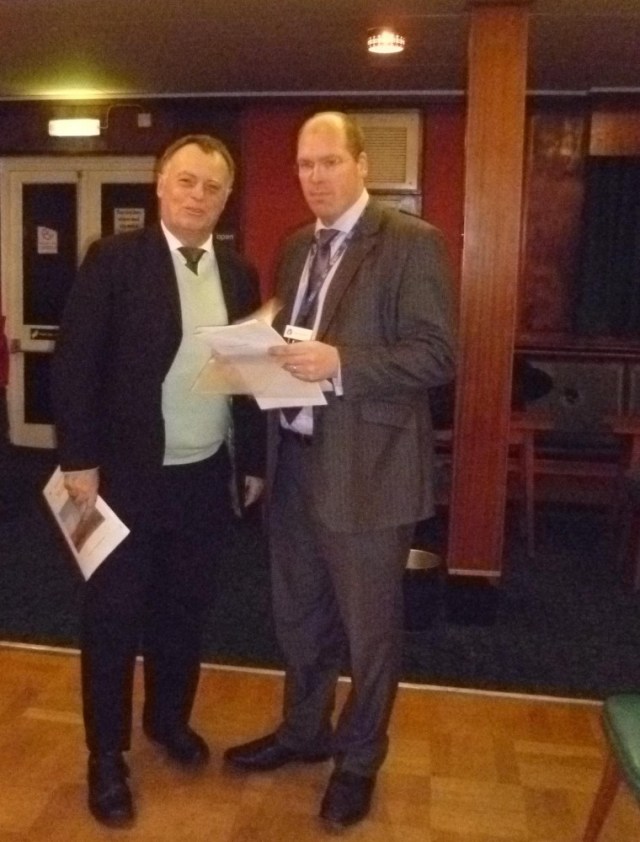
Andrew Smith MP (L) and Barry Russell, EA

Andrew Smith, MP for Oxford East (left) and Barry Russell, Area Flood Risk Manager, Environment Agency, at OFA’s APM.

keith andy flood star 2010 APM_2

Keith Hutchence (R) of the Environment Agency was awarded our Flood Star for 2010. He was thanked for all he has done and presented with a unique bottle of “OFA Flood Star 2010” by Andy Webber.

Presentation by the EA
We were pleased to be sharing our meeting with the EA. They have been thinking about further ways to protect the Earl and Duke Street and Marlborough Court area, in particular possible ways of keeping water out of the back of properties bordering the Bulstake Stream. Barry Russell, EA Area Flood Risk Manager, presented these ideas to the meeting and answered questions. The ideas are at an early stage and residents will be consulted further; any comments in the meantime can be made direct to the EA or via your local OFA person.
Barry told the meeting about the planned pavement hump for the Botley Road end of Earl Street, which will be topped with a row of sandbags during flooding, keeping water out of the street. The County Council will be installing this in the New Year. There are also plans to provide a removable flood barrier for the alleyway into Duke Street from the east, to stop water flowing into the street from the Bulstake Stream.

Peter Rawcliffe then spoke about:

Events and work completed in 2010
January: Network Rail remove redundant level crossing bridge at Redbridge.

March: publication and launch meeting of our Building on Success, Suggestions for medium-term measures to further reduce the risk of flooding in Oxford and the surrounding area. See list of attendees at the launch meeting here.

EA clear Hinksey Stream from North Hinksey to Redbridge.

November: meeting with EA’s Director of Operations; Head of Operations; and Thames Regional Director, and others.

Maintaining and developing our website.

Still in progress, but now heading for a successful conclusion:

  • Duke and Earl Street – see above.
  • Lamarsh Road as a flood route, to which we have made an important contribution – initiating the idea (March 2010), pressing the case and helping with the assessment (Oct 2010). The City, County, EA and developers Kingerlee have all played active roles and we are together on course to a successful conclusion. The result will:
    • Benefit existing and new businesses in and off Lamarsh Road.
    • Benefit residents who reach their houses via Lamarsh Road – Oriel Mews, and in future Rewley Press and Kingerlee housing.
    • Divert water away from proposed Earl Street pedestrian hump. The level in Lamarsh will be just lower than the height of the hump plus one sandbag.

2011: in the pipeline already:

  • Willow Walk, North Hinksey – culverts are to be installed to move water more quickly down the floodplain. Suggested by OFA and taken up by  EA and City.
  • Hinksey Stream, further clearance at Redbridge (EA).
  • Network Rail, clearing several waterways and renewing weir north of Redbridge.
  • Lamarsh Road – see above.
  • Culvert through causeway at South Hinksey (Vale of White Horse).

OFA’s top 4 for action in 2011:

John Mastroddi described the issues at Munday’s and Stroud’s bridges at Redbridge. See Building on Success.

Richard Thurston spoke about two things that would help Osney Island:

  • West Street Pumping Station: upgrade the current pumping station by installing a pump of greater capacity.
    Redesign the outfall so that the water is discharged with the flow of water in Osney Stream.
  • Build a new spur from the Bridge Street extension road drain via the passageway into the Environment Agency’s land, where a new sump be created. From the sump, excess water would be pumped into the weir pool.
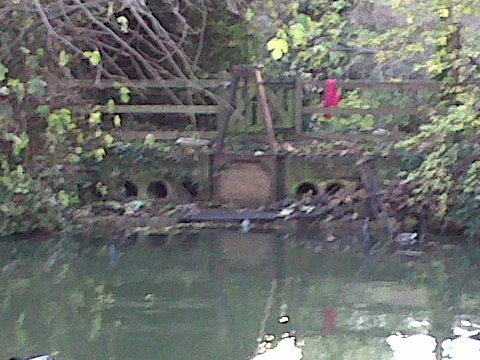
obstructions weir sluice castle mill stream

Mike Hamblett showed us the poor state of the weirs and sluices on Castle Mill Stream – the photo speaks for itself.  Castle Mill Stream has potential to carry more water than it does, having relatively high gradients. We suggest these structures be mapped and listed and their condition and operation be examined, as a first step to improving them.

Mike then spoke of the broken down state of about 500 m of the west Thames bank above Tumbling Bay. See Building on Success. Water pours out of the river here when river levels are high, further damaging the bank in the process. We are concerned that this water may make flooding worse in the Botley Road area. The effect of the water leaving the river, compared to what would happen if it did not do so, should be investigated. As the breakdown worsens with each episode, one can expect that before long the entire bank over the 500m length will be affected – that situation should also be looked at. The bank could be repaired fairly easily.

Resilience and insurance

Nick Hills stressed that the time to install flood resilience measures in your house is when work is being done anyway – including of course after a flood. And that people should make sure this happens, not leave it to insurers – they tend to put back what was there before, chipboard floors and carpets included. Ask that the money be made available to you to spend as you see fit – see articles by Peter Rawcliffe and Nick Hills.

Lamarsh Road scheme – almost there!

24 November 2010

On 9 November Oxford City Central & South West Area Committee agreed to reallocate the money for “public art” that Kingerlee are contributing as part of their development, to the flood relief measures that we have been advocating in Lamarsh Road instead. The suggestion to do so came from Kingerlee (see post of 15 October) and has doubled the amount of money available for flood relief from Kingerlee. The necessary work will now be done. Kingerlee will do the work themselves while they are doing their own work anyway, so overheads will be minimised. After further discussions between Kingerlee, the City and the County, Kingerlee have instructed their engineers to prepare a scheme and hope to start work early in the New Year.
THESE ARE THE (ALMOST) FINAL DEVELOPMENTS IN A CAMPAIGN WHICH HAS OCCUPIED MUCH OF OUR EFFORT FOR THE PAST YEAR AND MORE. THE OUTCOME IS SUCCESS. Many other people, from City, County and the Environment Agency, and of course Kingerlee, have also worked very hard to achieve this result. MP Nicola Blackwood has been interested and supportive.

Meeting with senior members of the Environment Agency

8 November 2010

Peter Rawcliffe, representing the Oxford Flood Alliance, met with David Jordan, national Director of Operations at the Environment Agency, John Russon, Head of Operations, Howard Davidson, Regional Director, and Matt Carter and Barry Russell from the local EA area, on a recent visit to Oxford. We were pleased to have such an opportunity.

A wide-ranging discussion included:

A presentation by OFA emphasising the crucial importance of improving things at Munday’s underbridge in north Kennington.

How community flood groups form and become involved (‘the Big Society’) in working with the EA on flooding. The difficulties of establishing such engagement where it does not already exist.

Attitude to risk and particularly how it relates to the Big Scheme (OFRMS) for Oxford. OFA said there was public scepticism about whether the Big Scheme would ever happen and that people would like things done now to remedy obvious deficiencies, making the most of what already exists, even though they together fall short of a 1 in 100 year standard of protection (as is inevitable).

Once such remedial measures were taken, then incremental improvements to existing watercourses, particularly widening Hinksey Stream, working up the floodplain, might be a sensible approach, rather than relying on a possible new grand Western Conveyance which might very well never materialise.

Having said all that, information gathered for the Big Scheme can inform decisions in the meantime and if climate change makes things worse it might then be implemented. We suggested that improvements now should not be put off for fear of jeopardising the value for money of the Big Scheme – because of the very real and widespread doubt as to it ever materialising (even were no improvements made in the meantime).

Annual Public Meeting of the Oxford Area Flood Partnership (OAFP)

27 October 2010

Annual Public Meeting of the Oxford Area Flood Partnership (OAFP). (This is not OFA.)

We attended and asked about:

  • Lamarsh Road as a flood route (we presented our report – October 2010)
  • The railway track at Redbridge
  • Munday’s underbridge at Redbridge
  • Why OAFP meetings are held in camera
  • Work that we have been pushing for on Osney Island.

Continue reading

Meetings re Lamarsh Road as a flood route

15 October 2010

Brian Durham and Peter Rawcliffe, both of OFA, met David Coates, Planning Director of Kingerlee, at their Lamarsh Road site. We looked at the site and discussed things in the light of OFA’s report on Lamarsh Road, October 2010, which can be downloaded here.

We all three went on to meet Barry Russell and Selena Peters of the Environment Agency and Paul Kirkley of Oxford City Environmental Development.

Selena Peters presented the results of computer modelling of flood flows, now extended from 1 in 25 year flood levels to 1 in 50: even at 1 in 50, when defences are overtopped at Bullstake Close and Earl Street, the model suggests there is no further benefit to Earl or Duke Streets from relieving any dam effect at Lamarsh Road by lowering it (but see below).

Brian Durham of the Alliance spoke about the important findings described in his report, including those discovered by talking to Jewsons and the Army Surplus shop in Lamarsh Road.

Paul Kirkley (City) gave further information about various matters, including that culvert pipes from an adjacent site obstruct a drain beyond the far end of the Kingerlee site.

David Coates (Kingerlee) suggested how to move things forward, including that S106 moneys payable by Kingerlee and allocated for “art” could perhaps be made available for flood defences instead. This would be in addition to sums that Kingerlee is already contributing. OFA strongly supported this suggestion.

There is now a much better understanding of what might be useful; Brian Durham has shown that “less will be enough”, and it looks more likely to be affordable. In a nutshell, a limited lowering of about 8 cm at the south end to the west would bring significant benefit. The County have apparently agreed to do about 5 cm in an even smaller area, the hope now is to increase that.

The plan agreed at the meeting is that the EA will, with Paul Kirkley, produce specific proposals as to what is ‘required’. That they will then engage with the County road people to obtain as specific and detailed costings as are possible at this stage (unknowns e.g. services may make it less than exact).

Funding might include use of the £25,000 that Kingerlee has contributed, a similar amount (?£20K) that Rewley Press developers are putting in. The possible reallocation of the “art” funding is mentioned above.

Whether Earl and Duke Streets will be helped depends on how reliable the model proves in practice, but the proposed work in Lamarsh Road cannot make them worse. Previously flooded properties in Lamarsh Road will benefit. Kingerlee’s site, Oriel Mews and the Rewley Press residential development will benefit from improved vehicular and pedestrian access during floods.

Keith Hutchence, our new Flood Star

25 September 2010

We have been pleased to invite Keith Hutchence, our main contact with the Environment Agency, to become our fourth Flood Star. OFA’s Flood Star awards recognise an exceptional contribution to the work of flood risk reduction in our area. Keith will be presented with the award at our Annual Public Meeting in November. We have only awarded this one Flood Star this year: Keith’s award recognises the skills and commitment he has brought to his role in keeping communications between the authorities and the community open and active, making cooperative working a reality. Such cooperation is vital in flood risk reduction. Keith’s work has been of great benefit in this respect.

Botley Road area meeting

13 September 2010

We met with representatives of the EA, and both Oxford City and Oxfordshire County Councils last Friday, 10 September. We were shown the latest results from the computer model of flooding in the Botley Road area, developed by the EA in collaboration with City Council engineers. The effect of various interventions has been investigated.

The model suggests:
1. The existing Bullstake Close barrier, erected by the City Council to protect its properties there, will provide flood protection to properties to the south of the Botley Road at least to a 1 in 25 year flood level (the worst of the floods in recent years, in 2007, was about that level).

2. Creating a road hump at the north end of  Earl Street would protect the street from inundation (ie becoming a river) up to the same level. This will be done, by the County Council. The street will have to be closed to traffic throughout the work – the County will be consulting with residents about this. While there will inevitably be temporary inconvenience while the work is done, the benefits in flood risk reduction will be very well worth it.

3. A barrier across the alleyway in Duke Street would give further protection to Duke and Earl Streets, from floodwater coming from the Bulstake Stream behind the houses on the east side of Duke Street. The County hope to do this work, subject to discussions and agreement with the owners of the adjacent houses.

4. Floodwater would still be able to enter the rear of properties on the east of Duke Street direct from Bulstake Stream as it has in the past. – and not only flood those houses but then move on to flood people on the other side of the street and in Earl Street. This could be remedied in various ways – ranging from a permanent earth bank (bund) along the gardens of all the houses backing onto the stream, to individual house measures such as flood doors and airbrick covers, to sandbags. Please note that residents will be fully consulted about the options and that action can and will only be taken if people agree. It seems unlikely that everyone would agree to a garden barrier (and it would have to be in every garden without a break for it to work of course) even though this would give the best protection. Individual house measures on the other hand might a very different matter as they would protect the house itself first and foremost. It is possible (not certain) that money may become available to help householders buy the necessary protection. There’d need to be a community plan for placing protection if people were away or for any other reason unable to do it themselves when flooding threatened.
OFA will be working with the EA and the CIty on this. At last Friday’s meeting we suggested that maybe the EA come to our OFA annual Public Meeting – which will probably be in November – to present the options to residents and get their reactions. This isn’t decided on yet but may well happen.

5. Lowering the highest part of Lamarsh Road would not confer further benefit in a 1 in 25 year or smaller flood. Beyond that it is not clear how much benefit it might provide. The cost of lowering is now said to be £500,000. We are sceptical about that remarkably round sum: it has gone up and down like a yo-yo over the weeks – as low as £200,000 not long ago. OFA believes that there should be further consideration, that we should perhaps talk directly to Kingerlee, and that we should try to ensure that roads are built so as to allow the work to be done later even if it is not done now.