
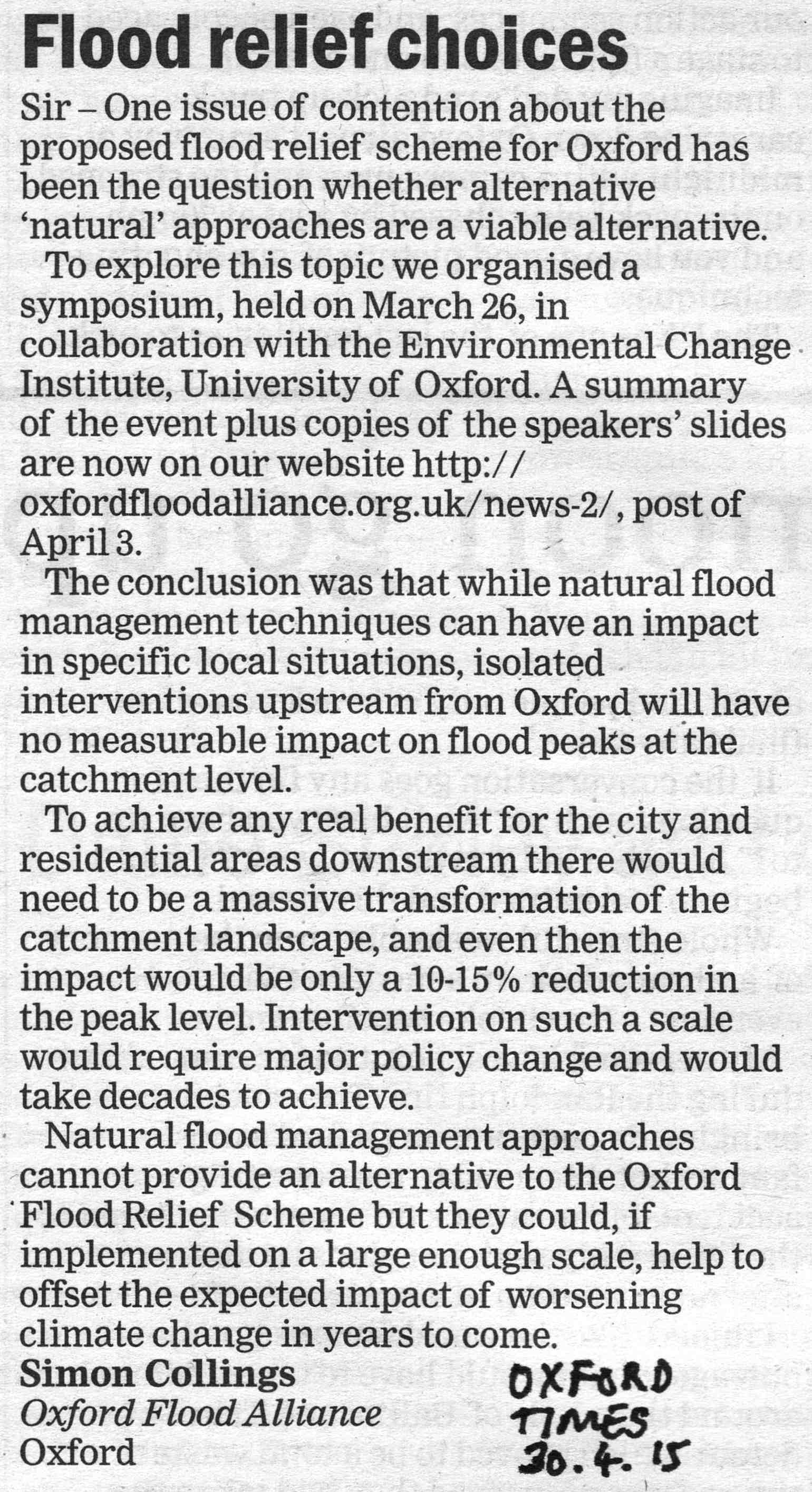
Letter to Oxford Times, 30.04.2015
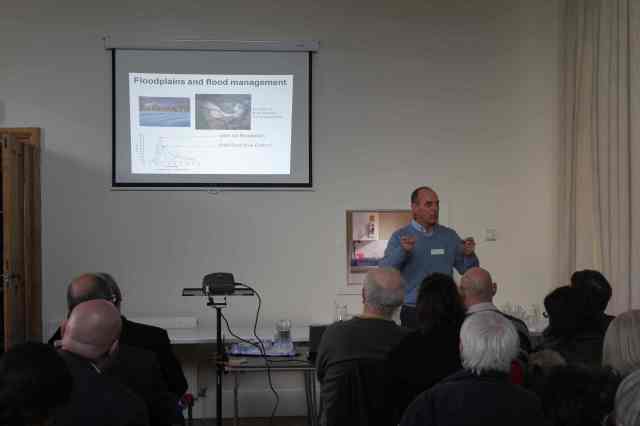
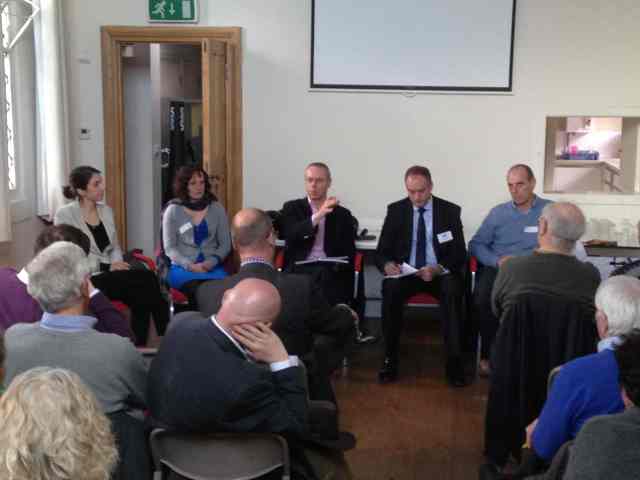
OFA symposium on natural flood management techniques : Summary Report
26 March 2015, Oxford, in collaboration with the Environmental Change Institute, University of Oxford
Could techniques such as planting trees and creating more wetlands in the upper Thames help to reduce flood risk in Oxford? This was the question we asked a number of experts to address at a symposium attended by around 60 people – a mix of academics, local residents and officials from local councils and the Environment Agency – on 26 March 2015.
Professor Mike Acreman, a rivers and wetlands expert from the Centre for Ecology and Hydrology at Wallingford, gave an overview of what science today can tell us. Prof. Acreman started by pointing out that fluvial flooding is natural, with benefits to the environment. We cannot stop it happening. He said that in theory tree cover should help to reduce runoff, through ‘canopy intervention’ and’ improved soil infiltration’ but the scientific data on this are weak. A study at Pontbren, in the Brecon Beacons, showed that soil infiltration was increased by hedges and trees. Restoration of mires on Exmoor has also shown some benefit in improved water retention. But the volumes involved are small compared to the total volume of water involved in a flood event. Foresting small areas of a catchment might bring localised benefits, but would have no measurable effect at the level of the wider catchment. To impact the whole catchment change to the landscape would be required on a massive scale, and even then this would have very limited impact in a major flood: soil can only retain so much water. During a period of prolonged rainfall the ground becomes saturated, as happened in late 2013 in the Thames catchment. Any additional rainfall simply drains into the river system. He also explained that interventions which have local benefits may have unintended consequences downstream. Flooding has temporal as well as spatial scale effects, and delaying the peak from a tributary can result in it being superimposed on the peak in the main river, rather than arriving before it, so increasing the overall peak level. Prof. Acreman argued that we need a mix of conventional engineering approaches, and enhancement of natural processes, to effectively manage risks.
Lydia Burgess-Gamble, a research scientist with the Environment Agency, talked about the work the agency is doing on natural flood-management (NFM) techniques. She explained that since the Pitt Report on the 2007 floods the EA has been engaged in more work of this kind and a small number of schemes have been established, with positive early results. These are small, localised interventions such as the 30 attenuation ponds (10,000 m3 of storage) built on 10 km2 of farmland around the village of Belford in Northumberland. In Pickering in North Yorkshire conventional flood defences have been supplemented by woody dams and tree planting by the Forestry Commission. Here the aim is to reduce flood risk from 25% a year to 4% by arresting flow in a ‘flashy’ beck which runs through the town. In the Thames valley there has been work including leaky dams slowing runoff into the Evenlode at Honeydale Farm. Flooding in Stockton-on-Tees is being tackled through building 40 storage ponds in locations identified through modelling. This scheme is at the initial stages of implementation. The EA plans more of these projects, creating ‘opportunity maps’ and working with natural processes where there is potential to achieve ‘healthy catchments’. ‘Catchment laboratories’ (including data collation and workshops) are proposed, building on ‘green engineering’, but there remain many knowledge gaps and the full impact of these types of interventions will not be understood for some time. Lydia said NFM was one tool only.
Derek Holliday of the CLA, which represents farmers and other landowners who together manage 70% of the land in England, described the major shift which has occurred in the last 10–15 years away from subsidies for crop production towards payment for ‘ecosystem services’. He argued that even bigger shifts need to happen but this requires a clear policy framework – farmers need to make spot decisions between land management options, and his members say they tend not to have the necessary information to favour flood-friendly options. They also worry about the `reversibility’ of these options, policies being changed. Without a clear framework, landowners will not make the investments which change would require.
With the fourth speaker, Nathalie Schaller from the Environmental Change Institute at the University of Oxford, we changed tack slightly and looked at climate change and its likely implications. After each extreme weather event the public wants to know if ‘climate change’ was a contributing factor – but limited research has so far been done. Nathalie presented the results of a study of the degree to which human-generated greenhouse gases increased the likelihood of the Jan/Feb 2014 floods in the UK: this type of approach is known as ‘event attribution’. A large number of computer simulations were run for different scenarios to try to separate out anthropogenic carbon from underlying climate variation. The study found that human activity had on average increased the risk of the 2014 floods happening by 40%. The implication of this for the future is that extreme weather events are likely to be more common.
Following the presentations there was discussion, with the presenters responding to points from the audience. The conversation ranged across many issues and it is not possible to capture all the points made. The overall conclusion was that natural flood-management techniques can bring benefits in smaller catchments, especially in lower-order flooding events. Isolated projects in the upper Thames would, however, have no measurable impact on Oxford with its large catchment (about 2,500 km2 upstream). A complete re-landscaping of the Thames catchment might, if it could be achieved, reduce flood peaks by 10–15%. Achieving the transformations in land-use necessary to deliver this benefit would require radical new legislation and/or a new culture, taking ‘around 40 years’ to implement. As a means of addressing flood risk in the city ‘natural’ methods would not replace the proposed flood relief scheme for Oxford and Abingdon, but might help prolong its life expectancy.
An interesting point of detail concerned the role of insurance companies which in theory should have an interest in funding flood-risk reduction measures for land, but which are not incentivised to make such investments.
There was also some discussion of groundwater, which is a major contributor to flooding in Oxford, over and above fluvial flooding. There appeared to be little which could be done to reduce groundwater at a macro level directly. Lowering surface water levels tends to lead in due course to lower groundwater levels.
There is potential scope for natural flood management techniques to benefit small communities, depending on the local catchment characteristics. There is still much to understand about what does and doesn’t work, and in what context, but the Environment Agency and others are establishing more schemes and are keen to implement projects in the Thames catchment if suitable sites can be identified.
These links download pdfs of this Summary Report, and of three of the speakers’ presentations:
OFA Symposium 2015, NFM and Oxford, Summary Report + links
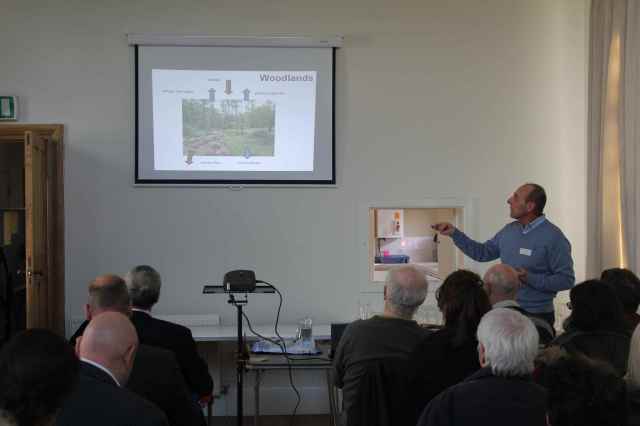
On 26 March 2015 South Hinksey Village Hall was packed to capacity, with over 60 people attending the Second OFA Flood Symposium, organised in conjunction with the Environmental Change Institute, University of Oxford. The afternoon was devoted to Natural Flood Management and Climate Change, particularly in relation to Oxford.
Prof. Mike Acreman is a wetlands specialist from the Centre for Ecology and Hydrology, Wallingford. Dr. Lydia Burgess-Gamble, a research scientist with the Environment Agency, has national oversight of research on natural flood management techniques. They opened the meeting with two excellent presentations on natural flood management, its potential and its limitations.
Derek Holliday, National Head of Environment at the CLA gave us an enlightening insight into the problems, economic and practical, faced by landowners and farmers in relation to what they may be able to do to reduce flood risk on their own land or elsewhere.
Dr. Nathalie Schaller, leader of the research project ‘Human influence on climate in the 2014 Southern England winter floods and their impacts’, Environmental Change Institute, Oxford then gave us a wonderfully clear account of this project, suggesting that anthropogenic factors may well have played a part in these floods – with obvious implications for the future.
The success of the afternoon can perhaps be judged from the wide-ranging and lively discussion which followed for well over an hour.
More detail on the main messages which emerged during the afternoon will be published on this website soon.
Oxford Flood Alliance are hosting their Second Flood Symposium this week, in collaboration with the Environmental Change Institute, University of Oxford. The meeting is fully subscribed.
The topic is Natural flood management, climate change and Oxford.
We will publish a summary of the proceedings on this website.
Peter Rawcliffe of OFA met with Peter Collins of the Environment Agency today. Discussion was to take forward proposals to get riparian owners to undertake maintenance of local waterways.
Ownership maps will be shared; a site visit was arranged for 19 March to the Coldharbour area of Hinksey Stream where there is serious, longstanding, obstruction; we hope a representative from Oxford City Council will be able to attend too.
16 October 2014
Our own Annual Public Meeting is on Thursday 13th November 2014, 7 for 7.30pm, the Demos, Osney Island, Oxford.
All welcome. Come and learn more about the Oxford Flood Alleviation Scheme and long-stretch maintenance.
Ask us questions, tell us what you think, discuss topics such as upstream storage and delaying run-off. Anything about flooding.
14 October 2014
Some key points
1 October 2014
OFA attended today’s OAFP meeting:
We asked the EA about progress on our proposals for working with them to ensure that riparian owners maintain the long rural stretches of waterways for which they (the owners) are legally responsible. The EA have prepared an ownership map as we agreed when last we met, so we hope to meet with them again soon.
The problem of flood water (groundwater?) in the back gardens on both sides of Earl Street was discussed. It is hoped that pumps in two gardens and property-level protection will resolve the problem: OFA and the City Council are working together on it.
OFA’s recent reconnaissance trip by canoe from South Hinksey to Redbridge discovered several serious obstructions, trees and so on. We showed photographs of some of them today and they have been reported to the EA as needing removal.

28 September 2014
Four of us were interviewed by Japan’s NHK for a television documentary on climate change. NHK is Japan’s national public broadcaster, and Japan’s largest broadcasting organization. The interviews and filming covered OFA’s evolution as a community organisation and what we have done, and the problems of flooding and measures taken to reduce its impact as exemplified in the Botley Road area and South Hinksey, while John Mastroddi highlighted the important multi-partner project at Munday’s bridge. The Committee on Climate Change, Thames Estuary 2100, Thames Barriers and others will form part of the programme too – it’s due out in Japan (with subtitles!) in November and internationally in December.
2 June 2014
A new member for our Steering Group
Adrian Porter, of South Hinksey, has accepted our invitation to join the OFA Steering Group. We are delighted: he is already knowledgeable and active on flooding and will be a great asset to OFA.
 oxford flood alliance