
We have submitted comments on the route options for the Oxford Flood Alleviation Scheme. You can read them here.
Tag Archives: Oxford Flood Alleviation Scheme
Brainstorm meeting: maintaining OFAS
We hosted a meeting today to discuss how we could maintain the Oxford Flood Alleviation Scheme for both flood relief and the environment over the next century. We had an excellent meeting: in attendance were Rodney Rose (County), Chris Brown (County), Bob Price (City). Penny Burt (EA), Emma Formoy (EA), Giles Strother (BBOWT), Jeremy Biggs (Freshwater Habitats Trust), John Mastroddi (OFA), Nick Hills (OFA), Adrian Porter (OFA), Tim Treacher (SOFAG), Rachel Sanderson (OPT), Judy Webb (ecologist and Ashmolean Rare Plants Group), Peter Rawcliffe (OFA), Simon Collings (OFA), Peter Thompson (Civic Society), Peter Lefort (CAG).
The main question: ‘How might we best organise things to keep the channel working well and make the best of all the benefits over the next 100 years?’ There was excellent discussion with the following conclusions:
There was a general agreement with the idea of coordinating management of OFAS, and that this could bring cost savings and enhanced benefits from the scheme.
It is currently unclear what form the coordinating body would take but it is clear that riparian owners will continue to own their land and will be responsible for managing that land. Their participation in the coordinating structure is therefore key.
More detail about exactly what the required maintenance will be, and how this splits across hard physical assets, the stream and the secondary channel is needed before a further discussion.
In the meantime it was agreed that work to consolidate the ecological vision for OFAS was needed. Conversations are already going on with various stakeholders about this and a draft set of ambitions exists. It was agreed that we should build on these.
Further public drop-in meetings for Oxford Flood Alleviation Scheme
Further public drop-in sessions are now arranged for the Oxford Flood Alleviation Scheme. These are for people to see and comment on the various options developed for the channel, ask questions and make comments and suggestions. The consultation will be available online as well.
All are from 2:30 to 7 pm – come when you like:
- Tuesday 19 January Oxford Town Hall, OX1 1BX
- Wednesday 20 January Abbey House (Council Offices), Abingdon, OX14 3JE
- Friday 22 January South Oxford Community Centre, OX1 4RP
- Wednesday 27 January Kennington Village Centre, OX1 5PG
- Thursday 28 January West Oxford Community Centre, OX2 0BT.
Storm Desmond, flooding and climate change
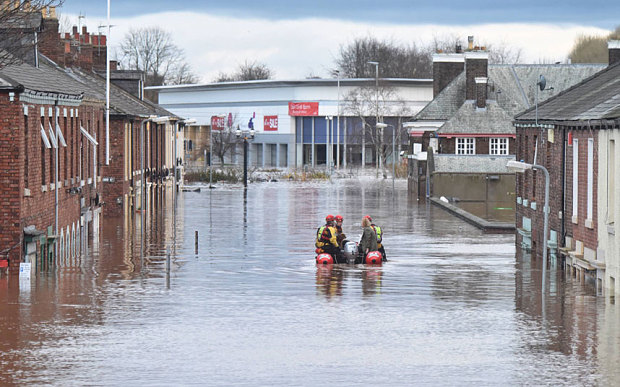 Corporation Road, Carlisle (Photo: North News)
There has been widespread and severe flooding in Lancashire and Cumbria due to unprecedentedly heavy rainfall in a short period from Storm Desmond. One feels for the people affected, many not for the first time.
‘The 405mm of rain that fell in Thirlmere in the 38 hours to 8am on Sunday marked a record amount of rain ever to fall in a 48-hour period while the 341.4mm recorded at Honister Pass on Saturday broke the highest rainfall record for any 24-hour period.’
‘Dame Julia Slingo, the Met Office’s chief scientist, said the “extraordinary” conditions were likely the result of climate change. Her comments were echoed by Liz Truss, the Environment Secretary, who told MPs: “Climate change is factored into all the modelling work the Environment Agency does but clearly in the light of this extreme weather we are going to have a look at that modelling and make sure it’s fit for purpose.” ‘http://www.telegraph.co.uk/news/weather/12038356/Floods-caught-ministers-by-surprise.html
‘Prof Hall [Professor Jim Hall, director of the Environmental Change Institute at the University of Oxford] said there was always a trade off between costs and risks. Nevertheless, he added that the latest floods “should be a trigger for a revaluation of protection standards”.’ http://www.ft.com/cms/s/0/57b91e9c-9cf1-11e5-8ce1-f6219b685d74.html#axzz3tiucxtde
There is more on the relation between flooding and climate change here http://www.belfasttelegraph.co.uk/news/uk/heavy-rain-and-flooding-fit-with-climate-change-predictions-34268682.html
Extreme weather events associated with climate change are already more common: we need to make sure the assumptions used in the modelling of the Oxford Flood Alleviation Scheme (Oxford FAS) sufficiently take into account the effects of climate change.
Climate change – Paris 2015
 There is lots of attention on climate change just now with the United Nations conference COP21* coming up next week. Whether governments will agree enough, and then do enough, to hold any increase in global warming to 2˚C remains to be seen. Limiting the average global surface temperature increase to 2°C over the pre-industrial average has generally been regarded as an adequate means of avoiding dangerous climate change – though there is some doubt about whether this is sufficiently stringent.
Whatever happens, we can expect an increasing frequency of extreme weather and we need to be investing in ways of mitigating the impact. As far as Oxford and the threat of flooding is concerned that, in our view, means the Oxford Flood Alleviation Scheme (Oxford FAS). See too a previous post on Oxford FAS and climate change .
* COP21 is the 21st Conference of the Parties, i.e. the annual meeting of all countries which want to take action for the climate. It will be held in France, from 30 November to 11 December http://www.cop21.gouv.fr/en/.
Oxford FAS, November update
An update on the Oxford Flood Alleviation Scheme has been published today:
Notice of our Annual Public Meeting – next Thursday, November 19th
 ANNUAL PUBLIC MEETING:
THURSDAY 19 NOVEMBER 2015
At The Democrats, Osney Island, 7.30 pm. Entrance at the north end of East Street.
Doors open from 7.00 pm.
EVERYONE VERY WELCOME –
YOUR CHANCE TO HEAR THE LATEST FROM
Network Rail on their plans to clear blocked culverts under the railway north of Redbridge.
Environment Agency on the multi-million pound Oxford Flood Alleviation Scheme (FAS) (Western Conveyance)
Thames Water on their major review of Oxford’s sewers.
ALSO
Hear our ideas on how Oxford FAS might be maintained not only for flood alleviation but also for wildlife.
Local planning applications, Weirs Mill Stream – and more.
OFAS: drilling a borehole
-
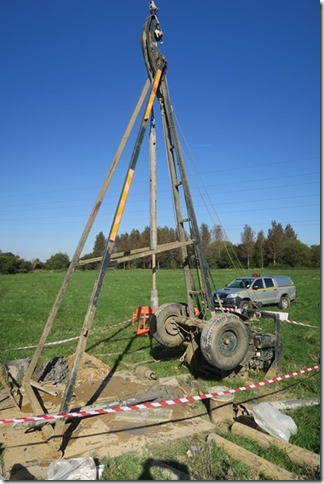
- A-frame percussive drill
-
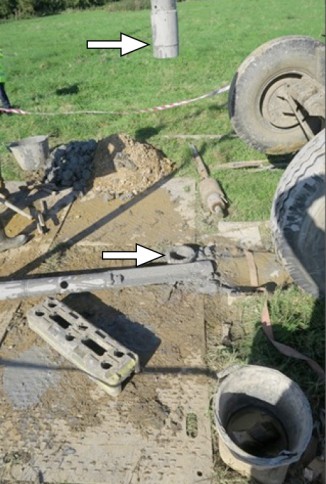
- Drill and hole, arrowed
-
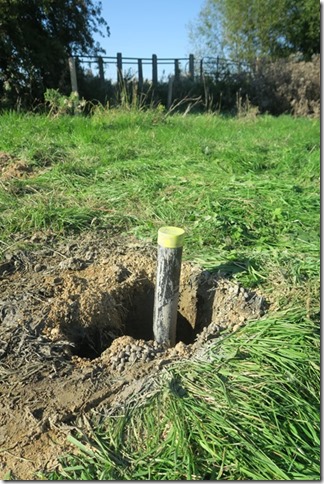
- Capped pipe
Oxford FAS ground investigations: a borehole being drilled this afternoon in South Hinksey.
The A-frame percussive drill dug 9 metres down, below the alluvial layer, the gravel layer and 5 metres into the clay.
The capped pipe is a monitoring site where the changes in ground water depth over time can be observed.
OFAS: ground investigations under way
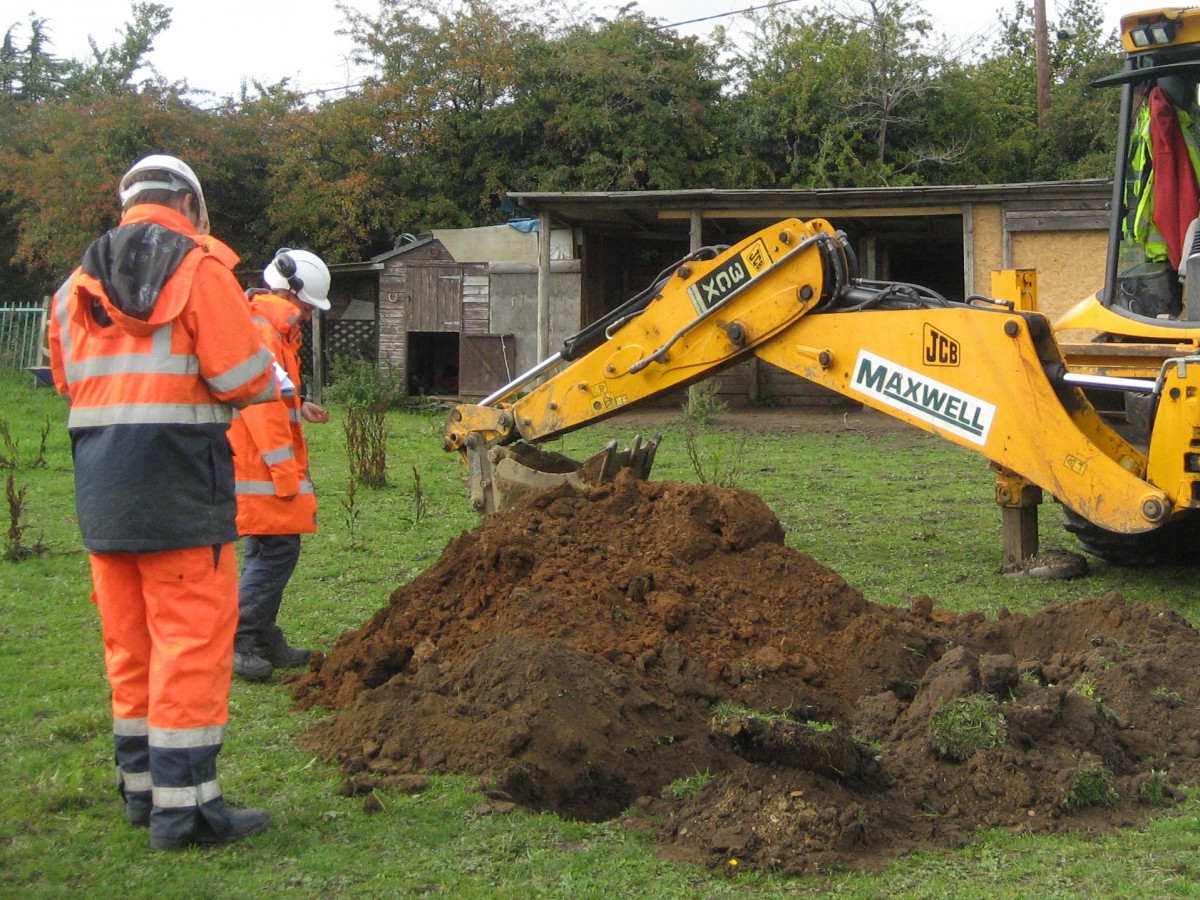 Test pit being dug at South Hinksey, 24 September 2015
Test pits are being dug and boreholes drilled over the flood plain below the Botley Road to examine what the ground consists of. Evidence of significant archaeology is also checked for. The information will be used to inform the modelling and planning for the Oxford FAS.
‘Drilling for Oxford’s relief channel begins’ http://www.bbc.co.uk/news/uk-england-oxfordshire-34287878
‘Oxford Flood Alleviation Scheme: ground investigation work begins’ https://www.gov.uk/government/news/oxford-flood-alleviation-scheme-ground-investigation-work-begins
 oxford flood alliance