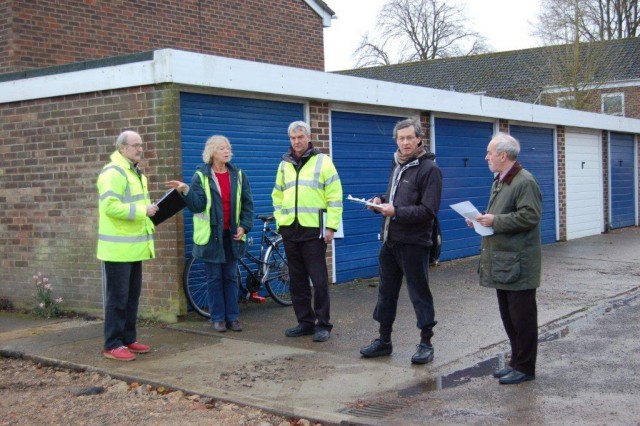
Nicola Blackwood MP visits Earl Street

10 June 2010

Nick Hills, Richard Thurston and Peter Rawcliffe of OFA met our new MP for Oxford West and Abingdon, Nicola Blackwood, in Lamarsh Road on Saturday 5 June. Nicola came to see and hear for herself about the severe and recurrent flooding of about 60 homes in Earl and Duke Streets, the reasons for it – and what OFA has proposed to reduce the risks of further flooding here.

We are delighted that Nicola has said she will support this initiative which could bring relief to many households. She is writing to the Environment Agency asking for details of the cost/benefit analysis, which is currently under way, as soon as it is completed. She will then help us to press for funding and urgent action with the three authorities involved: City, County and Environment Agency.

‘Building on Success’

16 March 2010

‘Building on Success’ is the name we’ve chosen for our new suggestions for further reducing the risk of flooding of the City of Oxford and the surrounding area.

The title reflects the real improvements since 2007 – but that at the same time there is more to be done. Our suggestions are modest, achievable and we believe are very good value for money. It’s not doing them that will be seen to be expensive when the heavy rains come again, as, inevitably, they will.

Reducing flooding is important for the whole community:

• flooded individuals and flooded families, who may be out of their homes for months
• businesses out of action or their trade affected
• travel disrupted, difficulties in getting to work and getting about by road and rail
• power cuts
• emergency services at full stretch
• huge financial costs for individuals and businesses who are flooded
• huge financial costs for everybody else – costs to commerce, to City, District and County Councils, and nationally.

A city that keeps flooding is expensive and bad for everybody. That’s why we’re asking organisations who up to now have had nothing directly to do with flooding to join us in trying to keep Oxford dry. We don’t yet know for sure, but climate change may well make flooding worse.

We’re holding a meeting next week to launch our suggestions. We’ve invited people from various authorities and Oxford groups. We’re asking politicians, at all levels, to help us. We’ll let you know what they say and how we get on.

Building on Success, OFA, March 2010

The three pinchpoints

01 February 2010

The three pinchpoints we targeted at Redbridge have now been dealt with. Last to go, the level crossing bridge which was obstructing the Main River at Redbridge known as Hinksey Drain (see here), has now been completely removed by Network Rail.

More work still needs to be done at Munday’s. In the much longer term a way may need to be found to get water under the railway even more effectively.

Earl and Duke Streets

31 January 2010

Work has begun on the next stage to help Earl and Duke Streets, Oxford. Thames Water, in conjunction with Oxfordshire County Council, is connecting gullies in Earl Street into the existing underground pumps so flood water can be pumped away more quickly. This is being done by connecting the pump chamber to a chamber in Lamarsh Road (Oriel Mews), which is, in turn, to be connected to the main run of surface water gullies in Earl Street.

Hinksey Stream cleared

30 January 2010

The OFA Flood Blackspot of July 2009 was the Hinksey Stream from North Hinksey to Redbridge, which badly needed clearing. This has now been done by the Environment Agency. It is very much better. Thank you!

Medium-Term Measures

20 January 2010

We are well on with producing our proposals for further Medium-Term Flood Measures for Oxford (see 22 Dec, Flood Scheme Postponed). Following a meeting last week of OFA’s Steering Group and our Allies from all parts of Oxford and surrounding area, everybody’s contributions are being assembled into a final document. We have decided how to present this. By the end of the month launch plans should be finalised. We believe that our suggestions will offer real hope of further significant reduction of flood risk – keeping more people dry in their homes and businesses.

Removal of the redundant level crossing bridge

19 January 2010

From our man in Kennington: “Network Rail have started the work to clear the concrete bridge.” This is the redundant level crossing bridge at Redbridge which obstructs Hinksey Drain. It is the final one of the three pinchpoints at Redbridge, that we highlighted in 2007, to be dealt with. Very good news indeed!

The photos show before, during and after:

Flood scheme postponed

22 December 2009

At our meeting with the EA on 8 December we were told that the 100-year flood protection scheme for Oxford had been postponed indefinitely: see EA End of Year Update, 2009.

While disappointing it is not a great surprise: we have always been doubtful whether this scheme would ever materialise. That is why for two years we have pushed, successfully, for action NOW.
We will continue to press for early action: there are 8 or 10 further measures across our area which, at modest cost, could significantly reduce flood risk, by helping to restore the floodplain to its proper function, keeping water flowing through rather than accumulating. This should help to keep people dry from all but the most extreme events. The Environment Agency of course shares this aim. We will continue to work closely with the Agency; we believe we need to define a new Medium-term Flood Strategy for Oxford. We will be looking to our politicians, both locally and nationally, to ensure that the necessary works are fully funded, so that the serious threat facing thousands of homes and businesses in Oxford is reduced. We have begun to formulate our response. We will have decided how to proceed by the second or third week of the new year.

Site meeting, West Oxford Inter-Agency Working Party

At this morning's meeting, from left to right: Nick Hills (OFA), Susanna Pressel (City and County Councillor), Keith Lead (Environment Agency), Paul Kirkley (Oxford City Council) and John Copley (Oxford City Council). Also present were Steve Smith (Oxford City Council) and (taking this photograph) Andy Webber (OFA).

At this morning’s meeting, from left to right: Nick Hills (OFA), Susanna Pressel (City and County Councillor), Keith Lead (Environment Agency), Paul Kirkley (Oxford City Council) and John Copley (Oxford City Council). Also present were Steve Smith (Oxford City Council) and (taking this photograph) Andy Webber (OFA).

7 December 2009

A site meeting this morning successfully settled the operational details for the new flood wall and associated sandbag wall at Bullstake Close. Who will monitor flooding at the wall and the criteria for maintaining or reducing the sandbag wall have been agreed.

Operation of the Penstock valves installed recently by Thames Water, to protect the drains of Earl and Duke Street from inundation from north of the Botley Road, was similarly considered and agreed.

Personnel from Oxford City Council will be given the necessary training for carrying out these operations.

A written plan will be prepared.

OFA Annual Public Meeting, 2009

3 December 2009

We had a successful meeting on 26 November 2009. Over 80 people attended, from all our areas and including City Councillors, County Councillors and Prospective Parliamentary Candidates. We welcomed Charles Tucker, Vice-Chair of the National Flood Forum who spoke of the work of the NFF, including currently in Cumbria. The Wolvercote Commoners have recently joined the Alliance and we were pleased to have Nigel Walmsley attending on their behalf.

Bottles of “OFA 2009, Special Star Reserve” wine were presented to our new Flood Stars Susanna Pressel and Nigel Bray, who were thanked for all they had done for flooded people in the area. Mary Timbrell, our third Star, could not attend as she was away, but a bottle awaits her return.

The meeting resolved to send a message of support to Cockermouth and Keswick. (This has now been done.)

Members of the Steering Group presented a review of the past year’s achievements, and looked forward to next year.

A lively discussion followed with many contributions from the floor. OFA was thanked by the audience for what it had achieved so far.