Thoughts on OFAS

Why do we need a flood scheme at all?

We have had five major floods since 2000 and climate change will make things worse (indeed there is evidence from Oxford University that it already has). Oxford residents, and the economic well-being of the City, will suffer badly if something is not done. While the scheme will cause disruption during its construction it is imperative that Oxford is protected.

But what about downstream, won’t they be worse off?

All the detailed computer modelling for the Scheme (and we have recently heard on the grapevine that a totally independent consultancy has confirmed this ) says that flooding will not be made worse downstream. We know that comparisons are made with the Jubilee River – this scheme is nothing like that. Indeed OFAS is actually increasing the capacity of the floodplain, which together with bunding and rerouting of flow will reduce flood risk to many hundreds of properties.

Is it a concrete channel?

No, it isn’t. What it is is a much more naturalistic 2-stage channel, used around the world for flood relief.

How will the environment be affected?

While there will, regrettably, be some environmental losses, we are pressing hard – collaborating with the Environment Agency, and with support from others, particularly the Freshwater Habitats Trust – for environmental enhancements as part of the scheme. While one cannot compare one environmental loss directly with another environmental gain we believe the positives will be considerable.

Maintenance.

It’s so important that there is a plan now for the very long-term maintenance of the Scheme. In our experience over the last 10 years  “if maintenance can be neglected it probably will be”. There are some honourable exceptions and we certainly have we have no criticism whatever of the local EA maintenance team, who achieve a huge amount with very limited resources. Others do nothing or very little unless goaded and embarrassed into action. This Scheme, being “natural” will deteriorate quickly if not proactively maintained. The initial intent was to plan maintenance for 10 years: that is simply not good enough for such an expensive and important project. We have proposed that maintenance be planned for in perpetuity by setting up a responsible, funded, local body, maybe as a charitable trust (or similar).

A Green group

thinks that Oxford could and should be protected by very different means – while they are short on specifics, their main idea seems to be that planting enough trees upstream in the Cotswolds would solve Oxford’s problems. It wouldn’t. Expert opinion at our 2015 Symposium of Natural Flood Management (NFM)  made that very clear. Even afforesting the whole of the Cotswolds (not that that would ever happen) would not do the job. Oxford is simply too far downstream for that. That’s not to say that NFM can’t work in smaller catchments, nor that it might not make a contribution.

Flooding land upstream?

The Environment Agency’s Oxford Flood Risk Management Strategy (OFRMS) suggests this may be needed one day if climate change makes things sufficiently bad. Involving as it would temporary flooding large areas of farmland and other land it is never likely to be easy to implement.


Maintenance and wildlife

We met with the Environment Agency (EA) and Jeremy Biggs of the Freshwater Habitats Trust (FHT) today.

We talked about articulating an environmental vision for the Oxford Flood Alleviation Scheme (the Scheme) which brings together the various initiatives which are planned and how these will be managed and maintained. This included possible bodies/corporate structures that might be involved in overseeing maintenance in the long-term, to deliver both flood risk reduction and benefits for wildlife. We are working towards a preferred option for the future management arrangements.

FHT is hoping to facilitate community involvement in the conservation of freshwater habitats within the Scheme area – for example by employing someone to liaise with local people, including schools, so they can be involved in wildlife science in the floodplain. Part of the funding has been secured by a generous offer of funding from Thames Water, and FHT and EA will now approach other bodies together.

OFA is about to send letters asking local businesses to contribute funding to help close the small funding gap that remains for the Scheme.

OFAS: Environmental meeting

Attended an environmental update meeting yesterday, organised by the EA with a number of local environmental stakeholders attending. A lot of thought is going into making the most of possible environmental enhancements that the Scheme can bring.

Led by Penny Burt of the Environment Agency we covered surveys, ecological trial areas, archaeology, low-flows and existing watercourses, fish passage, Hinksey Meadow, trees and bridges, habitat creation and access. Also mentioned was future maintenance – we felt that the plans were not nearly long-term enough and this was discussed.

For our part we are working closely with the Freshwater Habitats Trust. The Oxford area is rich in freshwater species, though there is, nevertheless, a long term decline: this Scheme could help reverse that trend. We’d like to give the public, including school children, a chance to be involved, including with data collection in the field – sometimes called ‘citizen science’.

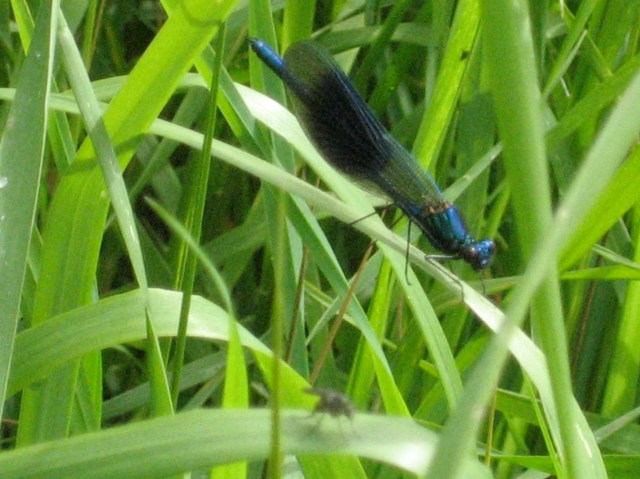
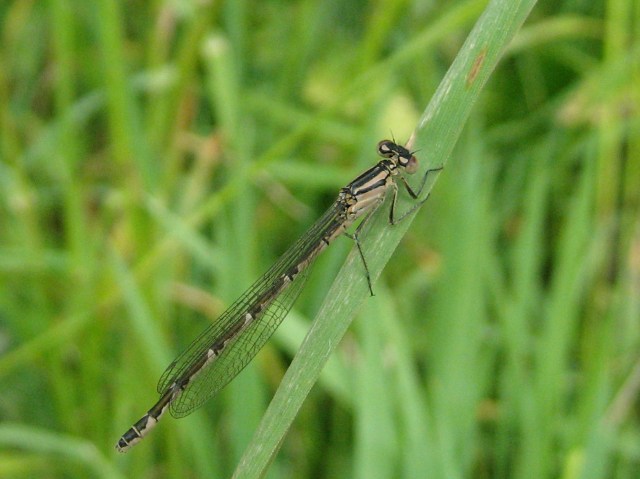
The damselflies in the photographs are closely associated with the freshwater habitat.

‘Oxford and the Thames: a national hotspot for freshwater wildlife’

Talk on 29 June by Jeremy Biggs of the Freshwater Habitats Trust

Jeremy Biggs gave an interesting and inspiring talk, ‘Oxford and the Thames: a national hotspot for freshwater wildlife’, in South Hinksey yesterday; it was well attended by professionals and members of the public alike.

The overall message was that the Oxford area, including (but much wider than) the area of the OFAS channel, is of relatively high quality (on a national scale) for freshwater wildlife. Nevertheless, there have been local extinctions and a gradual decline over the last century. Clean, unpolluted water is vital to any attempt to reverse the decline.

A lively discussion followed.

To make the most of the possible environmental enhancements from the OFAS scheme more detailed proposals will be developed. More could be achieved if additional, separate funding could be obtained. Such work could make a contribution to reversing the gradual decline and enable lessons to be learnt as to how to do this best.

See also Oxford and the Thames_talk flyer_Jun16 FINAL

A talk: Oxford and the Thames – a national hotspot for freshwater wildlife

Later this month,  Dr Jeremy Biggs of the Freshwater Habitats Trust will be giving a talk at South Hinksey Village Hall, on Wednesday 29 June at 2pm titled Oxford and the Thames: a national hotspot for freshwater wildlife, in association with the Oxford Flood Alliance.
 
He’ll look at what makes the Oxford area a national hotspot for freshwater wildlife, what problems freshwaters in the area face and what the solutions are. He’ll consider what the impact of the new flood channel could be and how it could help reverse the century-long decline in the areas freshwaters. There is more information at http://freshwaterhabitats.org.uk/news/oxford-and-the-thames-a-national-hotspot/ or in the flyer Oxford and the Thames_talk flyer_Jun16 FINAL.
  

The talk is free and anyone may attend but space is limited so if you think you would like to come along please let Jo Fever at Freshwater Habitats know so we can try and ensure there is space for all: info@freshwaterhabitats.org.uk or phone 01865 595505.


Clean Water for Wildlife – II

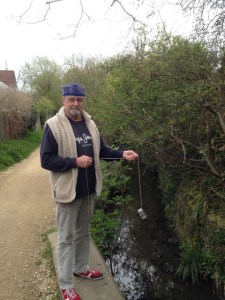
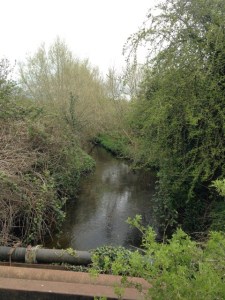
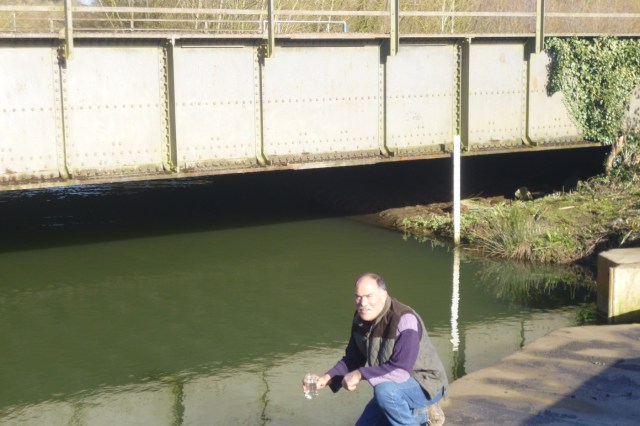
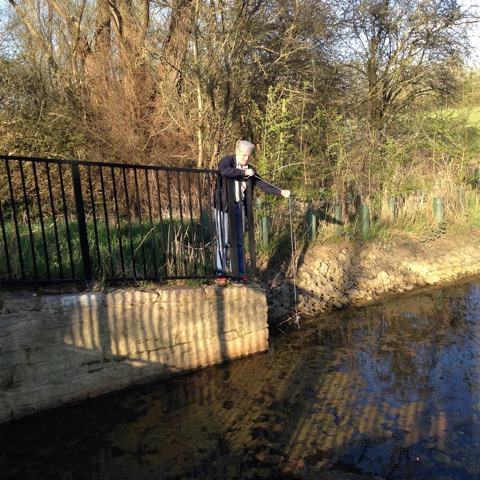
This study has now closed – we contributed results on samples from 31 locations (a few are shown above) – see previous post Clean Water for Wildlife.

As far as we know, this study, by the Freshwater Habitats Trust, is the first of its kind in the UK.

We’ll post the results when they become available.


Clean Water for Wildlife


We’ve been lending a hand with the Freshwater Habitats Trust’s ‘Clean Water for Wildlife’ survey. This part of their survey covers the ‘Ock catchment’ which (bizarrely) includes Oxford.

We believe that the Oxford FAS can provide benefits to wildlife alongside the flood risk reduction. Quality of water is important to any such aspiration, so work such as this survey is very important.

Anyone wanting to help can find out more at freshwaterhabitats.org.uk/projects/clean-water.

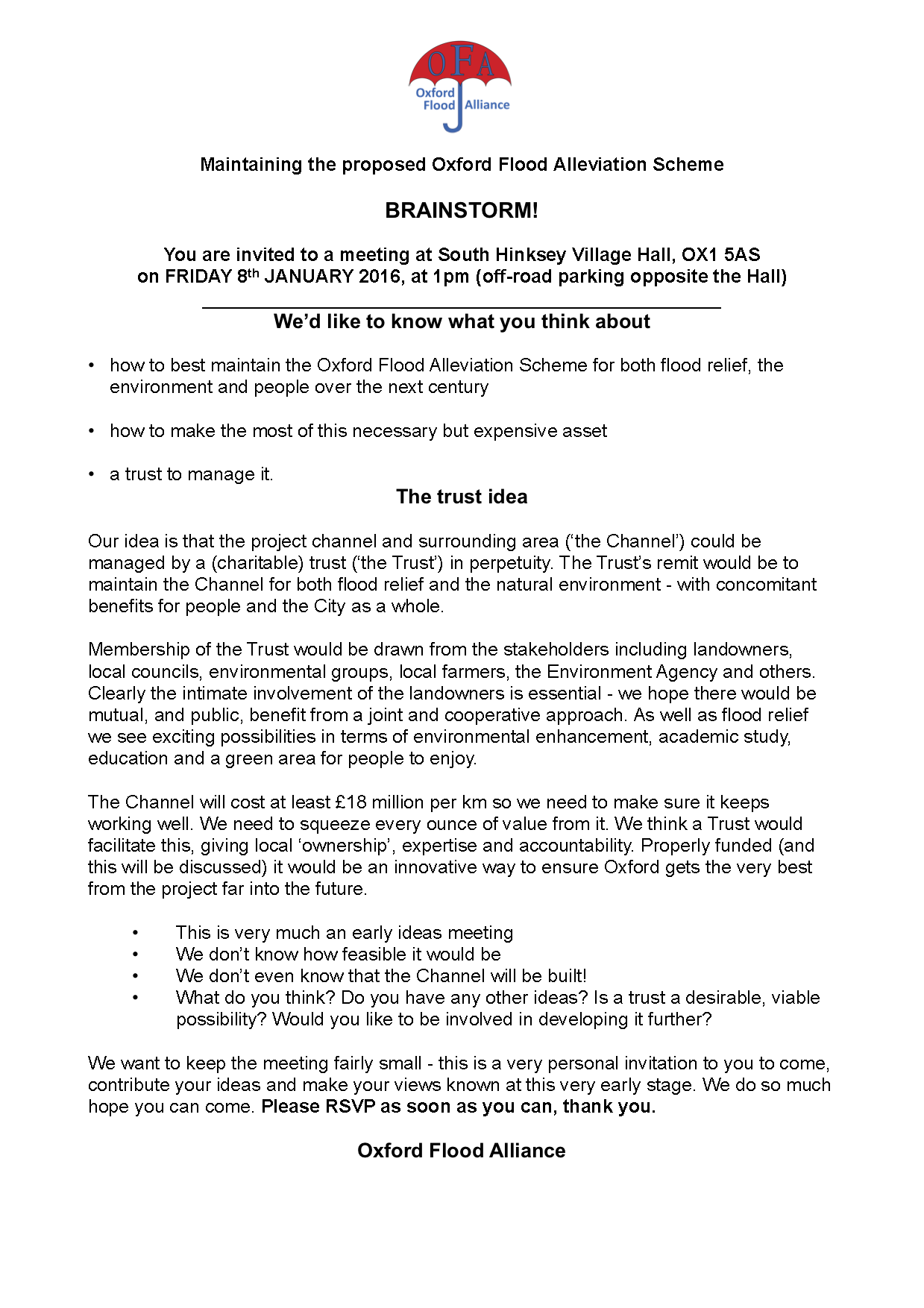
Brainstorm meeting: maintaining OFAS

We hosted a meeting today to discuss how we could maintain the Oxford Flood Alleviation Scheme for both flood relief and the environment over the next century. We had an excellent meeting: in attendance were Rodney Rose (County), Chris Brown (County), Bob Price (City). Penny Burt (EA), Emma Formoy (EA), Giles Strother (BBOWT), Jeremy Biggs (Freshwater Habitats Trust), John Mastroddi (OFA), Nick Hills (OFA), Adrian Porter (OFA), Tim Treacher (SOFAG), Rachel Sanderson (OPT), Judy Webb (ecologist and Ashmolean Rare Plants Group), Peter Rawcliffe (OFA), Simon Collings (OFA), Peter Thompson (Civic Society), Peter Lefort (CAG).

The main question: ‘How might we best organise things to keep the channel working well and make the best of all the benefits over the next 100 years?’ There was excellent discussion with the following conclusions:

There was a general agreement with the idea of coordinating management of OFAS, and that this could bring cost savings and enhanced benefits from the scheme.

It is currently unclear what form the coordinating body would take but it is clear that riparian owners will continue to own their land and will be responsible for managing that land. Their participation in the coordinating structure is therefore key.

More detail about exactly what the required maintenance will be, and how this splits across hard physical assets, the stream and the secondary channel is needed before a further discussion.

In the meantime it was agreed that work to consolidate the ecological vision for OFAS was needed. Conversations are already going on with various stakeholders about this and a draft set of ambitions exists. It was agreed that we should build on these.

Annual Public Meeting 2015

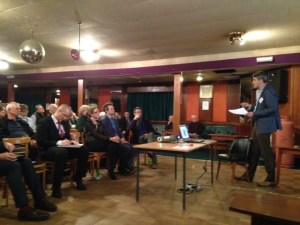
Our Annual Public Meeting on 19 November was well attended – we were delighted to welcome many members of the public, local councillors, representatives of all the local flood agencies, an Oxford University researcher and Andrew Smith, MP for Oxford East. Nicola Blackwood, MP for Oxford West and Abingdon, and Rodney Rose, Deputy Leader of Oxfordshire County Council, sent their apologies.

Adrian Porter began the evening by setting out our three key current objectives:

  • support for the proposed multi-partner Oxford Flood Alleviation Scheme (Oxford FAS)
  • maintenance of existing waterways
  • that as and when the Oxford FAS happens, maintenance should be properly provided for from the start.

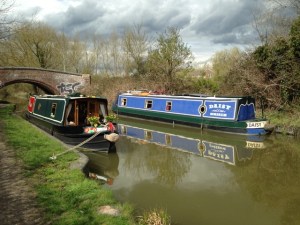
He went on to give an overview of the past year including our recent boat trip, with the Environment Agency, which identified necessary maintenance on Weirs Mill Stream: this work is being planned and funding being sought. John Mastroddi provided detail on the clearance under Munday’s bridge, which completes the project begun in 2013. Impending planning applications at Seacourt P&R and Oxford Four Pillars Hotel, both firmly in the floodplain, are on our radar.

Nick Hills, our Treasurer, told us that we had £346 in the bank, enough for several years at the present rate of spending! Nevertheless, being the good treasurer he is, he asked people to leave any donations as they left: this raised a very generous £110. Nick set out some of the things we’d been pleased to see in the year: among those not referred to in more detail later on were the permanent pipe under the Botley Road to allow pumping across the road without disruption to traffic (County and City Councils), Waitrose’s use of SUDS at their new shop and the successful public events for OFAS during the summer.

He explained how we support OFAS in principle and are contributing to the process along with the other partners – but always reserving the right to be a ‘critical friend’.

The first of our guest speakers, Joanna Grew from Network Rail, gave an account of their proposed Hinksey Flood Alleviation Scheme: this includes the clearing of culverts at Coldharbour (for which we have been pushing for some time), track raising and installation of new culverts. More detail can be seen in Joanna’s presentation downloadable here. You can download a leaflet about the scheme here.

James Playfair explained the progress of Thames Water’s ongoing sewer survey across Oxford, the Oxford Catchment Study. This is about to enter its second year: already some issues have been resolved including significant improvements to the pumps at Littlemore Pumping Station. The presentation can be downloaded here.

Last but not least Emma Formoy from the Environment Agency gave the meeting an up-to-date account of the Oxford FAS; Emma mentioned the possible wider benefits of the scheme, including for wildlife, and the crucial importance of rigorous modelling. More detail in the presentation downloadable here: this includes dates of the next round of Public Events in January 2016 when a consultation on the route options for the scheme will begin. These can be also seen in the Oxford FAS Newsletter – November 2015, perhaps more easily. In parallel with these events, people will be able to view these proposed options and partake in the consultation online.

Apart from these individual achievements and plans, what is remarkable, and heartening, is the considerable cooperation, for example sharing of modelling data, between these three agencies – i.e. they talk to each other! As one of us commented later, we have come a very long way since 2007. We are grateful to our guests for coming to talk and for all the work their organisations are doing. The sum (assuming they all reach fruition) will give Oxford a better, and more secure and sustainable, future.

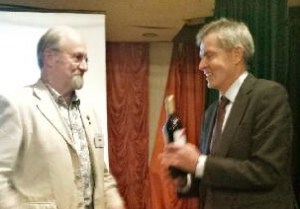
Nick Hills presented Steve Smith, Engineer with Oxford City Council, with our Flood Star award for this year. This is in recognition and thanks for Steve’s sterling work on many flood schemes and smaller works over the years, as well as co-ordinating the Oxford Area Flood Partnership.

Peter Rawcliffe spoke about OFA’s suggestion for maintaining Oxford FAS: as this is to be largely a ‘natural’ channel it will be subject to inevitable deterioration – so providing both a problem and an opportunity. OFA proposes that a trust be established, in perpetuity, to manage for both flood alleviation and wildlife. Trustees could be drawn from the several stakeholders – landowners, local authorities, Environment Agency, academics and wildlife bodies – to name just a few. We believe this is a practical way to make the most of what the scheme offers Oxford and its residents and visitors. This 7km channel will be ever more essential to Oxford if climate change develops as predicted. Each km may cost £18 million to build. We need to treasure it: in our view a local trust with local accountability, and autonomy to manage as it sees fit, fits the bill.

Simon Collings discussed modelling: as mentioned above this is absolutely vital to developing the case for OFAS – both to be as sure as humanly possible that it will work and equally importantly that no one downstream will be disadvantaged. We recently attended a meeting at the School of Geography, Oxford University: Simon explained some of the potential pitfalls of modelling that we had learned of there, and suggested that community review of the OFAS modelling (assisted by expert modellers) be included in the scrutiny process. This in addition to review by academic modeller(s) which is already under discussion for the scheme and which we strongly support.

We thank those who attended for their support and we thank our visiting speakers for helping to make the meeting a success. Our thanks too to the West Oxford Democrats Club for generously allowing us to use their hall once again.

Notice of our Annual Public Meeting – next Thursday, November 19th

Oxford Flood Alliance logoANNUAL PUBLIC MEETING:

THURSDAY 19 NOVEMBER 2015

At The Democrats, Osney Island, 7.30 pm. Entrance at the north end of East Street.
Doors open from 7.00 pm.

EVERYONE VERY WELCOME –

YOUR CHANCE TO HEAR THE LATEST FROM

Network Rail on their plans to clear blocked culverts under the railway north of Redbridge.

Environment Agency on the multi-million pound Oxford Flood Alleviation Scheme (FAS) (Western Conveyance)

Thames Water on their major review of Oxford’s sewers.

ALSO

Hear our ideas on how Oxford FAS might be maintained not only for flood alleviation but also for wildlife.

Local planning applications, Weirs Mill Stream – and more.