Further public drop-in meetings for Oxford Flood Alleviation Scheme

Further public drop-in sessions are now arranged for the Oxford Flood Alleviation Scheme. These are for people to see and comment on the various options developed for the channel, ask questions and make comments and suggestions. The consultation will be available online as well.

All are from 2:30 to 7 pm – come when you like:

  • Tuesday 19 January          Oxford Town Hall, OX1 1BX
  • Wednesday 20 January   Abbey House (Council Offices), Abingdon, OX14 3JE
  • Friday 22 January             South Oxford Community Centre, OX1 4RP
  • Wednesday 27 January    Kennington Village Centre, OX1 5PG
  • Thursday 28 January       West Oxford Community Centre, OX2 0BT.

The Paris Agreement, December 2015

COP21Nearly 200 countries, developing and developed, and including oil and gas producers, reached agreement at the COP21 conference in Paris to address climate change. This looks like the beginning of the end for fossil fuels.

The deal requires that countries should stem greenhouse gas emissions, with the goal of peaking emissions as soon as possible and continuing the reductions as the century progresses. The aim is to keep global temperatures from rising more than 2°C by 2100, ideally keeping the rise below 1.5°C.

The deal will encourage trillions of dollars to be spent adapting to the effects of climate change – including of course flooding – and developing renewable energy. Developed countries are to send at least $100 billion each year to developing countries beginning in 2020.

The agreement gives countries leeway in determining how to cut their emissions but they must report how they are doing. Progress will be reviewed every five years.

Some elements, like reporting requirements, are legally binding, others, such as the setting of emissions targets for individual countries, are non-binding.

This is potentially a game-changing agreement and has been widely welcomed. Hopefully the catastrophic possibility of irreversible and escalating change can be averted. Nevertheless, climate change is here with us and we can expect to see its effects on weather patterns continuing for the foreseeable future, with increased flooding a prominent result.

Let us hope that the implementation of the Paris agreement is as good as promised.

Storm Desmond, flooding and climate change

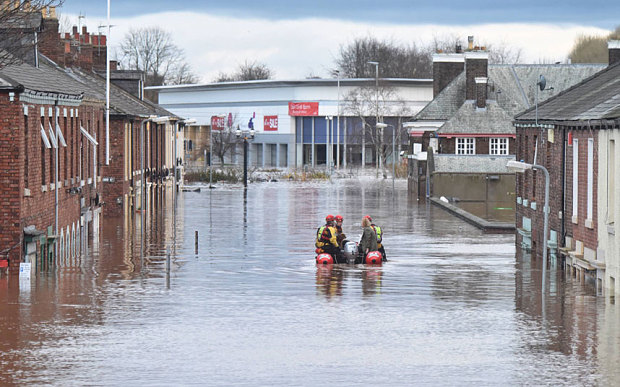
corporation road carlisleCorporation Road, Carlisle (Photo: North News)

There has been widespread and severe flooding in Lancashire and Cumbria due to unprecedentedly heavy rainfall in a short period from Storm Desmond. One feels for the people affected, many not for the first time.

‘The 405mm of rain that fell in Thirlmere in the 38 hours to 8am on Sunday marked a record amount of rain ever to fall in a 48-hour period while the 341.4mm recorded at Honister Pass on Saturday broke the highest rainfall record for any 24-hour period.’

‘Dame Julia Slingo, the Met Office’s chief scientist, said the “extraordinary” conditions were likely the result of climate change. Her comments were echoed by Liz Truss, the Environment Secretary, who told MPs: “Climate change is factored into all the modelling work the Environment Agency does but clearly in the light of this extreme weather we are going to have a look at that modelling and make sure it’s fit for purpose.” ‘http://www.telegraph.co.uk/news/weather/12038356/Floods-caught-ministers-by-surprise.html

‘Prof Hall [Professor Jim Hall, director of the Environmental Change Institute at the University of Oxford] said there was always a trade off between costs and risks. Nevertheless, he added that the latest floods “should be a trigger for a revaluation of protection standards”.’ http://www.ft.com/cms/s/0/57b91e9c-9cf1-11e5-8ce1-f6219b685d74.html#axzz3tiucxtde

There is more on the relation between flooding and climate change here http://www.belfasttelegraph.co.uk/news/uk/heavy-rain-and-flooding-fit-with-climate-change-predictions-34268682.html

Extreme weather events associated with climate change are already more common: we need to make sure the assumptions used in the modelling of the Oxford Flood Alleviation Scheme (Oxford FAS) sufficiently take into account the effects of climate change.

Climate change – Paris 2015

COP21There is lots of attention on climate change just now with the United Nations conference COP21* coming up next week. Whether governments will agree enough, and then do enough, to hold any increase in global warming to 2˚C remains to be seen. Limiting the average global surface temperature increase to 2°C over the pre-industrial average has generally been regarded as an adequate means of avoiding dangerous climate change – though there is some doubt about whether this is sufficiently stringent.

Whatever happens, we can expect an increasing frequency of extreme weather and we need to be investing in ways of mitigating the impact. As far as Oxford and the threat of flooding is concerned that, in our view, means the Oxford Flood Alleviation Scheme (Oxford FAS). See too a previous post on Oxford FAS and climate change .

* COP21 is the 21st Conference of the Parties, i.e. the annual meeting of all countries which want to take action for the climate. It will be held in France, from 30 November to 11 December http://www.cop21.gouv.fr/en/.


Annual Public Meeting 2015

Our Annual Public Meeting on 19 November was well attended – we were delighted to welcome many members of the public, local councillors, representatives of all the local flood agencies, an Oxford University researcher and Andrew Smith, MP for Oxford East. Nicola Blackwood, MP for Oxford West and Abingdon, and Rodney Rose, Deputy Leader of Oxfordshire County Council, sent their apologies.

Adrian Porter began the evening by setting out our three key current objectives:

  • support for the proposed multi-partner Oxford Flood Alleviation Scheme (Oxford FAS)
  • maintenance of existing waterways
  • that as and when the Oxford FAS happens, maintenance should be properly provided for from the start.

He went on to give an overview of the past year including our recent boat trip, with the Environment Agency, which identified necessary maintenance on Weirs Mill Stream: this work is being planned and funding being sought. John Mastroddi provided detail on the clearance under Munday’s bridge, which completes the project begun in 2013. Impending planning applications at Seacourt P&R and Oxford Four Pillars Hotel, both firmly in the floodplain, are on our radar.

Nick Hills, our Treasurer, told us that we had £346 in the bank, enough for several years at the present rate of spending! Nevertheless, being the good treasurer he is, he asked people to leave any donations as they left: this raised a very generous £110. Nick set out some of the things we’d been pleased to see in the year: among those not referred to in more detail later on were the permanent pipe under the Botley Road to allow pumping across the road without disruption to traffic (County and City Councils), Waitrose’s use of SUDS at their new shop and the successful public events for OFAS during the summer.

He explained how we support OFAS in principle and are contributing to the process along with the other partners – but always reserving the right to be a ‘critical friend’.

The first of our guest speakers, Joanna Grew from Network Rail, gave an account of their proposed Hinksey Flood Alleviation Scheme: this includes the clearing of culverts at Coldharbour (for which we have been pushing for some time), track raising and installation of new culverts. More detail can be seen in Joanna’s presentation downloadable here. You can download a leaflet about the scheme here.

James Playfair explained the progress of Thames Water’s ongoing sewer survey across Oxford, the Oxford Catchment Study. This is about to enter its second year: already some issues have been resolved including significant improvements to the pumps at Littlemore Pumping Station. The presentation can be downloaded here.

Last but not least Emma Formoy from the Environment Agency gave the meeting an up-to-date account of the Oxford FAS; Emma mentioned the possible wider benefits of the scheme, including for wildlife, and the crucial importance of rigorous modelling. More detail in the presentation downloadable here: this includes dates of the next round of Public Events in January 2016 when a consultation on the route options for the scheme will begin. These can be also seen in the Oxford FAS Newsletter – November 2015, perhaps more easily. In parallel with these events, people will be able to view these proposed options and partake in the consultation online.

Apart from these individual achievements and plans, what is remarkable, and heartening, is the considerable cooperation, for example sharing of modelling data, between these three agencies – i.e. they talk to each other! As one of us commented later, we have come a very long way since 2007. We are grateful to our guests for coming to talk and for all the work their organisations are doing. The sum (assuming they all reach fruition) will give Oxford a better, and more secure and sustainable, future.

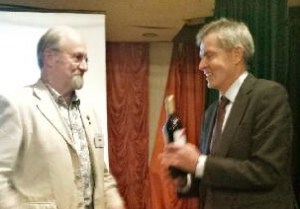
Nick Hills presented Steve Smith, Engineer with Oxford City Council, with our Flood Star award for this year. This is in recognition and thanks for Steve’s sterling work on many flood schemes and smaller works over the years, as well as co-ordinating the Oxford Area Flood Partnership.

Peter Rawcliffe spoke about OFA’s suggestion for maintaining Oxford FAS: as this is to be largely a ‘natural’ channel it will be subject to inevitable deterioration – so providing both a problem and an opportunity. OFA proposes that a trust be established, in perpetuity, to manage for both flood alleviation and wildlife. Trustees could be drawn from the several stakeholders – landowners, local authorities, Environment Agency, academics and wildlife bodies – to name just a few. We believe this is a practical way to make the most of what the scheme offers Oxford and its residents and visitors. This 7km channel will be ever more essential to Oxford if climate change develops as predicted. Each km may cost £18 million to build. We need to treasure it: in our view a local trust with local accountability, and autonomy to manage as it sees fit, fits the bill.

Simon Collings discussed modelling: as mentioned above this is absolutely vital to developing the case for OFAS – both to be as sure as humanly possible that it will work and equally importantly that no one downstream will be disadvantaged. We recently attended a meeting at the School of Geography, Oxford University: Simon explained some of the potential pitfalls of modelling that we had learned of there, and suggested that community review of the OFAS modelling (assisted by expert modellers) be included in the scrutiny process. This in addition to review by academic modeller(s) which is already under discussion for the scheme and which we strongly support.

We thank those who attended for their support and we thank our visiting speakers for helping to make the meeting a success. Our thanks too to the West Oxford Democrats Club for generously allowing us to use their hall once again.


Notice of our Annual Public Meeting – next Thursday, November 19th

Oxford Flood Alliance logoANNUAL PUBLIC MEETING:

THURSDAY 19 NOVEMBER 2015

At The Democrats, Osney Island, 7.30 pm. Entrance at the north end of East Street.
Doors open from 7.00 pm.

EVERYONE VERY WELCOME –

YOUR CHANCE TO HEAR THE LATEST FROM

Network Rail on their plans to clear blocked culverts under the railway north of Redbridge.

Environment Agency on the multi-million pound Oxford Flood Alleviation Scheme (FAS) (Western Conveyance)

Thames Water on their major review of Oxford’s sewers.

ALSO

Hear our ideas on how Oxford FAS might be maintained not only for flood alleviation but also for wildlife.

Local planning applications, Weirs Mill Stream – and more.

Community meets academia

On 4 November three of us participated in a workshop hosted by Oxford University’s School of Geography and the Environment. The other ten participants included representatives from Pickering flood group in North Yorkshire, from Flood Network, from CAG (Community Action Groups) Oxfordshire, academics from Oxford, Lausanne and London, and communicators.

The workshop focused on the ‘Environmental Competency Group’ concept developed by the Oxford academic team (Prof Sarah Whatmore and Dr Catharina Landström) and exemplified in their working with the local community in Pickering in Yorkshire to develop a flood scheme.

Hydrological and hydraulic computer modelling of flooding are key tools in designing flood alleviation measures. We learnt about the importance of considering, and if needs be challenging, the assumptions underlying the modelling, and the possibility that the terms of reference given to consultant modellers may on occasion be rather restricted, meaning that potential alternatives could be missed. Nor is modelling a perfect process, the quality depending (of course) on the people doing the work. For these reasons independent scrutiny is important. While this could be by a another commercial consultant modelling team, review by academics can add further, expert and independent assurance to the process.

A further check would be a review of the model by community members to see, as far as possible, whether it matched local observations.

More generally we were able to set out how OFA has developed and worked over the past eight years. Likewise, we heard how the Pickering group had worked successfully, with help from the Oxford academic team. There was discussion of how such experience might be shared with others developing community flood groups.

The workshop was both interesting and useful: we thank the organisers and look forward to further collaboration in future.

OFAS: drilling a borehole

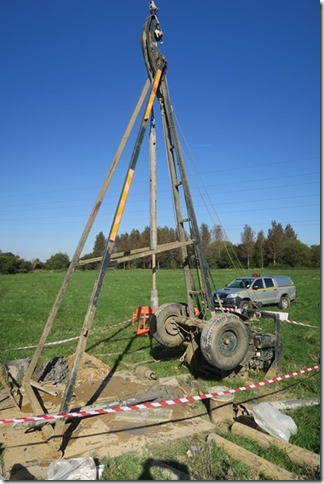
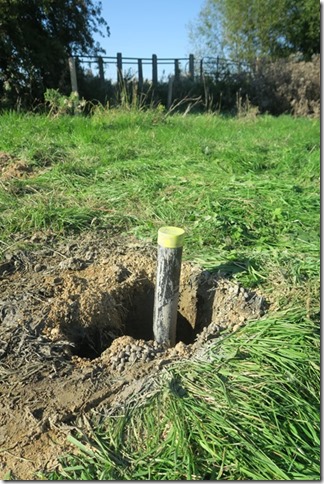
Oxford FAS ground investigations: a borehole being drilled this afternoon in South Hinksey.

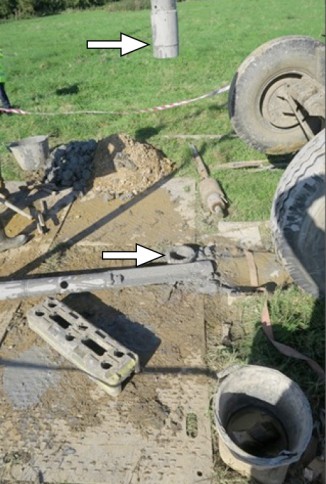
The A-frame percussive drill dug 9 metres down, below the alluvial layer, the gravel layer and 5 metres into the clay.
The capped pipe is a monitoring site where the changes in ground water depth over time can be observed.

OFAS: ground investigations under way

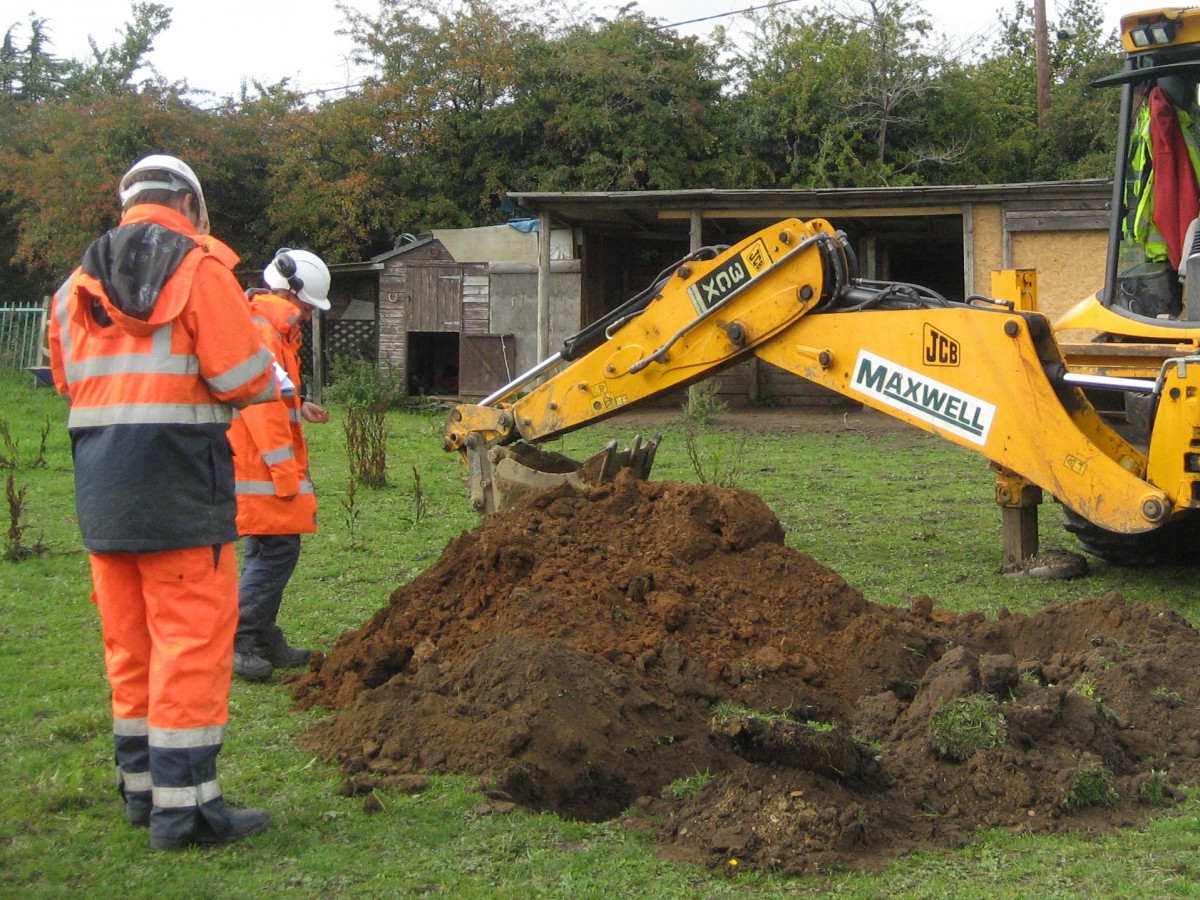
Digging a test pitTest pit being dug at South Hinksey, 24 September 2015

Test pits are being dug and boreholes drilled over the flood plain below the Botley Road to examine what the ground consists of. Evidence of significant archaeology is also checked for. The information will be used to inform the modelling and planning for the Oxford FAS.

‘Drilling for Oxford’s relief channel begins’  http://www.bbc.co.uk/news/uk-england-oxfordshire-34287878

‘Oxford Flood Alleviation Scheme: ground investigation work begins’  https://www.gov.uk/government/news/oxford-flood-alleviation-scheme-ground-investigation-work-begins