
Oxfordshire County Council has published details of the replacement bridge on the southern bypass near Kennington. The existing bridge needs to be replaced because of structural weaknesses. The new bridge has been designed in partnership with the Oxford Flood Alleviation Scheme and will increase capacity of the Hinskey streams to help reduce flood risk. The new design also includes improved traffic layouts. Anyone wishing to comment can do so using the form provide
Category Archives: OFAS
Earth Trust’s River of Life II wetland
The local environmental charity Earth Trust is one of several organisations providing advice to the Environment Agency about the biodiversity aspects of the Oxford Flood Alleviation Scheme. Their experience of introducing new wetland habitat on the Thames is an invaluable source of learning. This recent post on their website gives details of some of the early progress in their River of Life initiative, including data about carbon emissions.
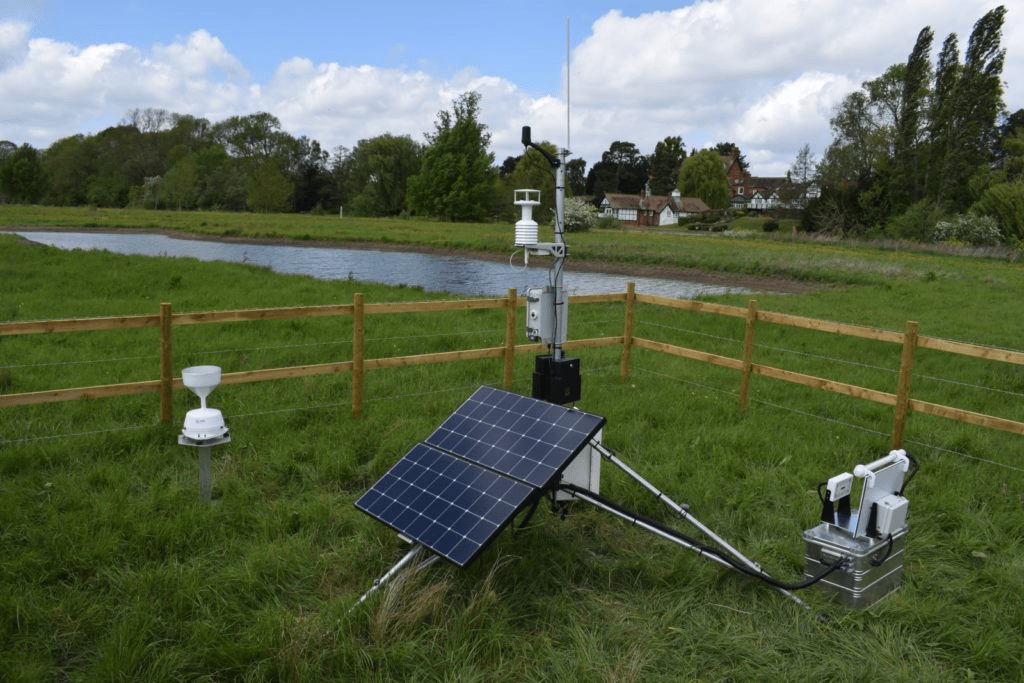
This earlier post, from June, describes an innovative remote monitoring station (see photo below) which enables the Trust to gather data about the presence of various species in the project area – bats, water voles, birds, moths. Lessons from this initiative will be beneficial to the implementation of the Oxford Flood Alleviation Scheme and may help inform the way biodiversity gain is monitored.
Latest update on Flood Alleviation Scheme
The Environment Agency has circulated its latest newsletter with updates about the Oxford Flood Alleviation Scheme. The text of the newsletter is reproduced below:
Scheme update
Since our last newsletter we have submitted the planning application for the Oxford Flood Alleviation Scheme to Oxfordshire County Council and they have held a consultation on the proposals. We have received a request for further information from them, which is quite normal for a project of this size. Once we have submitted this additional information the council will run a 30-day consultation on the newly submitted information, before considering it alongside the rest of the application.
We expect to make a Compulsory Purchase Order (CPO) for the land needed to build the scheme later this year.
Movement of material by rail
Construction of the scheme requires removing material from the floodplain offsite. We will reuse as much material as possible on site, for example to create earth embankments. Excess material will be taken to sites which already have planning permission for environmental restoration, such as former quarry sites.
We are looking to transport some of the excavated material by rail. We will be submitting a planning application to construct a temporary access track to the Hinksey Rail Sidings. Use of rail will depend on gaining planning permission to access the sidings, their availability and trains at the time of construction, and agreements with the operator of the sidings.
Once the work is finished, the temporary access track, alongside a temporary bridge crossing Hinksey Stream and pedestrian diversion, will all be removed and reinstated to their current use.
Maintaining the scheme for decades to come
We have a detailed programme in place to maintain the scheme operationally and to establish and manage habitats for at least the next 100 years.
In order to secure the potential benefits the scheme can bring for future generations, once we have all the necessary approvals and are nearing construction of the scheme, we will appoint an environmental partner who will be responsible for looking after the wildlife and landscapes of the scheme area in the long-term.
They will work alongside our operational team to bring additional environmental enhancements, involve local people and community groups, establish opportunities for scientific research and visit schools to teach children about the work we do to protect and enhance the environment.
Earth Trust is helping us set the foundations for this approach. They are advising us on the development of plans for how the eventual land management of the completed scheme could/should function to deliver the long term environmental, climate and human health and wellbeing benefits of the scheme.
Scheme design
We have received lots of helpful feedback on the design of the scheme during our consultations and conversations with local communities over many years. The planning application we have submitted will ensure that the scheme provides Oxford with robust and reliable flood protection, that will also enhance the local environment.
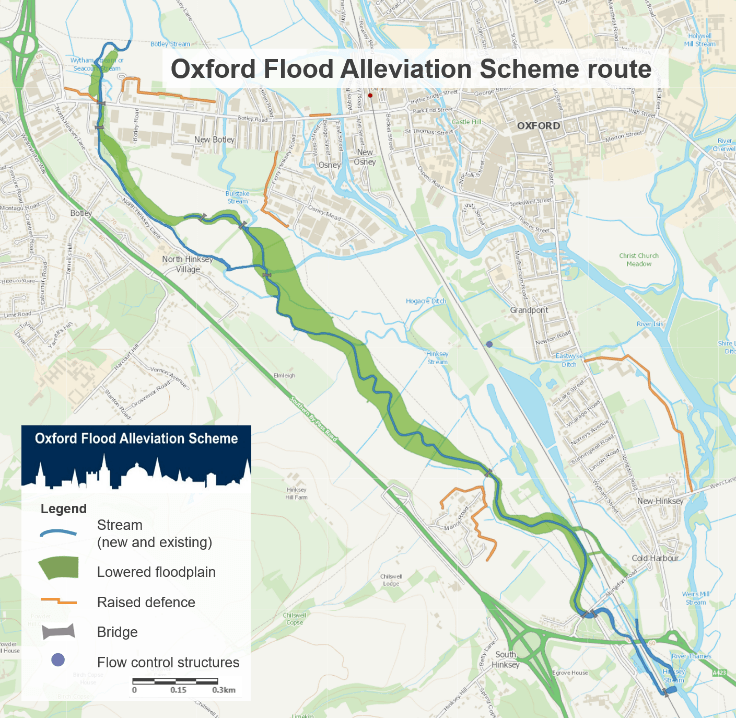
The new stream with lowered floodplain is integral to the working of the flood scheme so that flood risk is reduced adequately and not transferred elsewhere. The lowered ground alongside the new stream does not store static water but provides additional space and a defined route for it to flow through the floodplain, away from communities, properties and businesses. Absence of a defined route for the water could lead to an unintended increase in flood risk elsewhere.
Crucially, the design will also enable us to create valuable new environmental features within and around the whole area of the scheme. This will include wetland habitat, new floodplain meadow, and backwaters and ponds.
Next steps
Before we can start building the scheme, we need to have all approvals, including planning permission and our compulsory purchase order, in place. Subject to approvals, we currently anticipate construction to begin in 2024.
Construction projects are currently experiencing cost increases due to wider inflation and the price and availability of materials and labour. The scheme’s budget takes inflation into consideration and its costs are reviewed regularly.
Until the scheme is completed, the Environment Agency has well tested flood-protection plans in place for Oxford, working with others, including the fire service and county council, to help those at greatest risk in the city. We encourage people to check their own flood risk and sign up for Environment Agency flood alerts.
Oxford flood scheme – next steps
The revised planning application for the Oxford Flood Alleviation Scheme will be submitted soon for planning permission. OFA has worked closely with the Environment Agency over many years on the development of OFAS. The scheme will, in our view, greatly improve the level of protection to communities and businesses at risk from flooding, and will make the city far more resilient to climate change. We believe OFAS is the best option for Oxford, and that it strikes the appropriate balance between the many competing factors which have to be accommodated within the scheme design. Apart from providing high levels of flood protection it also includes ambitious targets for increased biodiversity. We’ve been through a long consultation process on the scheme and taken on board many suggestions from local people. That broad consultation phase is now at an end and we’re moving into the planning process through which those who continue to have reservations about aspects of the scheme will be able to argue their case. OFA’s view is that we need to come to a decision at this point so the project team can get on and build the scheme. Major revisions to the design now would result in significant delays and might even jeopardise the scheme altogether. Risk of severe flooding is increasing all the time and further postponement is not in the interest of the large flood affected community in the city. OFA will be doing all it can to help ensure the scheme secures planning permission.
Flood risk increasing says Environment Agency
‘Significant climate impacts are inevitable especially for flood and coastal risks, water management, freshwater wildlife and industrial regulation,’ says the latest Environment Agency adaptation report published earlier this month.
According to the latest projections, summer rainfall in the UK is expected to increase 22% by 2080, and winter rainfall by 13%. The report sets out what the agency is doing to help reduce flooding of properties and businesses, ensure future drinking water supply, reduce pollution, and protect the biodiversity of freshwater habitats. The Oxford Flood Alleviation Scheme (OFAS) features as a case study in the report, an illustration of the kind of action the EA is taking in partnership with others.
Early action is needed the agency warns: ‘Despite more than a decade of concerted effort to reduce these risks, the speed and scale of climate change means that many are either increasing or remain significant. This broad conclusion matches recent assessments from the Climate Change Committee, the Intergovernmental Panel on Climate Change and others.’
The OFAS scheme will be submitted for planning approval this winter. The planning documents will incorporate the latest government assumptions about future rainfall and flood risk.
Maintenance and meadow management
We understand that an update on the search for an environmental partner for the Oxford Flood Alleviation Scheme (the Scheme) is likely to come soon.
We have all along pressed to see the best possible done environmentally: having an expert partner to help manage the environmental aspects of the Scheme, while at the same time maintaining it for its purpose of flood relief, over the decades ahead, seems the ideal way.
Floodplains, with their meadows and wetland areas, are a valuable, and increasingly less common, habitat, demanding expertise to manage them well. So we’re waiting expectantly to learn what’s been happening.
Flood exercise today
The flood exercise mentioned in the last post, testing and demonstrating readiness to deploy defences, is under way today. In South Hinksey temporary barriers are being set up by the Environment Agency (EA). At Bullstake Close on the Botley Road the barriers there, which have been used before in a flood, will be erected; and fire crews are showing how the pipe which has been installed under the Botley Road can be used to deal with flood water and reduce the flooding of the road.
For South Hinksey this is a very reassuring demonstration of the ability to now defend the village from flooding. Such barriers have never been used here before.
Of course Oxford still needs a bigger, more permanent scheme – in the form of the Oxford Flood Alleviation Scheme. The OFA update in the previous post summarises the present position – the Scheme is under way, albeit delayed. In the meantime today’s activities show that we will not be without protection in the interim.
Emma Howard-Boyd, Chair of the EA, and Sir James Bevan, Chief Executive, are in South Hinksey today to see what’s being done and meet the teams and there is no doubt that protecting Oxford in both the short and long term is being taken very seriously.
Our thanks to everyone who is working hard on behalf of the many local residents, businesses and other organisations affected by flooding.
OFA Update / OFAS & Flood Exercise
This update has recently been sent to those on our mailing list.
Dear OFA contact,
We last sent out an update in Oct 2019, just after the news about the problems with the A423 bridge (southern bypass) and likely delays to the Oxford Flood Alleviation Scheme (OFAS). OFA is still active and has been participating in meetings of the Sponsoring Group for the OFAS scheme and has also held separate meetings with the Environment Agency team about water course maintenance since our last update.
Despite the A423 issues, and the challenges presented by coronavirus, the OFAS scheme continues to progress. The EA and the County Council have agreed a collaborative approach to replacing the A423 bridge and constructing the OFAS scheme. This should save on costs for OFAS, and reduce the level of maintenance required in future.
The EA withdrew the original planning application earlier in the year and is currently revising this to incorporate the new A423 arrangements, and to update the documents on some other aspects of the scheme. Once these are resubmitted to the planning authority the public will have a fresh opportunity to comment on the plans. The EA is continuing to meet with objectors to the scheme with a view to trying to address outstanding areas of public concern.
Because OFAS is now expected to be delivered two years later than originally expected it is important that effective flood response procedures are in place in case a major flood event happens in the next few years. The EA, Fire Brigade and the local Council officials will be holding a practice response on 20 August to test aspects of current procedures. Because of coronavirus these will not involve the pubic.
The text of a recent update from the Environment Agency is pasted below which provides some additional information on OFAS and other matters,
OFA Steering Group
Oxford Scheme update
A423 bridge replacement
Oxfordshire County Council began the propping work on the A423 Kennington Railway Bridge in July.
Replacement of the A423 Bridge has provided an opportunity to design and build the bridge and the flood scheme together. This allows us to reduce disruption during construction and ensure the best use of public money. The updated design will use open channels instead of culverts to allow the flow of floodwater under the bridge. This will provide a better environment for wildlife and requires less maintenance.
The bridge is at the southern end of the scheme and during a flood, water would need to pass underneath it to re-join the River Thames. This capacity needs to be in place before the scheme is constructed to avoid increasing flood risk elsewhere. We also need to have all approvals, including planning permission and our Compulsory Purchase Order secured.
South Hinksey Archaeology
If you’ve been walking near South Hinksey, you may have spotted our contractors on site. We are carrying out archaeology surveys in a field near South Hinksey village to check whether the area is suitable for us to use as the main compound for when we construct the scheme. The archaeology surveys will determine whether there are any historical artefacts in the field. We want to ensure there’s no risk of us damaging any artefacts or remains. Once we have finished the investigations, we will remove our equipment from the site and reinstate the fields.
Kendall Copse Ground Investigations
To complement the new A423 bridge replacement, we are reviewing the design of the scheme around Kendall Copse, near Kennington.
From 10 August, we will be digging trial pits and drilling boreholes to understand the ground conditions beneath the site in order to finalise these designs.
Oxford Flood Incident Exercise
To ensure our flood protection plans are well-tested, the Oxford Flood Alleviation Scheme partners and emergency responders will be practicing their incident response plans on 20 August 2020.
The flood response exercise will consist of:
•temporary flood barriers in South Hinksey and Bullstake Close
•pumps to remove flood water along Botley Road
Due to the current Government guidance on public gatherings, we won’t be able to invite members of the community to attend. We will be sharing updates on Twitter and Facebook as the exercise progresses. We will also share video footage of the temporary barriers and pumps so you can see our field teams in action.
Managing your flood risk
During the summer months, flood risk might be low on your list of priorities, but Environment Agency officers are thinking about it year-round. Throughout the year our operations staff carry out inspections and clear debris to keep main rivers moving. To report a blockage that could cause flooding call our 24 incident hotline: 0800 80 70 60.
You can also find out what maintenance is planned in your area: environment.data.gov.uk/asset-management/index.html
Stay prepared by signing up for flood alerts and preparing a flood plan: https://flood-warning-information.service.gov.uk
Want to know more?
If you have any questions or want to be added to our mailing list, please contact us at: OxfordScheme@environment-agency.gov.uk
Storm Dennis
Appalling floods in Wales (and elsewhere) https://www.bbc.co.uk/news
The Oxford Flood Alleviation Scheme is, unfortunately, delayed but is still as much needed as ever. In fact more so – as Earth continues to heat up the changing climate is producing more extreme weather and consequent severe flooding.
River levels above, and in and around, Oxford have already risen quite a bit since the storm’s rain over the weekend, and the next few days will see further rises in Oxford as the water makes its way downstream from the Cotswolds. It remains to be seen how big these rises are. You can follow local river levels and the flow rate upstream at Farmoor here.
Concern in the Oxford area
-
- Behind Marlborough Road, Oxford, morning, 13/11/19
-
- On the edge of South Hinksey, morning, 13/11/19
There is increasing concern today that water levels are high in the Oxford area, with a good deal more water still to come down to Oxford from the Cotswolds catchment. The area is presently (midday) on an EA Flood Alert (the lowest level of concern).
We’re seeing more flooding globally, Venice is badly hit at the moment – and the awful flooding in the north of England continues.
There is no doubt that the climate is changing. Oxford has always flooded but the change will make it more common and more severe. The immediate threat may recede now, let’s hope so, but it highlights again that it’s imperative that Oxford is better protected, not only for the many people directly affected but for the city itself to continue to function and thrive into the future.
The multi-partner Oxford Flood Alleviation Scheme is in process and all concerned are working hard to make it happen as soon as humanly possible. As we have said before, “it can’t come soon enough.”
 oxford flood alliance