
An article in today’s online Oxford Mail – £400,000 has already been spent in consultancy fees and other expenses on this unnecessary plan. If it goes ahead the present budget is over £4 million, a lot of public money to no good purpose.
Seacourt P&R expansion is, quite simply, not necessary (including 4 Dec parking data)
It’s easy to get lost in the long and complicated arguments over flooding and planning objections.
But one thing stands out, very, very clear, and very, very important:
There is no need to increase capacity at Seacourt P&R. Oxford has more than enough parking, including enough park and ride.
This is despite the opening of the new Westgate shopping area. If the parking isn’t needed then why does the Council want to spend over £4 million of your, public, money on it? Never mind that it will sit largely unused, and be subject to flooding, and expensive pumping out, maintenance and repair. No, we don’t understand it either.
We looked at online data two days ago, Monday 4 December, 3 weeks before Christmas. At the busiest time, 2pm, there were over 2,700 empty spaces, many in park and rides. Seacourt and nearby Redbridge had 538 empty spaces between them.
Click table to enlarge.
-
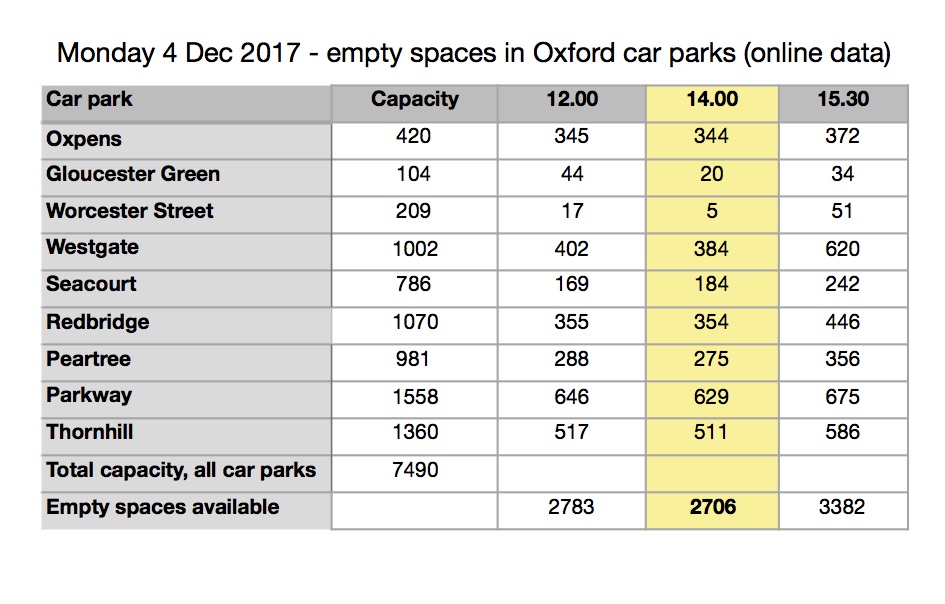
- Parking 4.12.17
See also our letter to the Oxford Times
For more detail look at these reports:
Thoughts on OFAS
Why do we need a flood scheme at all?
We have had five major floods since 2000 and climate change will make things worse (indeed there is evidence from Oxford University that it already has). Oxford residents, and the economic well-being of the City, will suffer badly if something is not done. While the scheme will cause disruption during its construction it is imperative that Oxford is protected.
But what about downstream, won’t they be worse off?
All the detailed computer modelling for the Scheme (and we have recently heard on the grapevine that a totally independent consultancy has confirmed this ) says that flooding will not be made worse downstream. We know that comparisons are made with the Jubilee River – this scheme is nothing like that. Indeed OFAS is actually increasing the capacity of the floodplain, which together with bunding and rerouting of flow will reduce flood risk to many hundreds of properties.
Is it a concrete channel?
No, it isn’t. What it is is a much more naturalistic 2-stage channel, used around the world for flood relief.
How will the environment be affected?
While there will, regrettably, be some environmental losses, we are pressing hard – collaborating with the Environment Agency, and with support from others, particularly the Freshwater Habitats Trust – for environmental enhancements as part of the scheme. While one cannot compare one environmental loss directly with another environmental gain we believe the positives will be considerable.
Maintenance.
It’s so important that there is a plan now for the very long-term maintenance of the Scheme. In our experience over the last 10 years “if maintenance can be neglected it probably will be”. There are some honourable exceptions and we certainly have we have no criticism whatever of the local EA maintenance team, who achieve a huge amount with very limited resources. Others do nothing or very little unless goaded and embarrassed into action. This Scheme, being “natural” will deteriorate quickly if not proactively maintained. The initial intent was to plan maintenance for 10 years: that is simply not good enough for such an expensive and important project. We have proposed that maintenance be planned for in perpetuity by setting up a responsible, funded, local body, maybe as a charitable trust (or similar).
A Green group
thinks that Oxford could and should be protected by very different means – while they are short on specifics, their main idea seems to be that planting enough trees upstream in the Cotswolds would solve Oxford’s problems. It wouldn’t. Expert opinion at our 2015 Symposium of Natural Flood Management (NFM) made that very clear. Even afforesting the whole of the Cotswolds (not that that would ever happen) would not do the job. Oxford is simply too far downstream for that. That’s not to say that NFM can’t work in smaller catchments, nor that it might not make a contribution.
Flooding land upstream?
The Environment Agency’s Oxford Flood Risk Management Strategy (OFRMS) suggests this may be needed one day if climate change makes things sufficiently bad. Involving as it would temporary flooding large areas of farmland and other land it is never likely to be easy to implement.
Archaeology
News of archaeological finds from the investigations done as part of OFAS
Car park usage today, 3 December
There were plenty of empty spaces in both city centre car parks and park and rides.
Click table to enlarge.
-
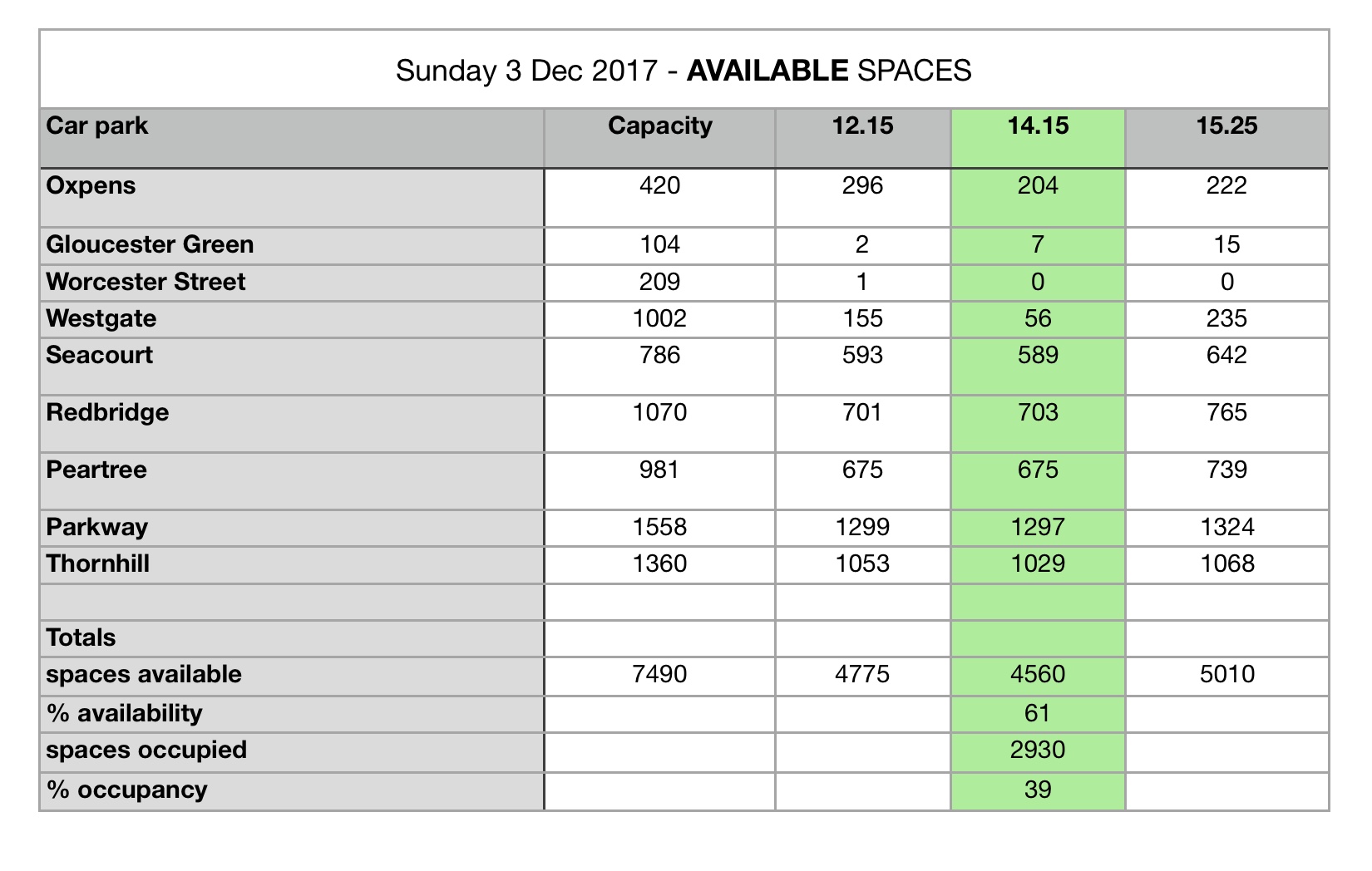
- Parking 3.12.17
Objecting to Seacourt P&R extension – our latest comments
-
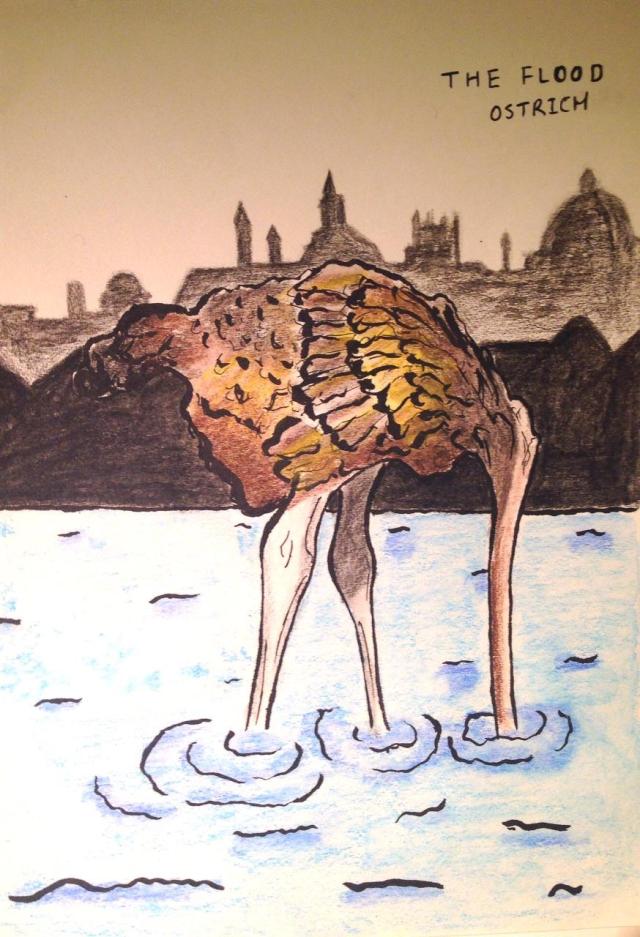
- The Flood Ostrich burying its head in the flood.
We remain strongly opposed to the planning application by Oxford City Council to extend its Seacourt Park and Ride into Oxford’s vital flood plain. There has been a nibble, nibble attrition of the flood plain over many years leading to worse flooding. That the City Council should itself be seeking to extend a car park into the flood plain that protects our city is quite extraordinary.
Here are our latest comments:
OFA comments on FRA Nov 2017 Final
OFA comment on PS Addendum Nov 2017 Final
Redbridge vs. Seacourt P&R from south + Maps
Now we are 10
-

- Osney Island, July 2007
-
- Vicarage Lane, July 2007
-

- South Street, Osney, July 2007.
-

- Earl Street, July 2007
-
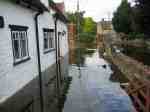
- Manor Road, South Hinksey, July 2007
-
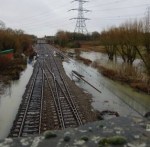
- Main line at Redbridge, 2008
The original meeting at which an Oxford flood grouping, soon named the Oxford Flood Alliance, was agreed on, was held in the Waterman’s Arms (now The Punter), Osney Island, on Thursday 29 November 2007. Simon Collings, Nick Hills, John Mastroddi and Peter Rawcliffe have been involved from the start.
Andy Webber, Mike Hamblett (also both in at the start) and Brian Durham are no longer on the Steering Group but have each made very significant contributions over the years.
Adrian Porter and Liz Sawyer are the newest, and valued, members of our team.
Very importantly our personal partners have been there with vital support throughout – thank you all.
A great deal has happened in the 10 years, with authorities now well working together to reduce risk and cope with floods when they arrive. We never dreamt in 2007 how much this would become a part of our lives – innumerable meetings and phone calls and thousands of emails later, we are working with people who are now close partners, some of whom we met at the start, others along the way. We have been called ‘a critical friend’ and are pleased by that.
We continue to work to promote what we see as the best for the people and the city of Oxford and area: currently of course the multi-million multi-partner Oxford Flood Alleviation Scheme. More on that in a later post.
Nevertheless, we have not sold out to the authorities! – we oppose things we see as contrary to our prime aim – to reduce flood risk. The current example is our total opposition to Oxford City Council’s proposal to extend Seacourt Park and Ride into the floodplain. No one has been able to produce another example of such a travesty anywhere else in the country. If allowed it would set a very dangerous precedent nationally.
We expect our 11th (we had two one year) Annual Public Meeting will be in February 2018.
New Oxford Flood Alleviation Scheme newsletter
OFA objections to revised Seacourt P&R FRA
We have submitted our comments on the revised Flood Risk Assessment (FRA) submitted by the Applicant, Oxford City Council, as part of its application to extend Seacourt Park and Ride into the floodplain north of the Botley Road, Oxford. It seems that this is being proposed as a panic response to a perceived lack of parking for the new city-centre Westgate development – that development has been known about for years and this application is evidence of a failure to plan properly for it.
We are opposed to this application on flood risk grounds and do not believe that the FRA gives a proper assessment of the risks.
The application is contrary to national planning advice and if allowed would set a most serious precedent nationally. Despite being asked, the Applicant has failed to supply a single example of where a similar development has been allowed, in Flood Zone 3(b) – the floodplain proper, elsewhere.
There are risks of both groundwater and river (fluvial) flooding of this particularly low-lying site. We are not satisfied that the development, in the floodplain, would not increase risk elsewhere. It would put vehicles, and more importantly people, at risk during flood events: in a very big flood the water could be 2 metres deep and flowing fast. Washed away cars could block the nearby river (whether this is the existing channel or the proposed Oxford Flood Alleviation Scheme channel) and bridge, preventing water getting away from the Botley Road area and making flooding there worse.
The car park is likely to be particularly expensive to build as the ground is inherently unstable and will almost certainly need special ‘lime stabilisation’.
It would be unusable during floods and require protracted pumping out and clean up afterwards – expensive in itself and losing revenue while the car park was closed.
It’s our view that the need for for this extension has not been demonstrated, nor the economic case made. It could easily prove a costly white elephant, an embarrassment to the Council, an extra expense on a already strained public purse, and a risk to public safety.
Oxford is subject to regular and damaging flooding – its floodplain should never be a place for a car park. For its own City Council to be proposing such a thing is hard to understand. When this was first proposed the same Council was simultaneously proposing to remove a large number of spaces at Redbridge P&R a mere 3 miles away – whether that is still the case we do not know but it does rather suggest a lack of co-ordinated planning.
We hope Oxford City councillors will see that this idea is a disaster in the making and show their good sense in abandoning it.
The many objections to the proposal can be seen on the Oxford City Council planning website (search for Seacourt) https://www.oxford.gov.uk/info/20066/planning_applications/328/view_and_comment_on_planning_applications
Our own recent objection is also here as a pdf.
New Chair of RFCC visits Oxford
The recently appointed new Chair of Thames Regional Flood and Coastal Committee (RFCC), Professor Robert Van de Noort, visited Oxford on 19 October with EA staff. He was briefed on the Oxford Flood Alleviation Scheme and then shown the Seacourt area at the western end of the Botley Road, which marks the northern end of the Scheme.
We were pleased to meet Professor Van de Noort in South Hinksey, where he went on to see both the lie of the land where the channel will come past the village and on to Kennington to the south, and the earthworks done in the village itself to make the village ‘temporary barrier ready’ for the coming winter and beyond.
 oxford flood alliance