
Our 9th Annual Public Meeting is on Wednesday 22 February 2017.
There is lots to hear and talk about and everybody is welcome.
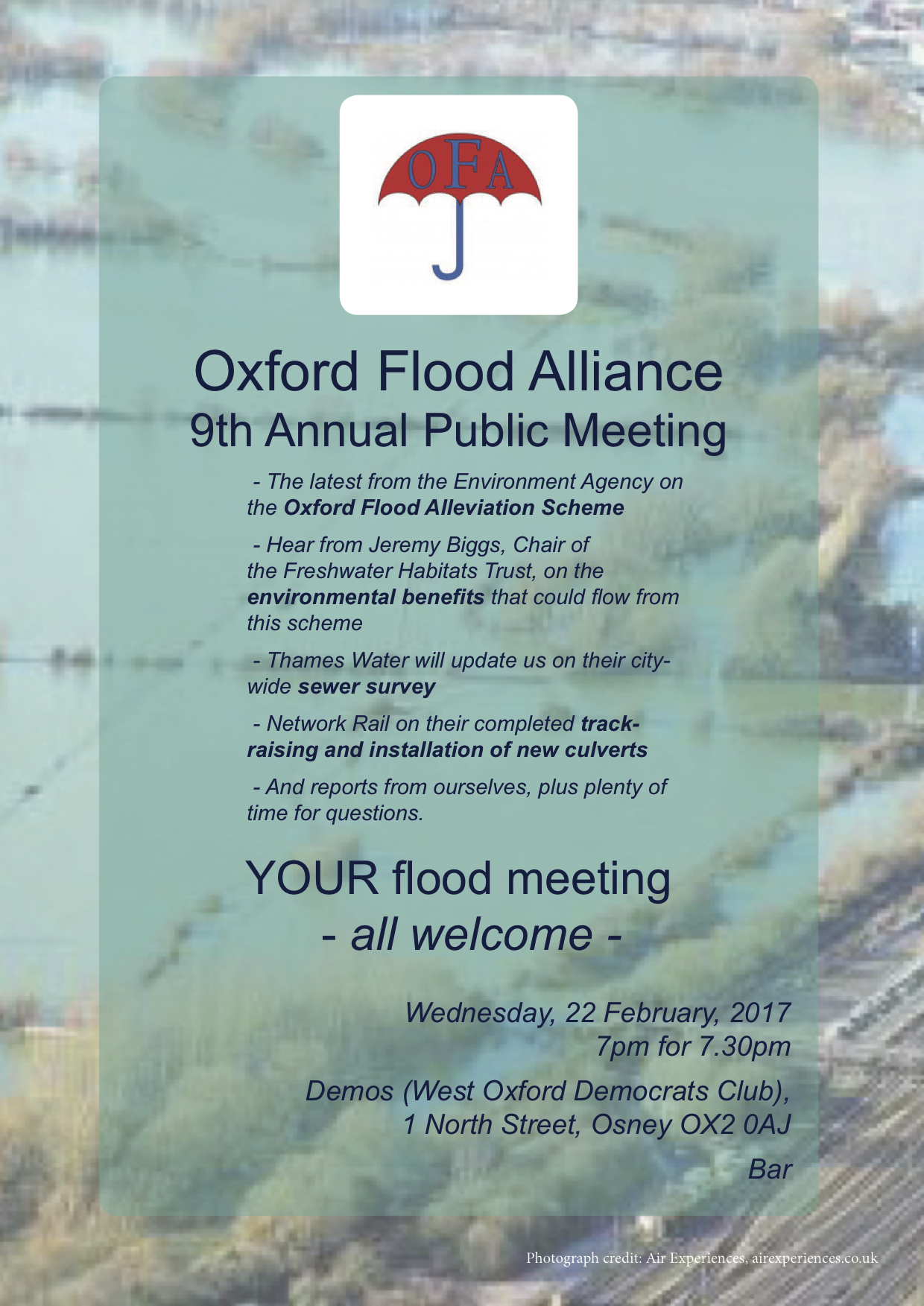
We hold an Annual Public Meeting, which has been in November up to now. This makes it close to the annual Oxford Area Flood Partnership meeting and the two have increasingly overlapped in content. We decided then that our “2016” meeting would be better held later. It will be on Wednesday 22 February 2017 at 7pm for 7.30. The venue as before, the Demos’ Club on Osney Island, Oxford. We will have speakers from the Environment Agency (on the Oxford Flood Alleviation Scheme), Thames Water (on their sewer survey) and Network Rail (on their track raising, waterway clearance and culvert installation). Everybody is very welcome.
Talk on 29 June by Jeremy Biggs of the Freshwater Habitats Trust
Jeremy Biggs gave an interesting and inspiring talk, ‘Oxford and the Thames: a national hotspot for freshwater wildlife’, in South Hinksey yesterday; it was well attended by professionals and members of the public alike.
The overall message was that the Oxford area, including (but much wider than) the area of the OFAS channel, is of relatively high quality (on a national scale) for freshwater wildlife. Nevertheless, there have been local extinctions and a gradual decline over the last century. Clean, unpolluted water is vital to any attempt to reverse the decline.
A lively discussion followed.
To make the most of the possible environmental enhancements from the OFAS scheme more detailed proposals will be developed. More could be achieved if additional, separate funding could be obtained. Such work could make a contribution to reversing the gradual decline and enable lessons to be learnt as to how to do this best.
The talk is free and anyone may attend but space is limited so if you think you would like to come along please let Jo Fever at Freshwater Habitats know so we can try and ensure there is space for all: info@freshwaterhabitats.org.uk or phone 01865 595505.
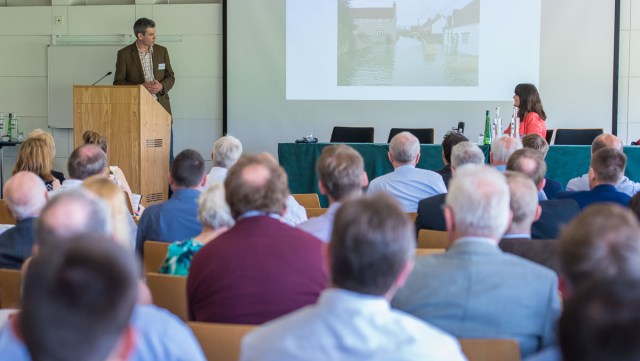
Following an invitation from Steve Hodgson of the Property Care Association, Adrian Porter of OFA spoke at their ‘Moisture in Buildings’ conference in Cambridge on 12 May 2016. Adrian writes:
‘It was interesting to be able to inform the building trade of the direct benefit that their work can have on consumers, from a very personal perspective, and also how they and the insurance industry need to collaborate to enable homeowners to make the right decision on property level protection.
I was pleasantly surprised to find that not only do the PCA acknowledge the need to improve standards across the building sector, but also that their members are hugely passionate about resolving the problems created by poor workmanship once and for all, for each homeowner.’
Delegate comments and the presentations can be found here:
http://www.property-care.org/annual-conference-2016/review-conference-moisture-buildings/
We have submitted comments on the route options for the Oxford Flood Alleviation Scheme. You can read them here.
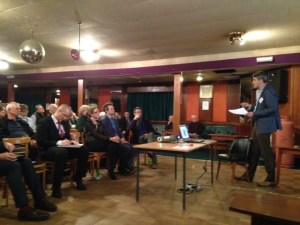
Our Annual Public Meeting on 19 November was well attended – we were delighted to welcome many members of the public, local councillors, representatives of all the local flood agencies, an Oxford University researcher and Andrew Smith, MP for Oxford East. Nicola Blackwood, MP for Oxford West and Abingdon, and Rodney Rose, Deputy Leader of Oxfordshire County Council, sent their apologies.
Adrian Porter began the evening by setting out our three key current objectives:
He went on to give an overview of the past year including our recent boat trip, with the Environment Agency, which identified necessary maintenance on Weirs Mill Stream: this work is being planned and funding being sought. John Mastroddi provided detail on the clearance under Munday’s bridge, which completes the project begun in 2013. Impending planning applications at Seacourt P&R and Oxford Four Pillars Hotel, both firmly in the floodplain, are on our radar.
Nick Hills, our Treasurer, told us that we had £346 in the bank, enough for several years at the present rate of spending! Nevertheless, being the good treasurer he is, he asked people to leave any donations as they left: this raised a very generous £110. Nick set out some of the things we’d been pleased to see in the year: among those not referred to in more detail later on were the permanent pipe under the Botley Road to allow pumping across the road without disruption to traffic (County and City Councils), Waitrose’s use of SUDS at their new shop and the successful public events for OFAS during the summer.
He explained how we support OFAS in principle and are contributing to the process along with the other partners – but always reserving the right to be a ‘critical friend’.
The first of our guest speakers, Joanna Grew from Network Rail, gave an account of their proposed Hinksey Flood Alleviation Scheme: this includes the clearing of culverts at Coldharbour (for which we have been pushing for some time), track raising and installation of new culverts. More detail can be seen in Joanna’s presentation downloadable here. You can download a leaflet about the scheme here.
James Playfair explained the progress of Thames Water’s ongoing sewer survey across Oxford, the Oxford Catchment Study. This is about to enter its second year: already some issues have been resolved including significant improvements to the pumps at Littlemore Pumping Station. The presentation can be downloaded here.
Last but not least Emma Formoy from the Environment Agency gave the meeting an up-to-date account of the Oxford FAS; Emma mentioned the possible wider benefits of the scheme, including for wildlife, and the crucial importance of rigorous modelling. More detail in the presentation downloadable here: this includes dates of the next round of Public Events in January 2016 when a consultation on the route options for the scheme will begin. These can be also seen in the Oxford FAS Newsletter – November 2015, perhaps more easily. In parallel with these events, people will be able to view these proposed options and partake in the consultation online.
Apart from these individual achievements and plans, what is remarkable, and heartening, is the considerable cooperation, for example sharing of modelling data, between these three agencies – i.e. they talk to each other! As one of us commented later, we have come a very long way since 2007. We are grateful to our guests for coming to talk and for all the work their organisations are doing. The sum (assuming they all reach fruition) will give Oxford a better, and more secure and sustainable, future.
Nick Hills presented Steve Smith, Engineer with Oxford City Council, with our Flood Star award for this year. This is in recognition and thanks for Steve’s sterling work on many flood schemes and smaller works over the years, as well as co-ordinating the Oxford Area Flood Partnership.
Peter Rawcliffe spoke about OFA’s suggestion for maintaining Oxford FAS: as this is to be largely a ‘natural’ channel it will be subject to inevitable deterioration – so providing both a problem and an opportunity. OFA proposes that a trust be established, in perpetuity, to manage for both flood alleviation and wildlife. Trustees could be drawn from the several stakeholders – landowners, local authorities, Environment Agency, academics and wildlife bodies – to name just a few. We believe this is a practical way to make the most of what the scheme offers Oxford and its residents and visitors. This 7km channel will be ever more essential to Oxford if climate change develops as predicted. Each km may cost £18 million to build. We need to treasure it: in our view a local trust with local accountability, and autonomy to manage as it sees fit, fits the bill.
Simon Collings discussed modelling: as mentioned above this is absolutely vital to developing the case for OFAS – both to be as sure as humanly possible that it will work and equally importantly that no one downstream will be disadvantaged. We recently attended a meeting at the School of Geography, Oxford University: Simon explained some of the potential pitfalls of modelling that we had learned of there, and suggested that community review of the OFAS modelling (assisted by expert modellers) be included in the scrutiny process. This in addition to review by academic modeller(s) which is already under discussion for the scheme and which we strongly support.
We thank those who attended for their support and we thank our visiting speakers for helping to make the meeting a success. Our thanks too to the West Oxford Democrats Club for generously allowing us to use their hall once again.
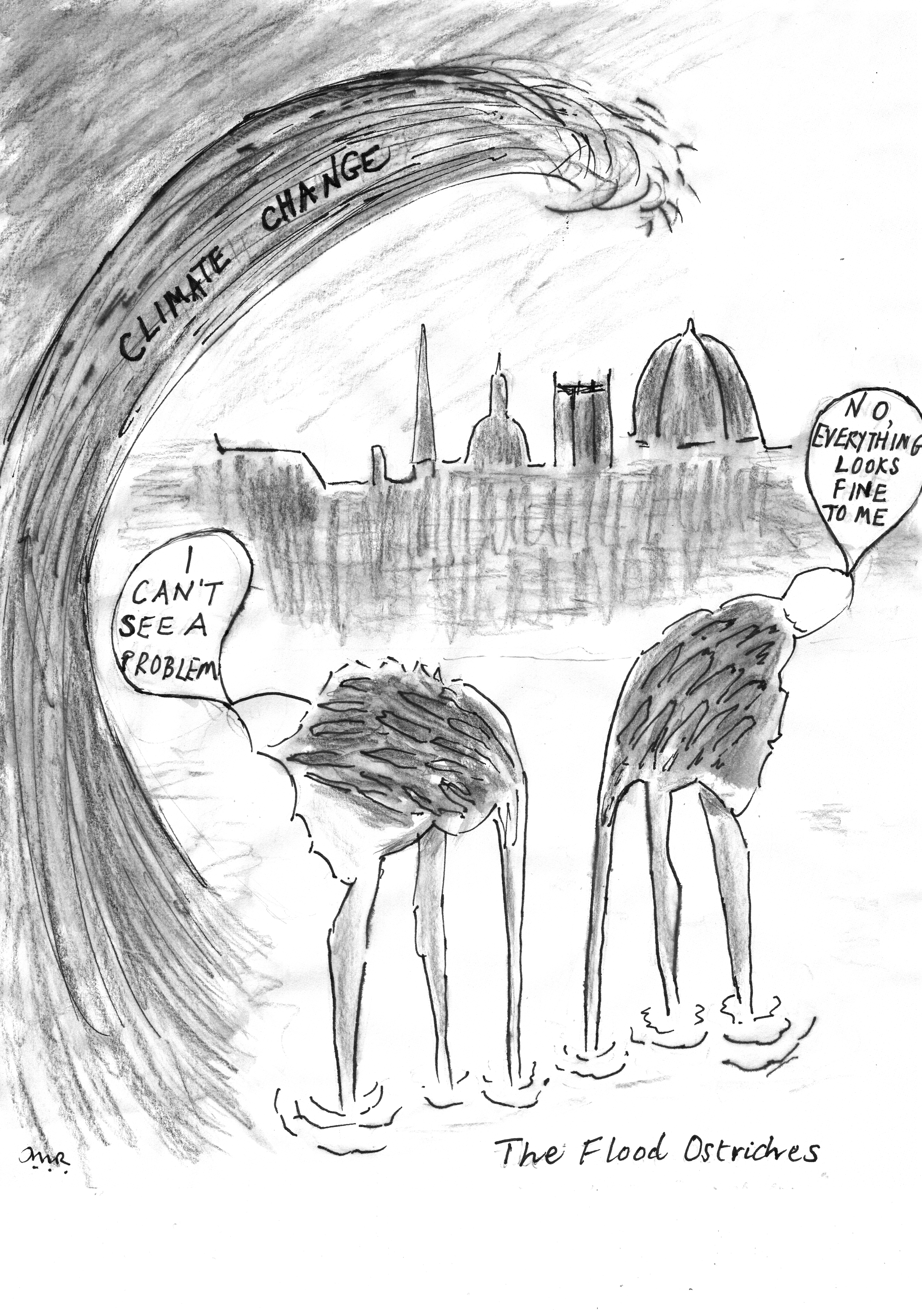
We’ve an article in July 2015 edition of ‘Visions’, the newsletter of the Oxford Civic Society.
It sets out our views on the threat posed to Oxford by flooding, with emphasis on the possible effects of climate change, and the relative merits of the possible options for combating that threat.
Simon Collings represented OFA at the second meeting of Oxford City Council Scrutiny Panel on sewer flooding. Thames Water (TW) gave an update on where they are with a) Grandpont and b) the Oxford Catchment Study:
At Grandpont they have identified the most likely causes of sewer flooding and TW will now work with the City Council and residents to improve things. Local resident Brian Durham of OFA and SOFAG has been closely involved in this work.
On the Catchment Study they are engaged in two parallel processes:
So far they haven’t encountered anything which would suggest they need major capital investments, though they do plan to upgrade the pumps at Littlemore.
TW are talking to the Environment Agency (EA) team working on the Oxford Flood Alleviation Scheme, and the two modelling teams are going to share data and work together. By good luck the option development phases of both projects are working to similar timetables. EA will help TW understand how the river flooding affects the sewers, and TW will contribute to that work.
There will be one more meeting of the Scrutiny Panel in November/December but from then on formal reports will be given through the Oxford Area Flood Partnership, to avoid duplication of meetings.

This week saw the last two public drop-in events of this series, at the Town Hall and South Oxford Community Centre. Again they seemed well-received by visitors and valuable comments were made and recorded. The partners in the scheme, including OFA, have enjoyed meeting the many visitors, hearing their views and concerns. Hopefully people have been reassured by what they have learnt: certainly that has been our predominant impression.
Meanwhile, consultants have recently begun work on the next step – of preparing more detailed plans. The comments and suggestions received at these drop-in events are being collated and will be used in this planning.
Expect more public events in the autumn.
 oxford flood alliance